
Recent Entries:
Month: July 2016
July 29, 2016
Los Angeles Times Whitewashes Murder of 3 Israelis


From left: murder victims Alon Bakal, Shimon Ruimi and Amin ShaabanOn New Years’ Day, Israeli Arab Nashat Milhem opened fire in a Tel Aviv bar, killing Alon Bakal and Shimon Ruimi and injuring at least three others. During his flight from the killing scene, Milhem killed taxi driver Amin Shaaban, his third murder victim.
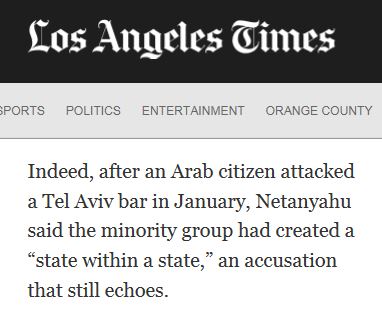
Here’s how The Los Angeles Times whitewashed that deadly attack this week: “After an Arab citizen attacked a Tel Aviv bar in January. . . “

The assailant did not merely attack a Tel Aviv bar. He murdered three people, so why the obfuscation?
July 27, 2016
A New York Times Round-Up Omits Anti-Israel Terror
Twice in one week, CNN inexplicably omitted anti-Israel attacks in its overviews of terrorism around the world. And although the broadcaster later updated both articles to mention Palestinian attacks on Israeli civilians, many readers couldn’t help but wonder what was behind the omission in the first place. How could any well-versed journalist not remember that Israel has been a primary target of terrorists?
With today’s New York Times feature that fails to refer to anti-Israel attacks, readers may ask the same question. To be sure, the primary focused of the feature on a two-week period in March during which no Israelis were killed. And a paragraph in the introduction refers to a more recent week of mass casualty attacks in Iraq, Turkey, Afghanistan, Bangladesh, Somalia, Cameroon, and Saudi Arabia, a week in which two Israelis were killed in separate, individual-casualty attacks. But the piece’s introduction is more sweeping, referring to
an endless stream of terror attacks. Orlando and Beirut. Paris and Nice and St. Etienne-du-Rouvray, France. Germany and Japan and Egypt. Each bomb or bullet tearing holes in homes and communities.
The bullets targeting Israelis at Tel Aviv’s Sarona Market this summer also tore holes in homes and communities, and took four lives. Israel was not mentioned, despite the attack causing more casualties than the recent attack in Etinee-du-Rouvray, or this summer’s attack on a police officer in Paris that the feature appears to reference.
And while still, this passage doesn’t purport to be an exhaustive list of all of this summer’s terror attacks, the question again arises: Is The New York Times letting politics dissuade it from including anti-Israel terror attacks among those targeting civilians of other nationalities?
Although this one case doesn’t allow for a clear answer, it is an appropriate question, especially considering the newspaper’s documented tendency to downplay Palestinian violence against Israelis (see chapter four of CAMERA’s six month study here). The newspaper’s public editor in 2014 felt the need to remind her colleagues that Palestinians are “more than just victims.” Perhaps they should also be reminded that Israelis, all too often, are victims of international terror.
July 25, 2016
Turkey Cracks Down on Academics, Anti-Israel Scholars Silent

The government of Turkey has instituted a widespread crackdown that has affected academics, as well as the military, judiciary, journalists and others following the failed coup attempt against the country’s president, Recep Tayyip Erdogan, on July 15, 2016. Many organizations quick to criticize Israel for alleged repression have largely been silent about Erdogan’s actual measures.
Liel Leibovitz, a journalist with Tablet, an online magazine, noted that as of July 21, “Erdogan’s government has stripped 59,628 private school teachers of their accreditation, and the state-run Council of Higher Education called on all 1,577 deans of private and public universities to immediately resign (“Hey, BDS-Loving Professors Watching the Assault on Academic Freedom in Turkey: Why so Quiet?” July 21, 2016). Leibovitz also noted that 100 additional academics were fired and a travel ban issued “on all professors still employed.”
The response from many Western-based academic associations, however, was largely non-existent. These organizations include the American Studies Association, the Association for Asian American Studies, the Native American and Indigenous Studies Association, the National Association of Chicana and Chicano Studies and the Critical Ethnic Studies Association. Every one of them—while silent on Turkey’s repression—supports the boycott, divestment and sanctions (BDS) movement which maligns and tries to delegitimize Israel.
Other academic associations offered weak critiques of the Turkish government’s actions.
Winfield Myers, director of Campus Watch, a project of the Philadelphia-based think tank, Middle East Forum, highlighted one such organization, the Middle East Studies Association (MESA). In his Middle East Forum blog posts, Myers noted that, after an initial delay, MESA, “finally issued a letter condemning the actions against Turkish academics, days after the purges began.” The condemnation, however, was tepid. Myers pointed out that “…while MESA et al. condemn the persecutions, they never mention Turkish president Erdogan by name, nor do they note (much less condemn, the reason behind the purges: to pave the way for the Islamization of all of Turkish society, long a goal of Erdogan and his AKP colleagues and followers.”
The AKP (Justice and Development) party to which Erdogan belongs has its origins in the Muslim Brotherhood. As CAMERA has noted (“Egypt’s Muslim Brotherhood in Its Own, Original Words,” July 11, 2013), the Brotherhood was founded in Egypt in 1928 to repel Western influence and restore the Sunni Muslim caliphate that ended shortly after the collapse of the Ottoman Empire following World War I. The Brotherhood’s credo is “Allah is our objective, The Prophet is our leader. The Koran is our law. Jihad is our way. Dying in the way of Allah is our highest hope.”
(more…)July 25, 2016
On Death of Palestinian Boy, AFP Captions Treat Disputed Palestinian Claim as Fact
July 26 Update: AFP Partially Fixes Captions About Disputed Palestinian Casualty
July 25 — A series of Agence France Presse photo captions July 20 treated as fact the disputed Palestinian claim that Israeli forces fired rubber coated bullets which killed 12-year-old Palestinian Mohiyeh al-Tabakhi a day earlier during clashes in al-Ram. Although Israeli police disputed the Palestinian account, saying the troops did not use live fire, the captions ignored this information and reported the Palestinian claim as fact. A sample of the many captions follows.

The caption states:
Palestinian Territories, Al-Ram : Palestinian mourners carry the body of 12-year-old Mohiyeh al-Tabakhi, who was killed by Israeli soldiers who fired rubber-coated bullets near Jerusalem the day before, during his funeral in the Palestinian village of al-Ram, between Jerusalem and Ramallah in the Israeli occupied West Bank, on July 20, 2016.
The boy was hit in the chest by a rubber-coated bullet which caused cardiac arrest, medical sources were quoted by the Palestinian news agency WAFA as saying. / AFP PHOTO / ABBAS MOMANI (Emphasis added.)

The caption reads:
Palestinian Territories, Al-Ram : The mother (C) of 12-year-old Palestinian Mohiyeh al-Tabakhi, who was killed by Israeli soldiers who fired rubber-coated bullets near Jerusalem the day before, mourns during his funeral in the Palestinian village of al-Ram, between Jerusalem and Ramallah in the Israeli occupied West Bank, on July 20, 2016.
The boy was hit in the chest by a rubber-coated bullet which caused cardiac arrest, medical sources were quoted by the Palestinian news agency WAFA as saying. / AFP PHOTO / ABBAS MOMANI (Emphasis added.)
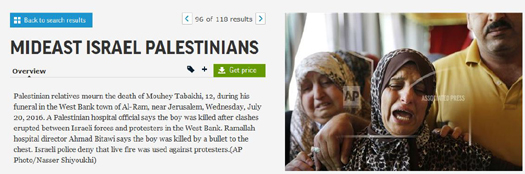
In contrast, the Associated Press, another leading photo agency, commendably published captions which noted the disputed circumstances. (An example follows.)

AP’s accurate caption states:
Palestinian relatives mourn the death of Mouhey Tabakhi, 12, during his funeral in the West Bank town of Al-Ram, near Jerusalem, Wednesday, July 20, 2016. A Palestinian hospital official says the boy was killed after clashes erupted between Israeli forces and protesters in the West Bank. Ramallah hospital director Ahmad Bitawi says the boy was killed by a bullet to the chest. Israeli police deny that live fire was used against protesters.(AP Photo/Nasser Shiyoukhi) (Emphasis added.)
July 25, 2016
Mobs Attack Christians in Egypt, Activists Plea for Help
Jihadists are on the march in Egypt, attacking Coptic Christian churches and homes with impunity. Last week, a mob of Muslims attacked a group of Christian homes in Minya where many of Egypt’s Christians are located. The attack was caught on video (displayed above) and has gone viral in Egypt.
In an effort to force the Sisi regime in Egypt to stop the violence, Coptic Solidarity, an American-based human rights organization, is calling for a protest to take place in front of the White House on Tuesday, August 2, 2016. A Search on Nexis indicates that this plea for help, issued on July 22, 2016 has largely been ignored by the mainstream media in the U.S., as have the attacks on Christians in Egypt.
(more…)July 25, 2016
U.S. Government Sanctions Al-Qaeda Terrorists Living In Iran—Media M.I.A

The U.S. Treasury Department announced on July 20, 2016 that it had sanctioned three high-level operatives of al-Qaeda, a U.S.-designated terrorist group, who are living in Iran. Although U.S.-Iran relations and Islamic terrorism have been the focus of extensive U.S. news media coverage, many outlets failed to report Treasury’s targeting of the Iranian-based al-Qaeda terrorists.
According to a departmental press release, “Treasury designated Faisal Jassim Mohammed al-Amri Al-Khalidi (Al-Khalidi), Yisra Muhammad Ibrahim Bayumi (Bayumi), and Abu Bakr Muhammad Ghumayn (Ghumayn) as Specially Designated Terrorists…for acting for or on behalf of al-Qaida.” The action was taken to “disrupt the operations, fundraising, and support networks that help al-Qaida move money and operatives from South Asia and across the Middle East.” All three operatives, Treasury noted, are “located in Iran.”
Tehran has a long history of supporting terrorist groups, including al-Qaeda, Hezbollah, Hamas and Palestinian Islamic Jihad, among other U.S.-designated terror groups. Indeed, a June 2016 U.S. State Department report named Iran as the leading country sponsoring terrorism (“State Department report finds Iran is top state sponsor of terror,” CNN, June 2, 2016).
Some U.S. news media did report the most recent sanctions against al-Qaeda members based in Iran. For example, The Chicago Tribune carried an Associated Press brief by reporter Matt Lee that noted the designations (“U.S. hits 3 Iran-based al-Qaida figures with terror sanctions,” July 20). Similarly, Fox News (“US. Hits 3 Iran-based Al Qaeda figures with terror sanctions,” July 20) and The Washington Free Beacon (“U.S. Sanctions Top Al Qaeda Operatives Working in Iran,” July 20), a Washington D.C.-based online publication, informed their audiences of the story.
Yet, many major U.S. news media failed to mention the recent Treasury designation of the al-Qaeda terrorists in Iran. A Lexis-Nexis search of The Washington Post, The New York Times, USA Today and The Baltimore Sun, among others, showed no mention of Treasury’s announcement.
Iran has frequently provided sanctuary to al-Qaeda. The 9/11 commission report, which investigated the Sept. 11, 2001 al-Qaeda terror attacks—the largest mass casualty terrorist attack in U.S. history—noted that there was “strong evidence that Iran facilitated the transit of Al Qaeda members into and out of Afghanistan before 9/11, and that some of these were future 9/11 hijackers.”
This is not the first time that the U.S. Treasury Department has sanctioned al-Qaeda operatives under Iran’s auspices. In July 2011, Treasury designated six al-Qaeda terrorists who were part of a cell “headed by Ezedin Abdel Aziz Khalil, a prominent Iran-based al-Qaeda facilitator, operating under an agreement between al Qaeda and the Iranian government,” according to a press release from that U.S. agency (“Treasury targets Iran’s ‘secret deal’ with al Qaeda,” The Long War Journal, July 28, 2011).
Indeed, in January 2009, four al-Qaeda operatives living in Iran were also sanctioned—one of whom was Saad bin Laden, the now deceased son of al-Qaeda founder Osama bin Laden. Another, Mustafa Hamid, has been described as “al-Qaeda’s emir in Iran (“U.S. Sanctions senior al-Qaeda members operating in Iran, The Long War Journal, Jan. 16, 2009).”
The failure by many media outlets to report that Iranian-based al-Qaeda figures received U.S. sanctions, is striking; both Iran and Islamic terrorism have received extensive—if sometimes flawed—coverage throughout the past year (see, for example “Where’s the Coverage: Dead Terrorist was al-Qaeda’s “leader in Iran,” CAMERA, July 23, 2015).
July 22, 2016
Lost In Translation, This Time in Europe
An Arabic translator misled English listeners at an event held at the Massachusetts Institute of Technology in 2011. Arabic translators in Europe are misleading law enforcement officials in Germany according to an article published by the Gatestone Institute.The Gatestone Institute has published a report about Arab-speaking translators mistranslating the testimony of sexual abuse victims in Germany and in some instances going so far as to threaten the victims who try to tell their stories to authorities. The article, written by Stefan Frank, indicates is that there is a “fraternal solidarity between interpreters and criminal defendants” in Germany.
The article is summarizes the story from a book titled Sex in Court written by a German author, Alexander Stevens, who works as a lawyer in Munich. He was approached by a young Syrian girl who had been forced by her family to marry a man who was 34 years older than she was.
After seeking help at a woman’s shelter, the staff at the shelter brought her to Stevens who, after interviewing her, concluded that she was the victim of terrible abuse and humiliation.
He visited her the next day to bring her to the police, but by this point, the young Syrian girl did not want to speak to him. Later he was given a note by a staffer at the women’s shelter in which the girl reported that she had gone to the police station, but that the interpreter intimidated her into not telling her story.
The interpreter told the girl, Sali, that she should not dishonor her husband and family by going to the police.
Subsequently to sending the note, the girl committed suicide.
The Gatestone article also documents how non-Muslim refugees who try to report abuse perpetrated by fellow refugees who are Muslim are oftentimes intimidated by Muslim interpreters who side with the accused. One source quoted in the article states that complaints are often retracted because the interpreters threaten to torpedo the victims’ asylum applications.
The Gatestone article might spark a memory on the part of loyal Snapshot readers. In 2011, Snapshots highlighted a video that documented the mistranslation of a speaker at an event that took place at the Massachusetts Institute of Technology. Here’s the summary:
(more…)July 21, 2016
At the United Nations, Saudi Money Trumps Rights Criticism

The Washington Post’s “U.S. forces to stay longer in Yemen to fight al-Qaeda” (July 18, 2016) included a paragraph which revealed much about how the United Nations really works.
The article, by reporters Thomas Gibbons-Neff and Missy Ryan, detailed how the U.S. military is planning to keep advisers in Yemen on a counterterrorism mission against al-Qaeda, the U.S.-designated terror group responsible for the Sept. 1, 2001 attacks. Gibbons-Neff and Ryan said that the U.S. also was assisting Saudi Arabia in its fight against Iranian-backed Houthi rebels that are at war with the Yemeni government.
The Post pointed out that U.S. support for Saudi Arabia was “complicated” by criticism of “high civilian casualties in the conflict in Yemen.” However, the paper then noted the kingdom’s revealing response:
“Last month, the United Nations put Saudi Arabia on a list of countries responsible for violating children’s rights in armed conflict after determining that the Saudi-led coalition was responsible for the deaths of 60 percent of the 1,953 children reported killed since the start of the conflict. Saudi Arabia has since been removed from the list after threatening to cut its support for U.N. peacekeeping programs [emphasis added].”
As CAMERA has frequently noted, U.N. bodies often unfairly single out and malign Israel (for a partial list of examples, see here). Yet, many in the U.S. news media often fail to point out the U.N.’s anti-Israel record; treating the organization, instead, as an unbiased actor.
In an article on U.S. intervention in Yemen, The Post—even if unintentionally—briefly highlighted how the U.N. really works, or perhaps more precisely, doesn’t work. U.S. news media outlets would do well to note it in the future.
July 20, 2016
‘Who You Callin’ a Human Shield?’
![AFP_BZ2ZL-4072[1].jpg](data:image/svg+xml,%3Csvg%20xmlns%3D%27http%3A%2F%2Fwww.w3.org%2F2000%2Fsvg%27%20width%3D%27280%27%20height%3D%27160%27%20viewBox%3D%270%200%20280%20160%27%3E%3Crect%20width%3D%27280%27%20height%3D%27160%27%20fill-opacity%3D%220%22%2F%3E%3C%2Fsvg%3E)
It should not go unnoticed that a major U.S. news organization—in this case The Washington Post—used the term “human shields” in its own voice when describing the practice of an Islamic terrorist movement embedding itself among civilians and holding them hostage.
In an article headlined “Iraqi troops retake Fallujah; One of Last Havens of Islamic State; Humanitarian crisis grows as thousands flee” (June 18, 2016 in print, June 17 online), Post correspondents Loveday Morris and Mustafa Salim wrote, among other things:
“There have been concerns about the plight of civilians stuck inside Fallujah. When the operation began in late May, as many as 90,000 people were believed trapped in the city, with the Islamic State holding them to use as human shields [emphasis added].”
The Post does not say who believed as many as 90,000 people were trapped in Fallujah or that the Islamic State in Iraq and Syria planned to use them as human shields. However, based on past actions by the group, the description no doubt seemed probable.
Hamas in the Gaza Strip and Hezbollah in Lebanon long have used the populations they claim to represent but daily intimidate as human shields in their “resistance” to Israel. In reporting non-combatant casualties resulting from Israeli counter-attacks against Hamas and Hezbollah, news media sometimes note Israel’s charges that the two terrorist organizations were hiding behind human shields. They have been less likely to report, in their own words and accurately, that the two Islamic fundamentalist movements did just that.
It’s worth noting Washington Post usage in this case, and keeping it mind the next time the press deals with civilian casualties among populations ruled by Hamas and Hezbollah as a result of Israeli responses to the groups’ aggressions. What’s good for ISIS ought to be good for them too.
It’s also worth recalling that using human shields, and attacking other non-combatant population from among them, is a double violation of international law and ought to be reported as such.
July 20, 2016
UPDATED: Israelis Killed in
“Alleged”Actual Attacks
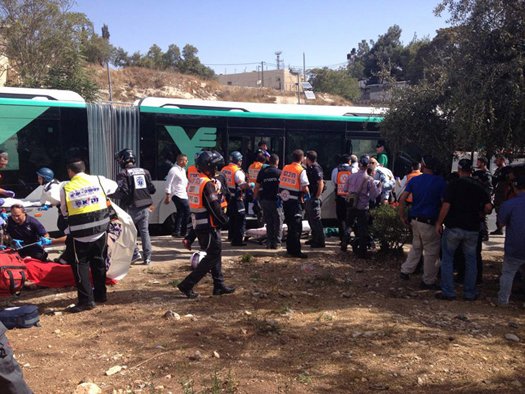
Bahaa Alyan took part in the Oct. 13, 2015 terror attack on a Jerusalem bus, killing three Israelis (Photo: Israel Police)In an article about new Israeli legislation to allow for the ouster of members of Knesset accused of racial incitement, Agence France Presse today pulls a Time Magazine stunt, reporting:
The legislation was put forward after three Arab-Israeli opposition lawmakers sparked controversy when they visited relatives of Palestinians killed by Israeli security forces after alleged attacks in Israel.
Alleged attacks? Haviv Haim, Alon Govberg and Richard Lakin were not killed in an “alleged” attack on Oct. 13 when Bahaa Alyan boarded their Egged bus in East Talpiot, indiscriminately shooting and stabbing passengers. Alyan’s father was among the Palestinian relatives with whom MKs Basel Ghattas, Jamal Zahalka and Hanin Zuabi met last February.
Indeed, AFP’s headline and article at the time of the MKs’ visit to the terrorists’ families got it exactly right: “Israeli leaders slam MPs who met attackers’ families.” AFP’s Feb. 5 headline rightly refers to “attackers’ families,” not “alleged attackers’ families.”
In addition, the Feb. 5 AFP story opened with the straightforward sentence: “Three Israeli Arab lawmakers who met relatives of Palestinians killed after carrying out attacks on Israelis faced fierce criticism. . . .” Indeed, there is no doubt that Baha Alyan, whose family the MKs visited, was one of the killers on that Egged bus Oct. 13.

As AFP’s Feb. 5 article correctly detailed later on:
Balad said [the relatives with whom the MKs met] included the father of Bahaa Alyan, who in October boarded a bus in Jerusalem with a friend, shooting and stabbing passengers and killing three people.
After a Facebook campaign launched by Israel’s Government Press Office, Time Magazine corrected the identical error concerning Alyan. CAMERA has contacted AFP editors to ask them to likewise correct their copy. Stay tuned for an update.
UPDATE: AFP has amended the text of the article to read:
The legislation was put forward after three Arab-Israeli opposition lawmakers sparked controversy when they visited relatives of Palestinians killed by Israeli security forces while carrying out attacks. [emphasis added]





![AFP_BZ2ZL-4072[1].jpg](https://blog.camera.org/wp-content/uploads/2016/07/AFP_BZ2ZL-40725B15D.jpg)

Search:
Search this site: