
Recent Entries:
Month: March 2013
March 27, 2013
Where’s the Coverage? Dis-Honor Killing in Gaza on International Women’s Day

In the run-up to President Obama’s visit to Israel, The New York Times found room on the front page to write about how Jews living in Jerusalem “fundamentally undermine” the so-called “peace process.” The newspaper also found place for an 8,000-word New York Times Magazine cover story celebrating violent Palestinian protesters. What editors didn’t find room for was any mention of the brutal murder of a young woman at the hands of her brother and father in Gaza.
Al-Monitor reports on Hiyam’s murder, after a young man was found in the house:
According to the police and the family, the father and brother strangled Hiyam. The young man, Ahmed, was beaten and thrown from a high structure and presumed dead. Neighbors were asked to witness the act and reported it to the police.
[Hiyam’s 13-year-old brother] Mohammed added, sadly, “The police came too late. They arrived after one and a half hours. If they had come earlier, they would have saved my sister Hiyam.” […]It was later revealed that the father and his son had first strangled Hiyam with a rope, and when that failed to kill her, they used a double wire instead.
The murder took place on March 8. That also happened to be International Women’s Day. While The Christian Science Monitor, The Washington Post and other news outlets commendably covered the day, neither these nor other news media found time or space to report on Hiyam’s murder. Other than Al-Monitor, only blogger Elder of Ziyon mentioned it.
The United Nations Web site declares the theme for this year’s International Women’s Day was “A promise is a promise: Time for action to end violence against women,” yet it seems that most major media won’t take the most minimal action, reporting.
According to the Palestinian Independent Commission for Human Rights:
Regrettably, women still suffer gender based discrimination in the Palestinian society. In 2012, ICHR registered (24) death cases of women, including (5) cases against the so called (honor killing) and (15) deaths under mysterious conditions. It still also monitors several patterns of violations against women, especially gender based violence.
The Palestinian Central Bureau of Statistics issued a report last year revealing that 37 percent of married women in Gaza and the West Bank admit to experiencing violence at the hands of their husbands. Over 65 percent say they never told anyone of the violence. (Isn’t that the media’s job?)
Where are the boycotters? Where are the flotillas? Where are the days of rage? And for the sake of decency… Where’s the coverage?
March 25, 2013
USA Today Gets It Mostly Right

USA Today’s “Palestinians not optimistic about Obama’s agenda” (March 20) reminded readers that many Arab residents of eastern Jerusalem wouldn’t want to live in a Palestinian state. Overall, the article was a relatively rare example of a major news outlet including essential context in an Israeli-Palestinian report.
Reporters Michele Chabin and Vanessa O’Brien noted “a recent survey conducted by Pechter Middle East polls showed that 35 percent of East Jerusalem residents said that in any two-state solution, they would prefer to live in Israel, while 30 percent preferred to live in a Palestinian state.” In addition, the survey “showed that 40 percent would prefer to move to Israel if their neighborhood [of Jerusalem] became part of Palestine.”
While only five percent of Jerusalem Arabs have opted for Israeli citizenship since 1967, the number applying to change their permanent resident status to citizen is rising, one resident of eastern Jerusalem told USA Today.
The dispatch also:
* Refers accurately to Hamas, which targets Israeli non-combatants and takes cover among the Gaza Strip’s civilian population, as a terrorist group that desires to eliminate Israel instead of calling it a “militant” organization, and
* In the print edition correctly describes the Temple Mount in Jerusalem’s Old City, not the adjoining Western Wall, as Judaism’s holiest site. The longer, updated online version muddies the language in this regard. (CAMERA has obtained numerous corrections from media that have erroneously termed the Wall the most sacred physical location for Jews.) By accurately describing the importance of Temple Mount to Jews, USA Today’s print report helps clarify why the site is a source of contention.
The article does err by saying that Israel’s West Bank security barrier and checkpoints “bar all but a few thousand Palestinians from accessing jobs, universities and hospitals in Israel.” The Israeli foreign ministry reports that last year more than 200,000 West Bank and Gaza Strip Arabs, patients and accompanying family members, were permitted to seek hospital treatment in Israel, and the Associated Press said recently that approximately 40,000 West Bank residents now are authorized to work in Israel, up from virtually none during the second intifada (2000 – 2005).
The newspaper commendably published a clarification in this regard in its March 25 print edition .
A reference to the “right of return for all Palestinians and their descendants to live in what is now Israel” should have been to the “alleged right of return …” No such right exists, as indicated by the early U.N. General Assembly resolutions on the subject, 194 (1948); 393 (’50); 394 (’50); and 513 (’52). That’s one reason Arab delegations voted against them at the time.
But overall, “Palestinians not optimistic about Obama’ s agenda” provides readers with important information routinely ignored in other major media. – Andy Wallin, CAMERA Washington research intern.
March 24, 2013
NY Times Tunes Up Israeli Apology Story

A couple of days ago, we critiqued an early version of a New York Times story about Israel’s apology to Turkey, and contacted the newspaper about misleading language in the piece.
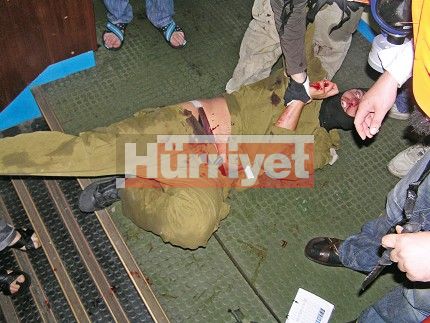
The article wrongly claimed Israel apologized for raiding the Mavi Marmara, a Turkish ship seeking to break the blockade of the Gaza Strip, when in fact the apology was not for the raid itself but for any mistakes that may have lead to the death of the passengers. The New York Times piece also mentioned that Israeli naval commandos killed several passengers on board, but failed to note that the commandos’ resort to force came as they were being attacked by passengers.
To the newspaper’s credit, the misleading passages were replaced with more precise language, so that the final version correctly notes Israel “apologized for deadly errors” and points out, somewhat more helpfully, that the passengers were killed ” in clashes on board.”
March 22, 2013
BBC Bests New York Times on Coverage of Israeli Apology
(March 24 update: After CAMERA contacted the newspaper, reporters improved some of the language for the final version of the article. See here for details.)
Question for the New York Times: Why be imprecise and risk misleading readers when it would be just as easy to be precise and accurate?
Consider the newspaper’s sloppy summary in its report on Benjamin Netanyahu’s apology to Turkey today. Twice in the first two paragraphs, reporters Jodi Rudoren and Mark Landler inform readers that Israel apologized “for a deadly commando raid” and expressed regret “for the raid.” But by nearly all accounts, Israel did not apologize “for the raid” itself, but rather for operational errors potentially tied to loss of lives during the incident.
The difference is substantive. An apology for the raid suggests Israel believes it erred in stopping the ship. An expression of regret about what happened during the raid suggests it acknowledges it could have carried out the operation differently and apologizes “any errors that could have led to loss of life,” as an Israeli statement put it.
The New York Times‘ obligation to avoid misleading readers about the scope of the apology is all the more important when considering that the wording and scope of the Israel’s apology was surely a point of dispute between the two parties that had to be carefully negotiated.
An more accurate summary of the apology would have been simple. Consider the BBC‘s lead paragraph:
Israel’s prime minister has apologised to Turkey for “any errors that could have led to loss of life” during the 2010 commando raid on an aid flotilla that tried to breach the Gaza blockade.
Even The Guardian, notorious for its hostility toward Israel, was clear in its lede that Israel apologized “for the loss of nine lives” on board the ship.
As it tends to do, the New York Times also avoided pointing out that the loss of lives on the boat were part of a intense and violent battle between Israeli troops and the activist passengers who attacked them as they boarded the ship. By withholding such context, it leaves the blatantly false impression that Israel simply boarded the ship and attacked peaceful non-combatant passengers.
The BBC report, on the other hand, noted that Israel says “its commandos used lethal force because activists had attacked them.” The BBC’s reference could have been better. They give equal weight to Israel’s description of soldiers being attacked and the denial by some of the passengers, despite the fact that video footage shows the naval commandos being attacked as they were descending onto the ship with their hands still on the rappelling ropes. But nonetheless, its contextualizing of the deaths still bests the New York Times.

March 21, 2013
PBS Report Starts Off Well, Gets Caught in the Weeds

The March 19th broadcast of PBS News Hour included a segment by Margaret Warner about the Fatah-Hamas split. It started off pretty well with a look at how Hamas has worked to put Palestinians living in the Gaza Strip on a perpetual war-footing with Israel. The segment showed a fair amount of footage of Palestinian teenagers going through paramilitary training and provided some context for the imagery with Warner reporting that the training “is now offered in all of Gaza’s high schools. It’s further evidence of Hamas’ entrenched grip on power here.”
(more…)March 21, 2013
Where’s the Coverage? Iran Systematically Oppresses Baha’is
Even though representatives of the government of Iran have testified that “any religious or political belief is guaranteed under the Constitution,” that “no one can be put to trial or punished, or deprived of social rights owing to a particular belief,” and that “the investigation of individuals’ beliefs is forbidden, and no one may be harassed or taken to task simply for holding a certain belief,” that’s exactly what happens to Baha’is in Iran, according to two recent reports.
United Nations special rapporteur on the situation of human rights in the Islamic Republic of Iran, Ahmed Shaheed, announced a report which outlined systematic government oppression of Baha’is, “intimidation, arrest, detention and interrogation that focus on their religious beliefs,” including psychological and physical torture.
A report from the Baha’i International Community, entitled “Violence with Impunity,” explains that:
Since [the Islamic revolution in] 1979, more than 200 Baha’is have been executed, hundreds more imprisoned and tortured, tens of thousands denied employment, education, freedom of worship, and other rights—all solely because their religion is declared to be a “heretical sect.”
This persecution has intensified in recent years. Since 2005, more than 660 Baha’is have been arrested, and, by the end of 2012, at least 115 Baha’is were languishing in prison. The increase in arrests has been accompanied by a rising tide of violence against Baha’is, marked by incidents that include arson attacks, anti-Baha’i graffiti, hate speech, the desecration of Baha’i cemeteries, and assaults on schoolchildren.
After detailing numerous violent attacks, the report concludes that:
…the Iranian government has apparently made it official policy not to investigate, prosecute or otherwise punish those who assault Baha’is or their properties. Indeed, the evidence shows that police officers, prison guards, local officials, the clerical establishment, and individual citizens have not only been encouraged to attack Baha’is through incitement in the media—they have also been given to understand that such attacks can be undertaken with complete impunity.
While, to their credit, UPI and The New York Times did cover the U.N. briefing, both focused almost exclusively on a crackdown on journalists and did not mention persecution of Baha’is. No other major media outlet even did that much.
The Baha’i International Community report received even less media attention. Only The Jerusalem Post covered both reports.
The Baha’i faith was established in Iran in 1863 and recognizes the universality of all religions. There are an estimated 350,000 Baha’is in Iran but the religion’s international headquarters, the Baha’i World Centre, is located in the Middle East’s only free country. You guessed it, that’s Israel.
The Baha’i International Community report concludes that, “the only real protection for Iranian Baha’is comes from continued international outcry and action.” Therefore it is even more urgent that we demand… Where’s the coverage?
March 20, 2013
Report: PA Bans Photos, Video from Hebron
The Times of Israel reports:
The Palestinian Authority issued a ban on releasing photos and videos from the West Bank city of Hebron ahead of US President Barack Obama’s visit, which begins Wednesday, Channel 10 reported Tuesday night. The Palestinian media is expected to comply with the PA’s directives, according to reports.
Hebron residents are reportedly opposed to the US president’s visit and the Palestinian Authority is attempting to avoid embarrassment over hateful displays in the city.
March 19, 2013
Will Donald Miller Correct?

Donald MillerFour months ago, Donald Miller, a Christian writer who has a large following among Evangelical (and post-Evangelical) young adults in the United States, wrote a blog entry about the Arab-Israeli conflict titled “The Painful Truth About the Situation in Israel.”
The entry, which was posted on his blog which promotes his most recent book “Storyline,” began with a reference to the death of Jihad Misharawi’s 11-month-old son Omar and declares that he was killed by an Israeli airstrike in the Gaza Strip. To add drama to the entry, Miller posted a photo of Jihad Misharawi holding the body of his dead child and grimacing in agony.
Well, as it turns out, there’s good reason to believe that Omar Misharawi was not killed by an Israeli airstrike, but by a Hamas rocket that fell short during the fighting.
(more…)March 18, 2013
The LA Times’ Crime of Omission

What the LA Times won’t tell you about Sharawna: Imprisoned for his role in a Beer Sheva bombing and an attempted kidnapping (Photo from Ma’an)In its online and print articles, the Los Angeles Times carefully omits the crimes of Ayman Sharawna, a hunger-striking Palestinian just released from an Israeli jail. The print article, a truncated Associated Press article, reads:
A freed Palestinian prisoner received a hero’s welcome in the Gaza Strip on Sunday evening after ending his hunger strike in an Israeli jail and agreeing to a plea bargain that will confine him to the Hamas-run territory for 10 years.
Ayman Sharawneh arrived at the Erez Crossing in an ambulance with siren blaring and red lights flashing. Dozens of TV cameramen and photographers gathered around the vehicle as it crossed into Gaza. Palestinians waved national flags and chanted slogans calling for freedom.
Sharawneh, 53, appeared weak, shaky and shrunken. He was taken to a hospital in Gaza City.
A resident of the West Bank, Sharawneh had been refusing food since July to protest his incarceration. His lawyer, Jawad Bulous, said Sharawneh accepted the offer of confinement to Gaza, fearing he would be sent to prison for decades in a military court hearing set for Monday.
“The occupation committed two crimes,” Sharawneh said, referring to Israel: “arresting me, and then keeping me away from my family. But in Gaza, I am also with my family.”
While the Times finds space to quote Sharawneh about Israel’s alleged “two crimes” of arresting him and keeping him from his family, it does not find the space to note why in fact Sharawneh was arrested. Indeed, if an innocent man was arrested, there is justification for calling it a crime.
But the full Associated Press story, from which Times editors lifted the first five paragraphs about Sharawneh’s weak condition, his noisy release, the waving flags, freedom, and alleged Israeli crimes, actually does continue on to detail why Sharawneh was in jail in the first place. The Times’ didn’t see fit to include the following AP paragraphs:
Sharawneh, who was serving a 38-year prison sentence for participating in militant attacks, was among about 1,000 Palestinian prisoners freed in 2011 in exchange for an Israeli soldier held for five years by Hamas militants in Gaza.
In one attack, he detonated an explosives-filled handbag in the southern Israeli city of Beersheba, wounding more than a dozen people. He was also involved in a kidnapping attempt, according to Israel’s Shin Bet security service.
He was arrested again in January 2012 after being accused of violating the terms of his release by making contact with members of the militant Islamic group Hamas. The military court could have ordered him to serve out the remainder of his original sentence.
March 13, 2013
Where’s the Coverage? Prisoner Dies in Palestinian Custody
On March 2, Khaled Abu Toameh reported in the Jerusalem Post that Ayman Samarah, a 40-year-old Palestinian from Jenin, died while in custody at Jericho Prison, one of the Palestinian Authority’s biggest prisons in the West Bank. Almost no major news outlet picked up the story. A Google News search turned up mostly blog posts and tweets.
Contrast that with the widespread coverage of the case of Arafat Jaradat, a 30-year-old Palestinian who died in Israeli custody. Actually you don’t have to. In American Thinker, Leo Rennert does that for us:
…When it came to Jaradat’s death, mainstream media, led by the New York Times and the Washington Post, went all out with a slew of articles – Israel claiming it was probably a heart attack and Mahmoud Abbas and the Palestinian Authority screaming “torture” even before the autopsy could be completed. Predictably, the Times and the Post also put more stock and gave greater prominence to Palestinian propaganda than to Israel’s explanations and methodical autopsy.
But when it came to Samarah’s death in a Jericho prison run by Abbas and the PA, there was no coverage at all in either the Post or the Times. Not a single word. Even though families of Palestinians detainees have held sit-in strikes at the Jericho prison, alleging torture of their kin. Sadly, this is all too familiar a pattern in Palestinian territories – in the West Bank, under Abbas control, Hamas prisoners can expect brutal treatment, while in Gaza, run by Hamas, it’s Fatah detainees who tend to complain of torture. But there’s no media interest.
Rennert wrote that on March 4. That was over a week ago. And still, no major news stories.
Why would the media cover the death of a prisoner in Israeli custody but not a prisoner in Palestinian custody? Is it possible that they are not truly interested in relaying the plight of Palestinian prisoners at all but only in focusing on something that might make Israel look bad? If not, one has to ask… Where’s the Coverage?





Search:
Search this site: