
Recent Entries:
Month: January 2015
January 30, 2015
Highlights from Matti Friedman’s Speech on Mideast Media Coverage
Building on his important critique of Middle East media coverage (in Tablet), his short follow-up (also in Tablet), and his more detailed exploration (in The Atlantic), former Associated Press reporter Matti Friedman this week delivered a masterful speech on how and why journalists get the story of Israel and the Palestinians so wrong.
The full text of the lecture, delivered at a Bicom dinner, can be found here. You should read it. Meanwhile, we’ve put together a few highlights from the speech, and a couple of thoughts, below.
In his presentation, Friedman asks, and then sets out to answer,
How have the doings in a country that constitutes 0.01 per cent of the world’s surface become the focus of angst, loathing, and condemnation more than any other?
January 28, 2015
Where’s the Coverage? Israeli Program Educates and Supports Palestinian Farmers

Earlier this month, The Jerusalem Post reported:
A group of 30 Palestinian farmers […] came to Israel for a two-day continuing education program in the Sharon region, to learn about some of the strawberry-growing methods used in Israel. The group, predominantly from the Tulkarm and Jenin areas, met with farmers developing commercial seedlings and others experimenting on new growth techniques – both employing hanging systems and traditional in-ground planting methods.
“I came to study new things today,” said Abed al-Salam, who is from a village near Tulkarm, where he grows both strawberries and vegetables.
The tour was organized by Israel’s Civil Administration of Judea and Samaria, the principle facilitator for similar such collaborative ventures between Israeli and Palestinian farmers.
Nasser Bsharat, from Al-Jiftlik in the Jordan Valley, stressed how much there is to learn about the different types of strawberries that can be grown – pointing out that there are 42 different types being cultivated at their first stop of the day, the Romano Strawberry Nursery.
The nursery, sandwiched between Kibbutz Tel Yitzhak and the Neveh Hadassah Youth Village in the Hof Hasharon Regional Council area, develops and markets strawberry seedlings to growers.
Bsharat said the farmers are keen to learn new techniques for growing strawberries both within greenhouses and in fields, as well as disease-prevention mechanisms.
Stressing not only the importance of cooperation between Israeli and Palestinian farmers, but also the routine nature of such relationships, Bsharat said the Jiftlik community lives “as neighbors” with the residents of the nearby Masu’a settlement.
“If I have any problem [with my farm], I ask my neighbors,” he said.
Well, this is certainly not the image of Israeli-Palestinian interaction promoted by most of the mainstream news media. How does this square with the apartheid narrative? How does this fit with the story of Israeli “settlers” persecuting Palestinian Arabs? It doesn’t. Better not report it then. And the popular press does not. Not a peep about any of the cooperation and positive contact.
Not a word about what The Jerusalem Post reported:
Cooperation on the agricultural level is longstanding between West Bank Palestinians and Israelis, with some 10 study-tour groups – about 1,200 farmers – coming to Israel each year, according to [Samir] Moaddi [the agricultural staff officer of the Civil Administration in Judea and Samaria]. Already at the end of January, he will be accompanying a group of 50 Palestinians to the Arava Open Day agricultural exposition at the Yair Research and Development Center in Hatzeva.
“The Palestinian population is hungry for knowledge,” Moaddi said.
About 60 percent of West Bank Palestinian produce is sold to the Israeli market each year, while some 200,000 tons of Israeli produce is sold in the opposite direction, Moaddi said.
This kind of economic cooperation and productive educational exchange just doesn’t match the storyline that Israelis oppress Palestinians at every turn. Therefore, rest assured you won’t be reading about it and we’ll have to ask… Where’s the coverage?
January 26, 2015
European Jews’ Latest Offence? Being the Target of Anti-Semitism Old and New
For some at the BBC, there is a clear discomfort with talking about about European anti-Semitism — at least when the result is dead Jews, whether in 2015 or in 1940s.
Tim Willcox recently stunned viewers when, immediately after the murder of four Jews in a French kosher market, he took issue with a French woman’s call for open acknowledgment that Jews are being targeted, countering that “Many critics of Israel’s policy would suggest that the Palestinians suffer hugely at Jewish hands as well.” In other words, French Jews don’t deserve to be acknowledged as targets if some people are offended by Jews thousands of miles away. (Willcox later apologized on Twitter “for any offence caused by a poorly phrased question,” though he has yet to apologize to his television audience.)
This Jewish problem, though, seems to extend beyond Jews daring to speak out about contemporary anti-Jewish murders. Seems it’s time that they shut up about the Holocaust, too. Yesterday morning, a BBC program focused on “moral, ethical and religious debates” asked its audience the following:
Our one big question this morning: Is the time coming to lay the Holocaust to rest? #BBCTBQ
— The Big Questions (@bbcbigquestions) January 25, 2015
January 26, 2015
When People Who Know Better Say Tel Aviv is Israel’s Capital
Ellie Geranmayeh, a policy fellow at the European Council on Foreign Relations, is the second observer of international affairs in recent days whose fancy title didn’t stop her from misidentifying Tel Aviv as Israel’s capital in a leading American newspaper.
Referring to the capitals of Iran, the U.S and Israel, respectively, Geranmayeh writes today in The New York Times (“Political sabotage over a deal with Iran“): “Spoilers have been striking from Tehran, Washington and Tel Aviv.” (Emphasis added.)
In The International New York Times, the mischaracterization of Tel Aviv as Israel’s capital is highlighted in a pull quote.

Further on in the Op-Ed, Geranmayeh repeats the erroneous reference to Tel Aviv as Israel’s capital, stating: “The results of the Israeli elections could deflate Tel Aviv’s fierce opposition to current negotiations with Iran.”
Earlier this month it was Kenneth Roth, executive director of Human Rights Watch, who was also in a position to know exactly where the seat of Israel’s government is. Nevertheless, he wrote in a Jan. 15 Op-Ed in The Los Angeles Times (“The Palestinians’ decision to join the ICC deserves support“):
In Washington, Ottawa, Paris and London, as well as in Tel Aviv, the response [to the Palestinians’ move to join the International Criminal Court] has ranged from discouraging to condemnatory.
Following communication from CAMERA, Los Angeles Times editors commendably published the following correction Jan. 22:
Israel: A Jan 15 OpEd about the Palestinians’ move to join the International Criminal Court implied that Tel Aviv is the seat of the Israeli government. The government is based in Jerusalem.
The New York Times itself in the past has previously corrected this point. The Nov. 22, 2002 correction stated:
An article yesterday about a man accused of having tried to hijack an El Al plane en route to Istanbul from Tel Aviv referred incorrectly to Tel Aviv. It is not he capital of Israel; Jerusalem is.
CAMERA has sent a request to Times editors that they again correct.
If Roth and Geranmayeh freely misrepresent a fact as basic as the location of Israel’s capital in order to suit their political agendas, what else are the supposed experts on international affairs distorting?
January 23, 2015
There Were No Palestine Borders, And No Palestine, in 1967
A story in today’s New York Times print edition, “Obama Not Planning to Meet With Israeli Premier,” written primarily by the newspaper’s Washington bureau, included erroneous and anachronistic language about Israel’s “1967 borders with Palestine.”
In 1967, of course, there was no country, territory, or entity called Palestine.
And the boundary between Israel and the territory in question, what had been the Jordanian-occupied West Bank, was explicitly not regarded as a border. As the 1949 armistice agreement between Israel and Jordan made clear, “The Armistice Demarcation Lines defined in articles V and VI of this Agreement are agreed upon by the Parties without prejudice to future territorial settlements or boundary lines or to claims of either Party relating thereto.”
This phrasing helps underscore why CAMERA has long called for newspapers to correct inaccurate references to “1967 borders” (even without explicit references to a pre-1967 entity called “Palestine”) and why we’ve often gotten corrections on the topic. The implication — not often spelled out, though it is in this particular piece — is that there was between 1948 and 1967 a sovereign country between the Green Line and the Jordan River, one that had internationally recognized borders, and one that is therefor the legal sovereign of all land east of the Green Line, whether that be the Jewish Quarter, the consensus settlements of the Etzion block, or beyond.
Readers of this blog might immediately recognize that this isn’t at all true; but the average New York Times reader may not, so the newspaper’s references to 1967 “borders” is likely to lead to substantive geopolitical misunderstanding on the part of its audience.
The New York Times has thanked CAMERA for making it aware of the erroneous language, but has not yet published a correction. We’ll hope to update this space soon with information about a correction.
Update: The newspaper has half-corrected half of its errors. Online, it quietly removed the false assertion that there existed a Palestine in 1967. But it did not remove the imprecise reference to “borders.” Moreover, it did not publish a formal correction, which means those who were misinformed by the article as published will almost certainly not know of the modification, and those who encounter the article in the future on online news databases will continue see the inaccurate language.
Update 2: The newspaper has now published a formal correction in print and online:
Correction: January 27, 2015
An article on Friday about a planned visit to the United States by Prime Minister Benjamin Netanyahu of Israel referred incorrectly to President Obama’s suggestion, in a 2011 conversation with Mr. Netanyahu, for a baseline for negotiating the borders between Israel and a future Palestinian state. He suggested using the pre-1967 lines that separated Israel from the Jordanian-controlled West Bank, not Israel’s “1967 borders with Palestine.” (There was no state called Palestine in 1967.)January 23, 2015
Iran’s Geopolitical Pincer

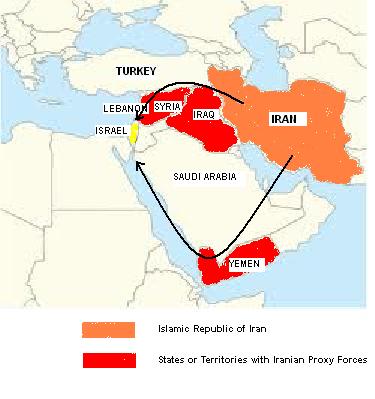
For centuries, military commanders have employed the tactic called a pincer to encircle an opposing force, box it in and then annihilate it with a coordinated attack from all directions. Such a tactic also applies more broadly as a geopolitical manuever to encircle entire nation-states. When one views a map of the changing strategic landscape in the Middle East, it is evident that Iran is conducting a vast geopolitical pincer movement westward. Enclosed within this vast pincer are Saudi Arabia and the State of Israel.
Although Iranian intentions toward Israel (as well as Saudi Arabia) are well known, major news purveyors like The New York Times continue to focus on the conflict between Israel and the Palestinians, as evidenced by the disproportionate number of articles on Israel and the Palestinians at the expense of in-depth coverage of more expansive conflicts in the region.
Despite the immutable nature of the Israeli-Palestinian conflict over the course of many years, major news media continue to amplify relatively minor incidents, routine demonstrations and property vandalism in the West Bank and publish flurries of articles whenever housing construction permits are issued by Israeli authorities in disputed parcels of land surrounding Jerusalem. This hyperfocus on Israel and the West Bank means less resources are available to draw attention to events that threaten to reshape the entire region with potentially catastrophic consequences. An example of a conflict that has not received the attention it deserves is the extension of Iranian influence in Yemen, culminating in the overthrow of the pro-Western government.
Periodically, the CAMERA blog has posted items discussing the importance of events in Yemen. Yemen is the most impoverished Arab state, even though it borders the wealthiest Arab state, Saudi Arabia. It has long been a hotbed of terrorism, spawning what is currently the most dangerous branch [internationally] of Al Qaeda. Its government was a key partner in the war against terrorists. With the fall of the Yemeni government to an Iranian-backed Shiite militia, two major blows have been struck against the West. Al Qaeda will have a freer reign to promote terrorism. But, an even greater risk is the continuing evolution of Iran’s reach in the region.
Some commentators are trying to draw attention to Iranian moves. Charles Krauthammer’s column in the Washington Post, “Iran’s Emerging Empire” discusses what is taking shape in the region, from Lebanon, to Syria and Iraq to Yemen.
In order to completely encircle Israel, Iran still must overcome large geographic obstacles – Saudi Arabia, Egypt and the Mediterranean Sea. But new permutations are conceivable. Saudi Arabia, ruled by a perpetual gerontocracy, may not prove as durable as it currently appears, especially if the United States decides to pursue a policy of disengaging from the region. Although Turkey is a regional Sunni competitor to Shiite Iran, under its current leadership, which has shown a penchant for anti-Israel and anti-Semitic outbursts, it may be open to some form of collaboration with the Iranians against Israel.
It would be helpful to American audiences if the media that focuses so much attention on Israel and the Palestinians would devote more resources and space on their pages to what Krauthammer refers to as the emerging Iranian Empire.
January 22, 2015
Memo to Martin Marty and Scott Appleby: You Got Played

Last week, in a piece about Christiane Amanpour’s misuse of the word “activist” when describing the Charlie Hebdo murderers, Snapshots highlighted how a book published in 1997, Islamic Activism and U.S. Foreign Policy, downplayed the radical Islamist agenda and the violent agenda of a group called Jama’at-i-Islami, a Pakistani organization founded by Islamist radical Sayyed Mawdudi in 1941.
The book, written by Scott W. Hibbard and David Little, portrayed Jama’at-i-Islami as a grassroots organization that relies on “constitutional and legal means for achieving its goals.” The book portrayed the organization’s founder, Sayyed Mawdudi as a man whose ideas were “revolutionary” but whose methods were “evolutionary.”
In the same entry, Snapshots reported that in fact, Jama’at-i-Islami was responsible for terrible massacres during Pakistan’s civil war and that Mawdudi was in fact, a radical who “called on his followers to fight (and kill) in an effort to impose their understanding of God’s will on their fellow citizens. Mawdudi’s followers used his writings to justify their violence.”
Hibbard and Little deserve criticism for downplaying the violence of Jama’at-i-Islami and the radicalism of its founder Sayyed Mawdudi, but they are not the only folks who sanitize the violent agenda of Jamaat-i-Islami and its founder Mawdudi.
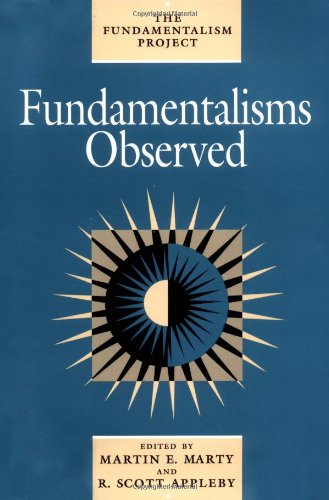
Hibbard and Little’s mistake is that they relied on an essay that appeared in an influential book, Fundamentalisms Observed for their information about Mawdudi and Jama’at-i-Islami.
This book, published by the University of Chicago Press in 1991 was the first text issued by “The Fundamentalism Project,” a six-volume study produced with great fanfare under the aegis of the American Academy of Arts and Sciences. (The Fundamentalism Project has its own entry in Wikipedia.)
The book, edited by Martin Marty from the University of Chicago and Scott Appleby from Notre Dame, received lot of play and praise when it was first published. Writing in The Christian Century, the house organ for mainline Protestantism (where incidentally, Marty served as senior editor for many years), Robert Wuthnow declared that the text provided a “valuable overview of some of the most important religious developments of our time.”
Another commentator declared that the book’s “individual contributions are of exemplary quality” that provide “sometimes brilliantly distilled synopses of their respective subjects.”
Such praise cannot, however, describe the book’s treatment of the previously mentioned Jama’at-i-Islami and its founder, Sayyed Mawdudi.
(more…)January 22, 2015
In ’48 War, the Jews “Didn’t Want These People to Leave the Village”

Israeli-Arab town of Jisr az-ZarqaAlexander Galloway, a former UNRWA director in Jordan, famously said that the Arab world was not interested in solving the Palestinian refugee problem, but instead preferred to “keep it as an open sore, as an affront to the United Nations and as a weapon against Israel.”
Today, ironically, it is UNRWA, the United Nations body responsible for Palestinian refugees, that’s often charged with perpetuating the refugee status of Palestinians. And if the refugee problem is still used as a weapon against Israel, it is largely as a key component of the simplistic, hostile narrative that holds Israel as uniformly guilty and the Palestinian as fundamentally victims.
An example of this narrative: The claim in a The New York TImes Op-Ed a few years back that, in 1948, “a people had been expelled from their land in a comprehensive ethnic cleansing operation.”
But from those not enlisted in the war-of-words against Israel — from those who speak casually, as citizens and not as warriors — that narrative is often undermined. In today’s Chicago Tribune (and in the LA Times last week) there is a story about the Arab-Israeli coastal town of Jisr az-Zarqa. One older resident is quoted talking about that allegedly “comprehensive ethnic cleansing operation”:
In 1948, amid fighting between Arabs and Jews surrounding the creation of Israel, there was no fighting in Jisr.
Arabs living in nearby villages fled, but “we didn’t even think about it, never even thought about leaving our lands,” said Gamil Jarban, 72, a retired fisherman, who said his father built the first house in Jisr. He said the people of Jisr were left alone because they were peaceful.
“Even when the Jews came here, they didn’t want these people to leave the village,” he said.
To those most dedicated to talking points drawn up by Palestinian rejectionists, Jarban’s frank remembrance might be viewed as a betrayal. But even Palestinian President Mahmoud Abbas can’t be angry. He’s been known to contradict his own narrative now and again.
January 21, 2015
Where’s the Coverage? Satellite Shows Iran’s Long Range Nuke-Capable Missile
The Times of Israel reports:
Iran has built a 27-meter-long missile, capable of delivering a warhead “far beyond Europe,” and placed it on a launch pad at a site close to Tehran, an Israeli television report said Wednesday, showing what it said were the first satellite images of the missile ever seen in the West.
It stressed that the missile could be used to launch spacecraft or satellites, but also to carry warheads.
Given that Iran is in negotiations with the “P5+1” (the five permanent members of the UN Security Council –the U.S., France, Great Britain, China and Russia– plus Germany) aimed at keeping the Islamic Republic from obtaining a nuclear weapon, a missile capable of carrying such a weapon is a big deal. Yet, none of the major news outlets have covered it.
Given that President Obama in his State of the Union address threatened to veto proposed bi-partisan legislation that would impose sanctions on Iran should the negotiations between Iran and the P5+1 fail to come to a successful conclusion by June of this year, a clear weapons program is a newsworthy political development as well. But, the mainstream media is silent.
Senator Bob Menendez (D-NJ), ranking member of the Senate Foreign Relations Committee has said, “Iran is clearly taking steps that can only be interpreted as provocative. Yet the Administration appears willing to excuse-away any connection between these developments and signs of Iran’s bad faith in negotiations.” Menendez went on:
The more I hear from the administration and its quotes, the more it sounds like talking points that come straight out of Tehran. And it feeds to the Iranian narrative of victimization, when they are the ones with original sin: An illicit nuclear weapons program going back over the course of 20 years that they are unwilling to come clean on.
Certainly Iran’s production and implementation of a missile system capable of carrying a nuclear warhead is a development worthy of reporting. It is a national security story. And when a senior Senator takes a President from his own party to task, it is a major political story as well. And yet… Where’s the coverage?

A satellite image shown on Israel’s Channel 2 news, January 21, 2015, said to show a new long-range Iranian missile on a launch pad outside Tehran. (Channel 2 screenshot) January 21, 2015
For NY Times’ Overseas Readers, Paris Kosher Market Attack Just a “Claim”
Maybe Jews were killed at a Kosher Market. Maybe they were weren’t. All we know that someone claims it happened.
At least that’s how The New York Times‘ International edition put it.

The domestic edition, on the other hand, got it right. “Earlier, surrounded by a huge security detail, Mr. de Blasio had gone to a kosher market in eastern Paris to place a wreath where a third terrorist had killed four hostages in a siege that galvanized France’s Jewish community.”




Search:
Search this site: