
Recent Entries:
Month: August 2013
August 30, 2013
The Tripod: CAMERA Links in Three Languages — August 29-30

BBC R2 promotes and mainstreams anti-Israel Greenbelt Festival
A BBC live broadcast from the recent ‘Greenbelt Festival’ avoided all mention of its anti-Israel campaigning agenda. (BBC Watch)BBC presentation of Israeli view on Syria intervention replete with inaccuracies
Saddam Hussein only attacked Tel Aviv; Israelis have to buy gas masks – just two of the inaccuracies in a three paragraph BBC presentation of Israel’s view of intervention in Syria. (BBC Watch)EFE: impartiality, credibility and immediacy
The Spanish wire agency has difficulties offering a complete account of an event, devoid of opinion. (ReVista de Medio Oriente)Reflections on Interning with the CAMERA Campus Department
Life as an intern at CAMERA. (In Focus)CAMERA Fellow Published in Tulane Paper
Ben Kravis writes that one can be a passionate pro-Israel activist and be pro-Palestinian. (In Focus)Farewell to Journalism
Spanish news agency Europa Press bids farewell to journalism, and promotes pro-Palestinian activism. (ReVista de Medio Oriente)The lies of George Galloway
British MP George Galloway advanced a bizarre anti-Israel conspiracy theory on Iranian TV regarding the use of chemical weapons in Syria, and then, when challenged on it in the House of Commons, flatly lied about it. (CiF Watch)August 29, 2013
AP Returns Golan Heights to Syria
AP’s online “interactive” item entitled “Syria’s civil war” contains a map (below) placing the Golan Heights, in their entirety, within Syria.

Israel gained most of the Golan Heights from Syria in the 1967 Six Day War, and annexed the territory in 1981.
As is clear from the CIA Factbook map (below), most of the Golan Heights are within Israel. (Though the CIA map does not color the Heights white, the color used for Israel, it indicates that the territory is “Israeli occupied.”)

In light of the fact that the map is part of an item meant to explain Syria’s civil war, the erroneous location of the Golan Heights within Syria is particularly misleading. There is, of course, no Syrian civil war in the Israeli Golan Heights.
Sept. 1 Update: AP Amends Map with Golan Heights
August 28, 2013
Where’s the Coverage? Israel Surrounded by Threats

CAMERA has reported:
Recent statements by U.S. President Barack Obama and Secretary of State John Kerry portend a forceful American response to the Syrian government’s alleged use of chemical weapons.
Should the United States –and allies– strike Syria, both Iran and Syria have threatened to retaliate against Israel. This has received coverage in the popular press. The news media have also reported that Israel has had to call up reservists and deploy extra missile defenses, and even recounted:
In addition to [gas] masks, the Israeli government handed out small plastic tents designed to protect newborns and was running videos with step-by-step instructions on how to correctly don the gear.
What the media have missed are the multiple threats that Israel confronts beyond this immediate crisis. Israel literally faces peril on every border and Israelis are in danger from terrorists even when they travel abroad. This infographic from the Israeli embassy in Washington D.C. depicts some of the dangers:

The embassy maintains:
It’s because of these threats Israel is ever more committed to maintaining our existing peace agreements with Jordan and Egypt, and reaching an historic peace agreement based on the principle of two states for two peoples – Israel the nation-state and homeland for the Jewish people and an Arab Palestinian state as the homeland for the Palestinian people.
Israel and Israelis yearn for a peace that allows Israel to be able to invest in ourselves, building a better society for our children, and creating a prosperous future.
Israel committed to peace with its neighbors? Israel interested in reaching an agreement with the Palestinian Arabs? Well you certainly haven’t heard much of that from the media. As for the multiple, persistent threats all around… Where’s the coverage?
Please spread the word by posting the infographic to your Facebook page and by tweeting the link on Twitter.
August 28, 2013
The Tripod: CAMERA Links in Three Languages — August 27-28
Not Boycotting. Terrified.
Ynet was quick to report on another cultural boycott. However the artist himself declared that he’s not boycotting – he’s terrified of BDS bullying (Presspectiva)The Line That Turned Into A Border
Another instance of Ha’aretz “lost in translation” (Presspectiva)BBC backgrounder on peace process erases twenty years of terror
A BBC Q&A article charts the Middle East peace process – without any mention of Palestinian terrorism. (BBC Watch)BBC’s Knell amplifies Hamas propaganda, downplays its terror designation
The BBC reverts to form by presenting Hamas as a terrorist organization designated only by Israel. (BBC Watch)Indy legitimises ludicrous charge that Israel is ‘ethnically cleansing’ Jerusalem
Population statistics in Jerusalem alone easily disprove the hyperbolic charge by pro-Palestinian propagandists that Israel is ‘ethnically cleansing’ Arabs from Jerusalem. (CiF Watch)Jeff Jacoby at CAMERA Conference
Why be a proud Zionist? (in Focus)The “bureaucracy” of media activism
The Spanish news agency Europa Press has come up with a formula to help it comply with its journalistic obligation to present balanced, impartial information. At least it seems to think so. (ReVista de Medio Oriente)Middle East headlines in the Spanish speaking press
Headlines focus on Israel’s display of the Iron Dome and the threat of a Western attack in Syria. (ReVista de Medio Oriente)Where’s the coverage?
Spanish media reported on the death of three Palestinians during a raid by Israeli border police in Qalandia checkpoint; but did not bother to report on the death of another man killed by Palestinian security forces. (ReVista de Medio Oriente)Looking Forward to Advocate for Israel; 2013-2014 Academic Year
Reflections from a student on CAMERA and the student conference. (In Focus)August 28, 2013
Norwegian FM Calls for Palestinian Concessions

Remember when Palestinian president Mahmoud Abbas told a Washington Post reporter that he’s content waiting for Israeli concessions? He famously told Jackson Diehl that he can sit back and wait because “in the West Bank we have a good reality . . . the people are living a normal life.”
Norwegian foreign minister Espen Barth Eide seems to agree with one part of Abbas’s assessment. In an interview with the Jerusalem Post, Eide said that when looking at a map of the Middle East, “there are two small points of land that are more peaceful,” a reference to Israel and the West Bank.
But he seems to disagree that this is reason for Abbas or anyone else to sit around. “The donors will not be ready to keep funding Palestinian state-building much longer if we are not seeing a political horizon,” he told the Post.
“I think this is important for the Palestinians to know, because if anyone there thought they could sort of just fall back to the comfort of an internationally subsidized state-building endeavor, that may be wrong,” he said in an interview. “And I think that it is important for some people on the Israeli side – living in reasonable comfort [given] that cooperation with the pseudo-state in the West Bank is quite good – to know that this cannot continue forever.”
He also called for Palestinian concessions in the wake of Israel’s prisoner release involving Palestinian terrorists:
The Norwegian foreign minister said he had been misquoted by his country’s press before his arrival as saying that Israel’s release of Palestinian terrorists was not “an especially big sacrifice.”
He stressed to the Post that he believed the exact opposite – that the release of 26 terrorists was a “very important and very difficult concession which I know was hard to make.”
Then, saying something that European leaders do not often articulate, he added: “I also think that the Palestinians must now be ready to make some concessions, first and foremost on contributing a sense of security for the people of Israel.”
Norway has been widely criticized for its harsh anti-Israel and even anti-Jewish attitudes. Whether his statements will be unpopular back home, or signal a change in the political climate of the country, remains to be seen.
August 27, 2013
Syrian Chemical Weapons Use and the Impact of Media Coverage

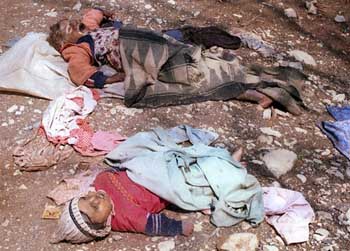
Aftermath of Iraqi Chemical Weapons Attack on Kurdish village of Halabja in 1988 that killed up to 5000 civiliansRecent statements by U.S. President Barack Obama and Secretary of State John Kerry portend a forceful American response to the Syrian government’s alleged use of chemical weapons.
It is worth noting that this is not the first, nor anywhere near the most significant alleged use of chemical weapons in the Middle East, or even by the Syrian regime. As CAMERA previously described, the use of chemical weapons by Arab regimes goes back to the 1960s with the Egyptian intervention into the civil war in Yemen. Saddam Hussein used chemical weapons against Kurdish civilians in Iraq and current Syrian President Bashir Assad’s father allegedly used them against rebellious citizens of Hama in 1982.
Back then coverage of the use of these weapons was limited. Today, with cellphone cameras and Twitter, images of the immediate after-effects of a chemical weapons attack have flooded the Internet. The ability of the media to magnify or diminish conflict is once again evident.
The Israeli-Palestinian conflict offers a classic example of disproportionate media amplification of a conflict. As CAMERA has documented, the media’s fixation over many years on the Israeli-Palestinian conflict fed the illusion that it was at the core of the region’s instability. This exaggerated media attention pressured government officials to prioritize activities addressing the Israeli-Palestinian conflict.
Media attention on the Syrian regime’s use of chemical weapons is certainly warranted, but the outcry and call for action again demonstrates the influence the media has in shaping our views on the relative importance of conflicts and in motivating action.
August 26, 2013
The Tripod: CAMERA Links in Three Languages — August 25-26
BBC Arabic reports on Syrian patients in Israeli hospitals – but not in Arabic
After months of ignoring the subject of Syrian patients being treated in Israeli hospitals, the BBC finally got round to reporting the story – but not to its Arabic Service audiences. (BBC Watch)BBC describes known terror finance man as ‘activist’
A senior Palestinian Islamic Jihad official with a record of terror financing is described by the BBC as an ‘activist’. (BBC Watch)Israel’s most deadly war?
There are historical facts, and there are Gidon Levy’s facts. (Presspectiva)3rd time’s a charm: CiF Watch prompts correction to Telegraph “correction” on refugees
After two unsuccessful attempts, The Telegraph finally published accurate information on the number of Palestinian refugees from the 1948 war. (CiF Watch)The Little Activist that Could
A Canadian student’s reflections on the CAMERA Training Conference: “The day before my flight to Boston for training, I almost backed out. . .” (In Focus)Middle East headlines in the Spanish speaking press
Headlines focus on Palestinians walking out of the negotiation process and Israel’s opinión about the Sirian conflict. (ReVista de Medio Oriente)August 26, 2013
Ha’aretz’s Amira Hass Attempts to Justify Her Obsessive Focus

Anyone familiar with Ha’aretz columnist Amira Hass knows that she is obsessive in her hostility toward and vilification of Israel. Her journalistic career focuses entirely on presenting the Jewish state in the worst possible light — as one that continuously harms and plots against Palestinians. And she let no facts get in the way of her mission.
A recent column by Hass about a Palestinian widow who was supposed to be deported from eastern Jerusalem (but wasn’t) because her temporary residency permit had expired prompted a reader to comment that Hass spends “too much time on trifles.” Given the cruelty with which Arab residents are treated in neighboring countries by their own leaders, the story of an illegal resident who faced deportation but was ultimately not deported does appear to be absurdly trifling. But Hass uses the criticism of her column as yet another opportunity to repeat her condemnation of Israeli authorities for even considering deportation. In a burst of self-righteous fury, Hass justifies her obsession and attacks her critics:
There are those who say Rajbi’s fear of being deported from her home in the Old City of Jerusalem is dwarfed by the suffering of the million Syrian children who have become refugees. Some would even go so far as to say that the history of Israeli domination over the Palestinians is dwarfed by the incomprehensible slaughter taking place in the region. According to that logic, men can tell the women in Israel and Italy not to complain about gender discrimination because their sisters in Africa still suffer the practice of female genital mutilation, while in India, the selective abortion of female fetuses is still widespread. Westernized Jews can tell Arab-Jews and Sephardi Jews that they should stop complaining because they’re doing far better than residents of favelas in Brazil.
Ranking injustices, atrocities and discrimination on a scale of horrors is just one more technique employed by those in power to retain their power, to justify their excessive privileges and to belittle any public or civil struggle for equality.
August 26, 2013
Syria Threatens to Make Israel a Scapegoat

Israelis order gas masks Sunday as threats from Syria grow Israeli daily Yediot Aharonot reports that “that Damascus views Israel as behind the aggression and therefore it will come under fire should Syria be attacked by the United States.”
In an interview for the American radio station Sawa in Arabic, President Bashar Assad’s fellow party member said: “We have strategic weapons and we can retaliate. Essentially, the strategic weapons are aimed at Israel.”
[Syrian Ba’ath national council Halef] al-Muftah stressed that the US’s threats will not influence the Syrain regime and added that “If the US or Israel err through aggression and exploit the chemical issue, the region will go up in endless flames, affecting not only the area’s security, but the world’s.”Similar threats were made by another senior Syrian official, an interview with AP.
Meanwhile, a senior official for the Syrian rebels blamed Israel “for giving the Syrian regime ‘diplomatic cover’ ” and declared that Israel must urge world intervention in the Syrian war if iit “wants to show the Syrian people it is not assisting the Syrian regime and the Syrian terror.”
The Algemeiner reports a huge Israeli increase in demand for gas masks on Sunday as the possibility of a military intervention in Syria became more likely.
August 23, 2013
The Tripod: CAMERA Links in Three Languages — August 22-23
BBC documentary on Tel Aviv gay pride fails to keep up with the news
A BBC World Service radio documentary on Tel Aviv’s Gay Pride parade paints a picture two months out of date . (BBC Watch)Inaccuracy corrected in one BBC Rouhani article, left standing in another
Two BBC articles made the same erroneous claim but, following complaints, the BBC corrected only one of them . (BBC Watch)Telegraph revision to false claim on Palestinian refugees is still misleading
Despite a revision made by editors at The Telegraph to a story which grossly inflated the number of Palestinian refugees from the 1948 war, the passage in question still fails to accurately convey the accurate number of refugees. (CiF Watch)Setting the Pace to Finish a Marathon
What You Missed at the CAMERA Student Leadership and Advocacy Training Conference. (In Focus)My Life Has Taken an Interesting Turn
A Students’ Reflections from the CAMERA Student Conference. (In Focus)







Search:
Search this site: