
Recent Entries:
Month: May 2010
May 23, 2010
Another Inaccurate Report from Gaza MD Officials

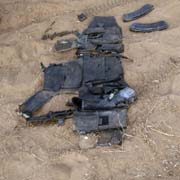
Weaponry found on the two Gaza fighters killed Friday (photos from IDF)Continuing a pattern earlier seen here and here, Gaza medical officials continue to feed the media inaccurate information about casualties. The Palestinian Maan News Agency reports:
Two teenage Gaza residents were killed by Israeli forces as they snuck out of the Strip allegedly looking for work, Palestinian medics said on Friday.
Yet, the report also says that both the Israeli military and Islamic Jihad agree that the two were armed fighters involved in a clash:
An Israeli military spokeswoman said the two dead were identified as armed by troops, and killed in an exchange of fire with Israeli forces “right next to Nirim,” an Israeli moshav in the western Negev.The spokeswoman thus confirmed reports by the operations room of the de facto government, which said “two resistance fighters were killed on the scene.”
De facto government officials had described “fierce fighting” in the Khan Younis area, and Islamic Jihad said its Al-Qassam fighters clashed with Israeli forces but reported no injuries. . . .
The Al-Quds statement said that at 1:40 in the afternoon “a group of affiliates fought back Israeli forces that had suddenly approached the area east of Al-Faraheen in the Khan Younis district,” and reported an exchange of fire.
The IDF released additional photos of the weaponry found on the two fighters.
May 21, 2010
On the Need to Confront Lies
Melanie Phillips in a recent interview touches on a topic near to the heart of many readers of this blog:
Jew-hatred, as I prefer to call it, can surely never be eradicated. But the lies that currently fuel it — lies about Israel’s behavior, the history of the Middle East, and so on — should be publicly confronted and exploded. Similarly, the ways in which the blood libels about the Jews pouring out of the Arab and Muslim worlds are poisoning minds not just in that world but in the West should also be prominently discussed …
Doing so, she argues, opens the door to reaching those who aren’t by nature bigoted against Israel, but have been indoctrinated with unchallenged falsehoods.
May 18, 2010
All the News That’s Fit to Print at the New York Times?

Update: The Times did publish an article on the subject the day after this post went up. The piece did not make it into its internet listing until today. The fact that it took several days for the paper to publish this account contrasts with the focused coverage of Israel’s decision to deny radical anti-Israel activist Noam Chomsky entrance to the West Bank. However, that said, it is worth reading the posted piece to notice the tone, which gives weight to the Hamas argument of the importance of upholding the law and not allowing unapproved building on state land. Is this balanced tone different from how the Times handles the plethora of articles on Israeli demolitions of Palestinian homes? Even the article’s title suggests ambivalence.
Original Posting
The New York Times relentlessly shines a bright light on any Israeli practice that it finds objectionable. With all its coverage of Israeli demolitions of Palestinian homes, it is curious that a recent news item about Hamas demolishing the homes of Gazan residents apparently did not make it into its coverage.A Reuter’s report recorded the responses of several Palestinians whose homes were destroyed by Hamas,
Issa Al-Sdodi, an employee of the previous Fatah-led administration, said Hamas policemen accompanied by bulldozers knocked down his three-storey house without advance notice.
“I put my savings into building it and now my family of 10 is homeless,” Sdodi told Reuters.Fatheya al-Ghezawi, 52, sat in the sand with her daughter near the rubble of her home, which had housed her family of 15.
She said she fled Gaza city last year after the house she had been renting was destroyed by Israeli forces. “This time, it wasn’t the Jews. It is Islam against Islam,” Ghezawi said.
The Associated Press reported on May 16, 2010
Hamas police wielding clubs beat and pushed residents out of dozens of homes in the southern Gaza town of Rafah on Sunday before knocking the buildings down with bulldozers, residents said.
Some 30-40 homes were reportedly knocked down after being declared illegal by the Hamas government.
Apparently the “paper of record” did not feel this was newsworthy as an on-line search of New York Times news items on the Middle East did not turn up any report on the Hamas demolitions. It did however, give extensive coverage to anti-Israel activist Noam Chomsky being denied entry into the West Bank, to a Palestinian youth who was shot by a settler during a stone throwing incident, to a story critical of Israel’s maintenance of mine fields at its borders, to a story of two Arab “activists” arrested for collaborating with Hezbollah and to yet another story about how there are American Jews who do not support Israeli policy.
May 17, 2010
Hass’ Mea Culpa

In a rare acknowledgment of error, Ha’aretz‘s Amira Hass today acknowledges that an earlier report she wrote was mistaken, thanks to her Palestinian source who lied:
A mistaken report needs to be corrected. Two weeks ago I wrote about a young man who claimed he was expelled from the West Bank to Gaza. He was born in Gaza but had lived in the West Bank since he was 7, he said. The military spokesman’s office informed me that it was not familiar with the case, but I’ve heard that line before – for example, in reference to Palestinians who were used as “human shields” during Operation Cast Lead. The fact that the army says it doesn’t know about an incident doesn’t mean such an incident hasn’t taken place.
But this time, it turns out that there was no evasive maneuver here, and there was a real reason this case was unfamiliar to the Israel Defense Forces: The young man has lived with his family in Israel for many years. And it was from Be’er Sheva, not the West Bank town of Dahariya, that he was expelled. For him, the lie he told reporters, myself included, is perhaps a fraction of a lie. After all, the distance between Dahariya and Be’er Sheva is small, the borders are artificial, the lifestyle is similar, relatives live on both sides of the Green Line. But as far as I am concerned, his tale is a full-fledged lie that piggybacked on the great media interest, the first of its kind, in the situation of Gaza natives who live in the West Bank.
Over the last few months, all sorts of rumors were disseminated, but were easy to spot right away as being totally unfounded: the rumors that 20 Palestinians were expelled as a single group to Gaza, that a Shin Bet questionnaire was distributed in four homes of native Gazans, that dozens of deported Palestinians were gathered in a protest tent in Gaza. These false rumors came on the heels of a Haaretz report about an amended military order, No. 1650, that is aimed at preventing infiltration into the West Bank.
May 17, 2010
Former PLO Ambassador Calls Arab Journalist ‘Traitor’

Abu Toameh: Accused of being a ‘traitor’ for reporting on Palestinian corruption and violenceThe Australian reports that Ali Kazak, a former PLO Ambassador to Australia, has labeled Israeli Arab journalist Khaled Abu Toameh a “traitor” for reporting on Palestinian corruption and violence::
Ali Kazak, a former ambassador for the Palestine Liberation Organisation, circulated an email this week accusing Abu Toameh of being an “Israeli propagandist” on the “Israeli payroll” and warning people not to be misled by him.
Kazak told The Australian: “Khaled Abu Toameh is a traitor.” These are dangerous words in the context of the Israeli-Palestinian conflict, and Kazak admits that many Palestinians are murdered in the West Bank and Gaza for being traitors.
He says he doesn’t agree with it but: “Traitors were also murdered by the French Resistance, in Europe; this happens everywhere.” . . .
Toameh responds: “It is absurd that this gentleman is calling me a traitor while the PLO whom he claims to represent is conducting security co-ordination with Israel and helping Israel crack down on Hamas and is even imprisoning Palestinians without trial in the West Bank. . . .
“. . . When he calls me a traitor he is actually sending a message to extremists that they need to kill me simply because I am demanding reform and democracy.”
This is not the first time that Abu Toameh, who writes for the Jerusalem Post, was threatened for covering stories that the Palestinian Authority would prefer to remain quiet. The Israeli Arab journalist also covered a major Palestinian corruption scandal earlier this year which was largely ignored or downplayed by the Western media.
For more on Palestinian intimidation of the media, see here, here and here.
May 17, 2010
NY Times Public Editor Weighs in On Jerusalem Terminology
Clark Hoyt, public editor of the New York Times, discusses the labeling of Jewish neighborhoods in Jerusalem located over the 1949 armistice line (Green Line) as settlements:
No subject arouses reader passion more consistently than the Israeli-Palestinian conflict, and The Times navigates a semantic minefield with almost every story on the subject. When Cooper wrote this month about a lunch that Obama had with Elie Wiesel, the Nobel laureate and Holocaust survivor, she said the president was trying to mend fences with American Jews upset at the administration’s stance against construction of “Jewish settlements in East Jerusalem.”
Nathan Dodell of Rockville, Md., said it was “tendentious and arrogant” to use the word “settlements” four times in the article when the Israeli prime minister, Benjamin Netanyahu, has explicitly rejected it in relation to East Jerusalem. Obama has used the term himself to refer to construction in East Jerusalem, and Cooper told me, “I called them settlements because that’s the heart of the dispute between the Israelis and the United States: settlement construction in Arab East Jerusalem, which the Palestinians want for an eventual Palestinian state.”
But to Dodell, she was taking sides. He asked why she didn’t use a neutral term like “housing construction.”
Settlement is a charged word in this context, because it suggests something less than permanent on someone else’s land. Israel argues that all of Jerusalem is its undivided capital, a claim not recognized by the United States and most of the world. Articles by Times reporters in Jerusalem do generally use words like “housing” instead of “settlement.” Still, Ethan Bronner, the bureau chief, said it would be unwise to adopt a hard and fast rule, because some areas of the city taken by Israel in 1967 had long been Jewish neighborhoods while others, built more recently, had the feeling of settlements.
I think Cooper should have found a more neutral term.
(Hat tip: Yisrael M.)
May 16, 2010
New Revelations about Old City in Ha’aretz Editorial

Ha’aretz: The Jewish Quarter is a “disputed area disputed area . . . on the agenda during negotiations with the Palestinians”Ha’aretz readers were treated to an eye-opening editorial on Thursday about the Israeli government’s alleged incitement concerning Jerusalem. The prime example of governmental incitement, according to the esteemed Ha’aretz editors, is the following:
The greatest achievement of all, however, belongs to Education Minister Gideon Sa’ar, who has doubled the number of schoolchildren visiting the Temple Mount and the City of David, from 200,000 two years ago to 400,000 since the start of the current school year. Under a new program drafted by the Education Ministry on the minister’s orders, students are obligated to visit Jerusalem at least three times during their 12 years of school.
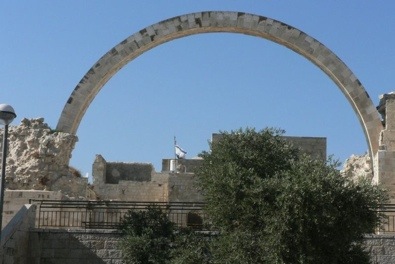
In theory, there is nothing wrong with this. Yet the visits tend to focus on sites like the Old City’s Jewish Quarter, the Western Wall tunnels, Zion Gate and the archaeological excavations of the Temple Mount’s southern wall – all disputed areas that are on the agenda during negotiations with the Palestinians, and are also associated with new Jewish settlement in East Jerusalem. Moreover, the tours, which are led by guides from the extreme right-wing organization Elad, blatantly ignore the Palestinians’ existence and bear the clear stamp of religious nationalist indoctrination.
Got that? At Planet Ha’aretz, the Temple Mount, where the First and Second Jewish Temples stood thousands of years ago, as well as the Old City’s Jewish quarter, including the Western Wall, and the southern wall of the Temple Mount, where Jews slowly ascended the steps to reach the Temples and bring their sacrifices, are not associated with the heart and core of Jewish history and religious identity, but rather “with new Jewish settlement in East Jerusalem.” Equally eye-opening is the revelation that the Jewish Quarter is a “disputed area . . . on the agenda during negotiations with the Palestinians.”
No wonder the editorial was approvingly reproduced by the American Task Force for Palestine.
(more…)May 16, 2010
National Geographic Parting With the Truth
Uri Goldflam blogs at CIC Scene about the “inaccuracies and downright lies” in the April 2010 National Geographic article “Parting the Waters.” Goldflam writes:
To drive the message [about Israel allegedly stealing Palestinian water] home – a picture of the dried up, sunburnt village, a deserted greenhouse and a line about the swimming pools at the Jewish settlements. Nice work NG.
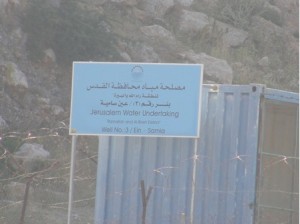
Indeed, Auja does dry up every summer. The picture below shows why:

Sign at Auja
A 2,000-foot-deep well doesn’t affect top-water. But this does. The blue and white sign reads: Jerusalem Water Undertaking, Ramallah and Al-Bireh District. Well no. 3/ Ein Samia. The water of Ein Samia is captured and transferred – to Ramallah. Ein Smia is the source of the Auja stream that feeds the village Auja. If you guessed that the well is Palestinian – you guessed right.
Goldflam raises additional worthy points, and readers should also know that Palestinians — not only Jewish settlers — also having swimming pools, a fact ignored by NG.
May 12, 2010
Muslim Student Supports Gathering Jews in Israel to Murder Them
During an exchange following a speech by David Horowitz at the University of California in San Diego, a member of the Muslim Student Association, when questioned whether she supported Hezbollah leader Hassan Nasrallah’s stated desire to gather all the Jews in Israel in order to facilitate murdering them, responded that she was “For it.”
The student had initially posed a question to veteran political activist Horowitz, to which Horowitz responded by saying,
I’m a Jew. The head of Hezbollah has said that he hopes that we [Jews] will gather in Israel so he doesn’t have to hunt us down globally. For or against it?
The student responded,
For it.
If one wonders what sort of environment fosters such banal hatred, consider this response from a commenter named A. Casavantes who claims to be her teacher at the university. A. Casavantes writes,
This girl is actually my student; I know her to be an intelligent, moral young woman who believes in peace. I do not support any organization that advocates violence against any specific group, nor do I believe that my student would do so. As a peace loving, Catholic teacher, I’m saddened that this speaker–her elder–manipulated the conversation in this fashion to make her look like someone she isn’t, out of an egotistical desire to prove his own point, rather than engaging in a constructive dialogue. A perfect example of why the peace process is limping foward so painfully.
Apparently in the moral universe inhabited by A. Casavantes, people who unflinchingly assert they support the mass murder of Jews should be engaged in constructive dialogue, while those who expose their views deserve criticism.
May 12, 2010
Gil Troy Addresses “Narrative Imbalance” on Jerusalem
In a recent blog post, McGill professor Gil Troy does a good job trying to explain, for those who might not understand, Eli Wiesel’s (and others’) passionate feelings about Jerusalem.
While doing so, he mentions a “narrative imbalance” about the holy city:
Unfortunately, if Jews celebrate their eternal ties to Jerusalem — or dare question Palestinian ties — they are deemed racist. Yet those who question Jewish ties to Jerusalem get human rights awards and EU grants, especially if they are Jewish. This narrative imbalance is another form of asymmetrical warfare.
Although he was speaking generally, that pithy description could very well be describing the Economist. As we recently noted, an editor’s attempt to defend the magazine’s recent distorted article on Jerusalem in fact served to deepen the magazine’s one-sided understanding of Jerusalem:
Rather than address the article’s unfair double standards, or CAMERA’s complaints about the consistent Palestinian denial of Jewish heritage in the Holy Basin, the editor chose instead to underscore Palestinian propaganda points. He insisted that promoting “Israeli claims to its holy places” and educating Jewish youngsters about Jerusalem’s Jewish history is “worthy of comment” – apparently more so than anything Palestinians have done to deny Jewish heritage. His response went into considerable detail about Israeli “ideologues” supposedly in cahoots with the government and involved in “Temple-related activity”:
Temple-related activity has increased in recent years sponsored by official and semi-official agencies promoting Israeli claims to the eastern part of the city and its holy places. These include the Western Wall Heritage Foundation, a government-run association, which seeks to “preserve and develop the Western Wall and its Tunnels, and to develop educational frameworks that make Jews everywhere feel closer to Jerusalem” and…to the Temple Mount. Its e-learning website includes an interactive programme in which “the child ‘builds’ the Temple on the Temple Mount”. Visitors to its tunnels…are similarly treated to models of a reconstructed Temple in place of the existing mosques…
The implication that it is an affront to Palestinians, and therefore wrong, to expose Jewish students to a historical reproduction of the Jewish Temple, to teach them how the Temple was constructed, or to encourage a Jewish connection to Judaism’s holiest site is extremely disturbing. Are Jews not entitled to be connected to their heritage and central religious tenets?
Similarly, the editor’s implied criticism of the Elad Association’s stated dedication to “continuing King David’s legacy and strengthening Israel’s current and historic connection to Jerusalem” through archeological excavations, among other initiatives, demonstrated a lack of regard for Jewish heritage.
By conveying the attitude that it is somehow sinister to strengthen Jewish knowledge about and connection to Jerusalem, the editor reflected the article’s double standards, where Palestinian rights and connection to the Holy Basin are a given, but Jewish rights and connection to the area are considered a threat.


Search:
Search this site: