
Recent Entries:
Month: May 2010
May 11, 2010
How Long Will Goldstone Keep Lying?

Wednesday of last week Yediot Achronot published a promotional piece for a bigger upcoming article which ran in the weekend magazine. The subject: Richard Goldstone’s past as an apartheid era South African judge who sentenced prisoners to death.
Ha’aretz was apparently perturbed by the upcoming negative publicity concerning His Honor and decided to preempt with an antidote of its own. Akiva Eldar conducted a phone interview with Goldstone which was published, no less, than on page 2 of the newspaper. The concerned Eldar permitted Goldstone to speak out against the articles attacking him, and in the process, allowed him to justify once again his report following Cast Lead.
According to the Hebrew version of the article, but for some inexplicable reason not the English version, Goldstone reportedly repeats his tired claim:
There were no facts which contradicted any important detail in the report. There were many marginal arguments, but no one — not the government of Israel and not any other party — discredited the main findings. (CAMERA’s translation.)
Marginal arguments? Not one source discredited him? Is he for real?
(more…)May 11, 2010
WSJ Relocates Israel’s Capital
Gerald Seib, Washington bureau chief for the Wall Street Journal, has relocated Israel’s capital to Tel Aviv. In a May 4 column, he writes:
None of this means there aren’t real strains between Washington and Tel Aviv over settlements in the West Bank, or over the value of a robust Arab-Israeli peace process to the broad American effort to knit Arab states into a coalition opposing Iran.
In fact, the strain between Israel and the United States over settlements in the West Bank has taken place between Washington and Jerusalem, where the Prime Minister’s office is located, not to mention the Knesset, the Supreme Court, and the Foreign Ministry.
The Boston Globe has in the past corrected this very same error (see below), and so should the Wall Street Journal.
Error (Boston Globe, 7/14/03): The refugees and many other Palestinians publicly say there can be no peace with Israel until Tel Aviv recognizes the refugees’ right to return.
Correction (7/17/03): Because of an editing error, a story on a Palestinian protest in Monday’s World pages incorrectly suggested that Tel Aviv is the capital of Israel. The capital is Jerusalem.
May 11, 2010
Ha’aretz‘s Marcus: Golan, “Simply a Lovely Area,” Devoid of Jewish History
While Op-Ed writers are certainly entitled — and should — voice their opinions for or against Israel’s relinquishing of the Golan Heights to Syria, they are not entitled to misrepresent history. Ha’aretz’s Yoel Marcus did just that in his column today, “Peace with Syria is more urgent,” in which he erases thousands of years of Jewish history in the Golan Heights. He writes:
The price tag is clear. It’s the Golan Heights. But unlike the places to be discussed in proximity talks and direct negotiations with the Palestinians, the Golan is not a holy site. Neither Abraham our patriarch nor Sarah our matriarch are buried there, and returning it for peace would not involve all those messianic emotions with which the Greater Land of Israel people are imbued. It’s simply a lovely area.
Simply a lovely area, and not for example, an area that Moses allotted to half the tribe of Menashe in the earlier biblical period. Also before 953 BCE, the city of Golan was set aside as a city of refuge for alleged murderers awaiting trial and served as a Levitical city for the family of Gershon. In the first Temple Period, the city was seized from Jewish control by the Aramean king, but reconquered by King Joash in 784 BCE. The region was then conquered by the Assyrian emperor, who exiles the Jews, who returned again to the Golan during the Second Temple Period.
In 30 BCE 30-20 King Herod gradually acquires all of Bashan from Emperor Augustus. Jews from Palestine and Babylonia settle in Bashan and again declare the area a part of the Land of Israel. In 67 CE, Josephus commands the Jewish army in the region during the Great Jewish Revolt. Gamla, the chief city in the Golan, is the last stronghold against the Roman Legions. Jewish settlement, however, continues and even thrives following the failed revolt.
Modern archeological finds dating from the Talmudic period include remnants of 25 synagogues and Jewish artifacts from more than 100 sites in the region. Jewish settlements are completely wiped out following the Islamic conquest until Jewish resettlement takes hold in the 1880s.
A lovely place, yes, with a few thousand years of Jewish history to boot. See here for CAMERA’s complete Golan timeline.
May 9, 2010
Globes Interviews Asserson of BBC Watch
The Globes interviews attorney Trevor Asserson, founder of BBC Watch, who has recently published his seventh study about BBC’s coverage of the Palestinian-Israeli conflict. Among the study’s findings is the following:
According to the study, out of 22 days on which the diary [of Jeremy Bowen, head of the BBC’s Mideast division] was published [during Cast Lead], only two days included balanced reports. “A soldier in the IDF spokesperson’s unit told me that during an inspection of humanitarian aid going into Gaza, they found night vision equipment that was meant to help Hamas see IDF soldiers. It was hidden among the food. They called Bowen and said to him, ‘Look, that’s why Israel is suspicious of the humanitarian aid.’ He refused to broadcast it. He said there was no story. There can be no explanation for that other than that he is biased.”
For CAMERA’s material on BBC, see here.
May 6, 2010
Abbas on Hamas Threat in West Bank

Hamas fighters relax in PA building after Gaza takeover Too often, the media fail to acknowledge that Israeli wariness about possible changes to the West Bank status quo is, to a great extent, tied to concerns over the what could become of the territory after those changes. Hamas took over the Gaza Strip after Israel withdrew, and turned the territory into a large rocket launching pad. It would be catastrophic if the same happened in the West Bank.
Although indirectly, Palestinian leader Mahmoud Abbas brought this issue to the foreground yesterday, and news organizations took note:
The Palestinian president on Thursday accused Hamas of smuggling large amounts of weapons into the West Bank as part of the militant group’s efforts to undermine his administration.
President Mahmoud Abbas’ his swipe at his Hamas rivals comes at a sensitive time, with the Palestinians divided between rival governments and U.S.-brokered indirect peace talks with Israel getting under way. Abbas said his security forces have confiscated most of the smuggled weapons.
Hamas seized control of the Gaza Strip from Abbas’ forces three years ago, and the two factions have been at odds since. Israel fears Hamas could also stage a violent takeover in the West Bank, and those security concerns, along with the Palestinian factions’ failure to reconcile, are likely to be key issues in the new round of peace talks.
In a newspaper interview published Thursday, Abbas accused Hamas of undermining efforts to reconcile the two factions by challenging his administration’s power in the West Bank.
“What they are doing is smuggling weapons and explosives and storing them in the West Bank,” he told the London-based Arabic paper Sharq al-Awsat. “On a daily basis, we find caches of weapons and big amounts of explosives.”
Read the entire AP piece here.
May 4, 2010
Ha’aretz, Holier Than the Pope

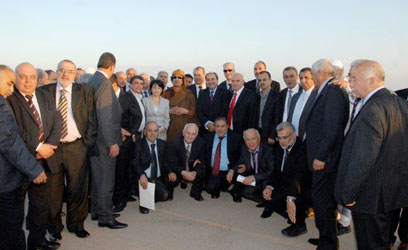
Ha’aretz‘s reaction to the visit of an Israeli Arab delegation with Libyan leader Muammar Gadhafi revealed just how tenuous the media outlet’s grip on reality is. The delegation’s harsh condemnation by those on the right of the Israeli political spectrum was apparently too much for the editors of Ha’aretz, who promptly spoke out to defend the Arab delegation and to attack those who dared criticize it.
An April 30 editorial (“Arab MK’s Libya Trip a Path to Mideast Peace”) stated:
Hysteria gripped the right wing in the Knesset after an Arab delegation of MKs and dignitaries visited Libya. . . .The tongues of Habayit Hayehudi and National Union, two parties that could unite under the name “the Racist Union,” were abruptly unleashed as though they were dealing with an unparalleled act of treason. . .
Libya is not on the list of enemy states. . . Libya signed the Arab League’s peace initiative, holds the League’s rotating presidency, and its ruler Muammar Gadhafi maintains excellent relations with the U.S. administration.
Following the depiction of Libya as one of the most important and enlightened countries in the world, the editorial writer explains to us, the ignorant readers, the motive and the justice of the Israeli Arab visit:
(more…)


Search:
Search this site: