
Recent Entries:
Month: October 2015
October 14, 2015
Where’s the Coverage? Hamas Official Calls for Attacking Israeli Embassies Overseas
A former senior Hamas official, Khalel Abu Hilal, called for terrorist attacks on Israeli embassies in the United States, Europe and the Middle East in an Oct. 8, 2015 speech that aired on Qatari-owned network Al-Jazeera. Hamas, the Palestinian Islamic Resistance Movement, is a U.S.-designated terrorist organization. Despite numerous recent attacks against Jews in Israel, Europe, and the U.S.—including a Molotov cocktail thrown at Jews in New York City—major new media outlets failed to note Hilal’s incitement. This is all the more surprising given that Hilal, who served as Hamas’ minister of information before becoming leader of the Palestinian Freedom Movement, has personally received attention in the past.
The former Hamas spokesman was quoted at length and profiled as part of a 5,282-word 2007 New York Times article on the rise of Hamas in the Gaza Strip (“A Life of Unrest,” July 15, 2007). That article described Hilal as a “thin, grizzled chain-smoker who sucks in tobacco smoke the way an emphysema patient sucks in oxygen, is at the center of the revolution. His journey,” The Times claimed, “is Gaza’s journey.” He also was quoted by Reuters and in turn by Times Op-Ed columnist Tom Friedman in a profile on Hamas (“Behind the Masks,” June 20, 2007).
Yet, his latest calls for attacks against Israeli embassies and kill Jews abroad, translated by the Middle East Media Research Institute (MEMRI), have received no coverage by either The New York Times or other major U.S. media.
According to MEMRI, Hilal said, “We want [Palestinians abroad] to launch a holy march on all the Zionist embassies, in all the Arab and Muslim countries, as well as in Europe and America. All these embassies must be stoned with holy stones, like Satan is stoned.” This apparently is a reference to a ritual enacted during Muslims’ annual pilgrimage to Mecca.
Hilal offered specifics as to what weapons should be used to commit the attacks. “These embassies,” he exhorted, “should be attacked with Molotov cocktails.” The day after Hilal’s Oct. 9 remarks, two Israeli students studying in New York City were targeted with a Molotov cocktail thrown by unidentified assailants, in a crime currently being investigated by the New York City Police Department (“Israeli Jews Assaulted With Molotov Cocktail in New York City,” Algemeiner, Oct. 12, 2015).
The former Hamas spokesman’s incitement was general:
“Why not target every infidel Zionist, who spreads corruption and depravity throughout the Arab and Islamic land? Why not stab this plundering settler? Why not run over this Zionist in Germany, in Tunisia, in Egypt, or in Jordan? Why not throw stones and Molotov cocktails at him? Why not stab him in his heart?”
Hilal’s statements encouraging violence and murder are hardly his first. He has exclaimed previously, “We have a Legislative Council whose members are martyrdom seekers….We raise our children from kindergarten to love martyrdom.” Hamas and other Palestinian sources including Fatah frequently referred to attacks against Jews in which the perpetrator dies as “martyrdom operations.”
A former high-ranking Hamas official now heading the misnamed “Palestinian Freedom Movement” calls to attack Israelis on foreign soil. Where was the coverage?
The MEMRI clip of Hilal’s remarks can be found here.
October 13, 2015
VOA: Palestinian Wounded by Gas Cylinder
(That She Exploded)
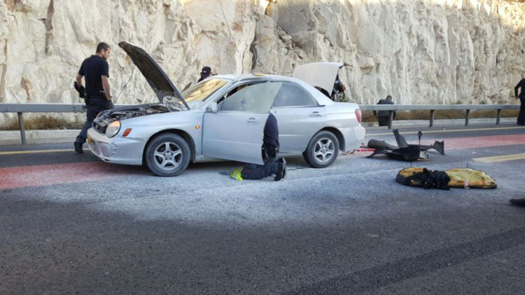
The scene of the A-Zaim checkpoint where a Palestinian terrorist exploded a gas canister, injuring a police officer (Photo: Courtesy of Israel Police)A Voice of America article Sunday casts the Palestinian woman who blew up a gas canister in her car that day, injuring a police officer, as a blameless victim as opposed to the perpetrator responsible for the explosion (“Israeli Airstrike Kills Pregnant Woman and Toddler in Gaza“). The Oct. 11 article distorts:
And a Palestinian woman was seriously wounded when a gas cylinder blew up in her car at a checkpoint outside a West Bank Jewish settlement.
Here’s what actually happened, via Haaretz:
In the Sunday morning attack, a Palestinian drove up to the Al-Zayim checkpoint near the West Bank settlement of Ma’aleh Adumim and blew up a gas canister in her car after a policeman ordered her to pull over. The policeman, 45, was lightly wounded, while the terrorist was hospitalized in very serious condition.
In a separate journalistic failure, the article states:
An Israeli airstrike on Gaza in response to Palestinian rocket fire killed a pregnant Palestinian woman and her toddler daughter. Medics say they died when the building in which they were taking cover collapsed. Several others were hurt.
Nowhere does the article note that the army said it targeted Hamas weapons manufacturing facilities.
October 13, 2015
Al Jazeera Kills Off Wounded Afula Attacker
Al Jazeera English falsely reported yesterday (“Bringing into question Israel’s extra-judicial killings“):
[Mahmoud] Abu Rahma [of the Al Mezan Center for Human Rights in Gaza] referred to another case, saying that Israa Abed, 30, from Afula in Israel, was shot dead by a group of police and soldiers who were two metres away and surrounding her. The Israelis claim she was holding a knife, though this remains unproven.
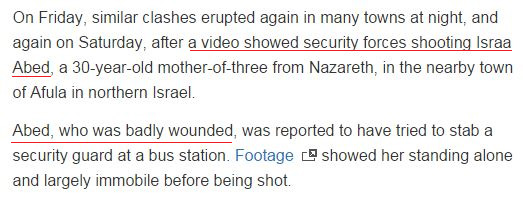
Israa Abed was, wounded, not killed when police shot after she attempted to carry out a stabbing in Afula. As Al Jazeera itself earlier reported:
In the northern town of Afula, a Palestinian woman was shot several times and wounded by police who closed in on her as she held up a knife, a video clip circulated on social media showed. Police said she had tried to stab a bus station guard.
Similarly, a separate Al Jazeera article published the same day as the Al Jazeera piece claiming she had been “shot dead” reported that Abed was “seriously wounded”:

Likewise, Palestinian Maan News Agency reported:
A Palestinian woman was shot and injured after an alleged stabbing attempt in Afula on Friday, Israel’s army and police said.

Stay tuned for an update about a correction.
Update 6:46 EST: Al Jazeera Can’t Get Its Story Straight on The Knife
One of our readers points out that the Al Jazeera story which reported without challenge the false claim by Mahmoud Abu Rahma, of Al Mazen, that Abed was “shot dead” also fabricated: “Israelis claim she was holding a knife, though this remains unproven.”
But, as the second Al Jazeera article notes: ” . . . a Palestinian woman was shot several times and wounded by police who closed in on her as she held up a knife, a video clip circulated on social media showed.”
October 13, 2015
NY Times Source Slams Article on Temple Mount

Prof. Jodi Magness: “I know of no credible scholars who question the existence of the two temples or who deny that they stood somewhere on the Temple Mount”Professor Jodi Magness, one of the scholars quoted — actually misrepresented and exploited — in The New York Times article last week which outrageously called into question the presence of the biblical temples, an allegation that was subsequently retracted — slams the article in a letter to the editor yesterday.
Professor Magness writes:
I am one of the specialists interviewed for “Historical Certainty Proves Elusive at Jerusalem’s Holiest Place” (news article, Oct. 9).
The question of the existence and location of two successive temples on the Temple Mount in Jerusalem is not nearly as contested as the article suggests.
Literary sources leave little doubt that there were two successive ancient temples in Jerusalem dedicated to the God of Israel (the first destroyed in 586 B.C., and the second in 70 A.D.). These sources and archaeological remains indicate that both temples stood somewhere on the Temple Mount.
The only real question is the precise location of the temple(s) on the Temple Mount. The site of the Dome of the Rock is the most likely spot for various reasons, despite the lack of archaeological evidence or excavations. I know of no credible scholars who question the existence of the two temples or who deny that they stood somewhere on the Temple Mount.
JODI MAGNESS
Chapel Hill, N.C.
The writer is a professor specializing in early Judaism at the University of North Carolina, Chapel Hill.October 12, 2015
NPR Guest Draws Attention to Israel’s Water Solutions

(This post was updated on Dec. 8, 2015)
On Oct. 7, 2015 Seth Siegel, the author of a new book examining Israeli responses to chronic water shortages, Let There Be Water: Israel’s Solution For A Water-Starved World, was a guest on National Public Radio’s nationally-syndicated Diane Rehm Show. Despite some attempts to shift the conversation in an anti-Israel direction by Rehm, whose biases CAMERA has documented (for example “NPR’S Diane Rehm Plays Gaza Wild Card: Herself,” July 22, 2014), the segment offered considerable information on Israeli achievements in water conservation.
Peter Gleick of the Pacific Institute and Patricia Mulroy of a D.C.-based think tank, the Brookings Institution, joined Siegel on Rehm’s show.
After a brief discussion on water scarcity, Rehm turned quickly to the Arab-Israeli conflict by asking her guests what role water played in it.
Gleick noted that “Israel and Jordan signed a peace treaty almost two decades ago and water was a component of that agreement and they’re working, not always successfully, but they’re working to try and deal with the limited water they have and to find joint solutions to reduce the risk of conflict.”
Siegel pointed out that Israel provides education courses in water technology and engineering for water managers and water engineers “in the West Bank and previously Gaza.” The author asserted this Israeli act created an “opportunity for dialogue” that’s “quite remarkable and quite wonderful.”
Rehm responded with, “And yet, you call Gaza City one of the least water secure places in the world.”
Siegel agreed but pointed out the real culprit for Gaza City’s water insecurity: Hamas, the U.S.-listed terror group, which has ruled the Gaza Strip since its election in 2006. Water scarcity in Gaza was the result of “ideology” and “government incompetence on the part of Hamas” resulting in water being “woefully mismanaged,” Siegel said. The author noted that both Israel and the Gaza Strip have the same climate and topography, yet Israel’s water security and quality are vastly greater. Siegel observed that these differences in water were the result of choice, not circumstance.
“Gazans could be enjoying something very similar,” he observed, “were they to agree to get into a compact of some kind with Israel in terms of developing the water resources from the Mediterranean or otherwise.”
Perhaps not satisfied with Siegel’s answer, Rehm asked Gleick of the Pacific Institute for his thoughts on the “relationship on water between the Israelis and Palestinians.”
Gleick characterized it as a “serious political problem” in that “Israel and the Palestinians do not agree about water. There is serious mismatch in control over access to resources.” He failed to inform listeners that this “mismatch” was the result of Palestinian Arab seeking to destroy the Jewish state instead of learning from and working with it.
Siegel made this point when responding to a question from a program listener. He noted that Gaza’s water situation is the result of “poor governance” that allows illegal well drilling, unregulated agricultural, avoidable flooding and sewage-dumping. “The solution,” Siegel asserted, is a “partnership with Israel, and Israel has shown repeatedly a desire to do that, but ideology gets into the way….”
Siegel observed that Israel sends a “significant amount” of water to the Gaza Strip every day and is even ready to use its own desalination plants and to buy sewage from Gaza and “treat it in the Western Negev so that its farmers there can reuse it [for irrigation] as they do Israeli sewage….So the solution is actually right at hand. It’s easy to do. But you need to have a situation where Hamas, which has a rejectionist ideology, needs to come to terms with serving their people best.”
Writing in The Washington Times, journalist Clifford May(December 2, “Unexpected Miracle in the desert”) also notes Israeli solutions to water scarcity. Referencing Siegel’s book, May notes that the Jewish state has succeeded in a task many previously may have considered to be impossible: making water more plentiful in a part of the world where it is a rare commodity.
Israeli solutions to vexing water issues confronting the globe are “right at hand”—for those who want them.
A transcript of this segment of the Diane Rehm Show can be found here.
CAMERA’s backgrounder on Israel and water issues (“Does Israel Use ‘Palestinian’ Water?” July 1, 2001) can be found here.
October 12, 2015
Bombings in Byzantium

More than 100 people died in a horrific bombing on Saturday, October 10, in Ankara, Turkey. The Turkish President, Recep Tayyip Erdogan, blamed the Islamic State. The Western media and governments have mostly gone along with his assignment of responsibility. But there is as yet no clear evidence identifying the perpetrators.
The victims of the bombings were Kurds. The Kurds are deeply suspicious of Erdogan and his party, the AKP, who are maneuvering to reverse the setback they suffered in elections in June when the Islamist party lost its majority. Erdogan has called for November 1 elections. Suspicions intensified when in the wake of the terrorist attack Turkey immediately launched air strikes against the PKK, a militant Kurdish group based in Iraq and Syria with which Turkey has been at war for several decades. The PKK has recently expressed willingness to abide by a cease-fire with Turkey.
Meanwhile, on the Turkish side, some have even suggested that the terrorist bombing was the work of the PKK in order to stir unrest within Turkey.
The bombings on Saturday targeted a peace rally of Turkish Kurds, who are in opposition to Erdogan’s government. A Kurdish party gained parliamentary representation for the first time in the June elections helping to undermine Erdogan’s parliamentary majority.
Historical context here is helpful. Recent history has not been kind to the Kurds. After the collapse of Ottoman rule, the Kurds were the odd-man-out in the region as the Arabs, Turks, British and French carved up the former provinces of the Turkish empire. More than 40 million Kurds are spread out over Turkey, Syria, Iraq and Iran. Despite the fact that Kurds can trace their identity as a distinct people back many centuries, they have been denied autonomy and have been victimized by the regimes that rule over them. Comprising more than 20 percent of Turkey’s population, Kurdish aspirations are viewed as a particularly serious threat by the Turkish majority.
The carnage on October 10 is the most recent and worst of a series of bombings targeting Kurdish peace activists this year alone. The bombings occurred within the context of heightened conflict between the Turkish government and Kurds, both in Turkey and in neighboring Iraq and Syria. Turkey is unyielding in its opposition to the creation of a Kurdish state on its borders. The Kurds accuse the Erdogan government of using the war against ISIS as a pretext to intensify attacks on Kurdish enclaves in Iraq and Syria.
Erdogan has been portrayed as scheming to restore the Ottoman empire, with himself at the helm. However, the inscrutable nature of contemporary Turkish politics, characterized by accusations, counter-accusations and suspected subterfuge, is a reminder that before the Ottomans arrived, this was the heartland of the Byzantine empire, seated in Constantinople, where political duplicity got its name.
October 12, 2015
AFP Headline Fumbles, Drops Palestinian Bombing
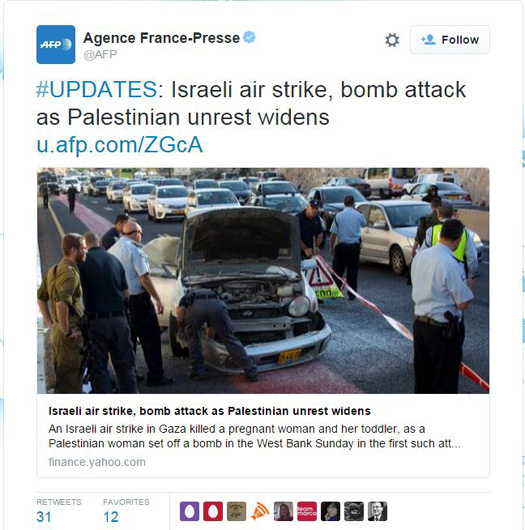
An Agence France Presse headline yesterday attributes a bombing attack, carried out yesterday morning by Palestinian Asra Jabas at a checkpoint near Jerusalem, to Israel:

The casual reader who glances only at headlines and does not read the accompanying story would believe that Israeli carried both a bomb strike and a bomb attack.
Following CAMERA’s communication with AFP, editors updated the story with a new headline, opting to omit the bombing entirely, rather than noting that it was carried out by a Palestinian.

October 11, 2015
LA Times Headline: When Palestinian Violence Becomes ‘Israeli Violence’
Oct. 14 Update: LA Times Corrects Headline, Article on Palestinian Terrorism
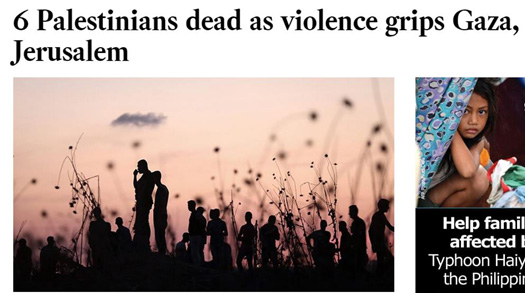
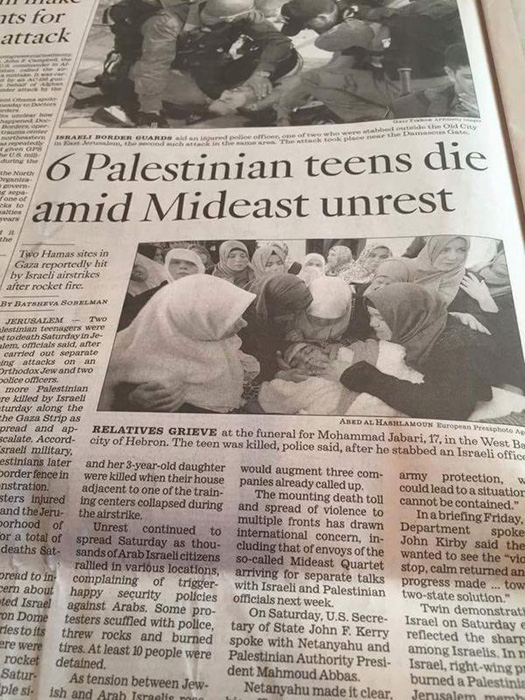
Flipping reality on its head, a Los Angeles Times headline online earlier today absurdly declared: “4 Palestinians are killed in Israeli violence.”

The Los Angeles Times is just the latest in a string of media outlets to depict the Palestinian perpetrators of terror attacks as victims.
As the accompanying article reported, two of the Palestinian fatalities were killed as they stabbed Israelis. In other words they were killed after they perpetrated what some would call “Palestinian violence”:
Two Palestinian teenagers were shot to death in Jerusalem on Saturday, officials said, after they carried out separate stabbing attacks on an ultraorthodox Jews and two Israeli police officers.
Two more Palestinian teens were killed by Israeli forces Saturday along the border of the Gaza Strip as violence spread and appeared to escalate. According to the Israeli military, scores of Palestinians later breached the border fence in a violent demonstration.
Editors have since only very marginally improved the headline:

But readers who only glimpse the newer headline, and don’t get as far as the actual story, would have no idea that two of the dead Palestinians carried out stabbing attacks against Israeli civilians and police in Jerusalem.
Also, in a factual error, not one, but two ultraorthodox Jews, were stabbed near Damascus Gate yesterday. According to Haaretz (print edition today):
Yesterday four Israelis — two police officers and two civilians — were wounded in Jerusalem. The civilians were stabbed in the first of two incidents near East Jerusalem’s Damascus Gate. One man suffered moderate wounds and the second light wounds, the Magen David Adom rescue service said. The men, both in their 60s, were rushed to Hadassah University Hospital Ein-Kerem.
Hours later a Palestinian stabbed two police officers after they asked for his I.D. outside the Damascus Gate, the police said.
CAMERA has contacted Los Angeles Times editors for a correction. Stay tuned for an update.
See also: “LA Times Corrects Caption That Downplayed Har Nof Atrocity“
Oct. 14 Update: Print Headline Also Abominable
The headline in the print edition was no better:

October 8, 2015
Lazy Sensationalist Journalism Exposed
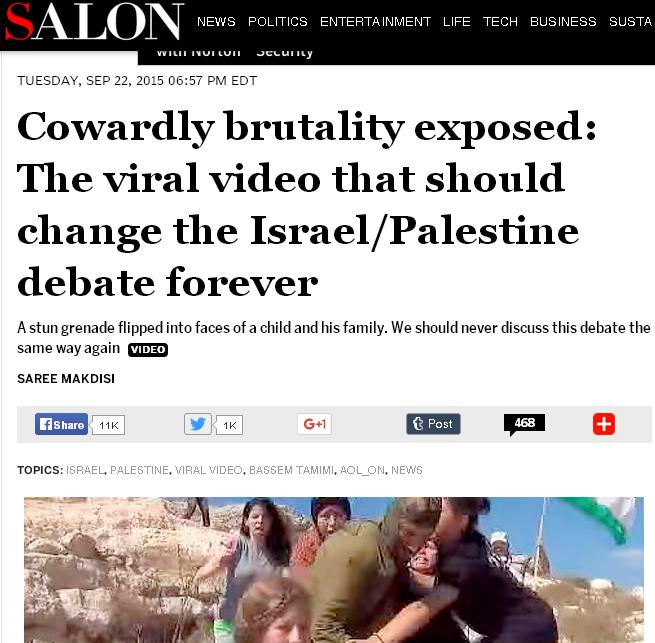
On September 22, 2015 Salon.com, an internet news-current events magazine, emblazoned on its front page the following

The problem was this incident had already been exposed as a staged “Pallywood” production three weeks earlier. The actors, children from the Tamimi family, have appeared in a series of staged videotaped incidents in which they intentionally provoke Israeli soldiers through aggressive behavior, such as biting. CAMERA has documented the Tamimi provocations. The little girl, Ahed Tamimi, shown as the victim of the bullying Israeli soldier, has earned the epithet, Shirley Temper, for her behavior.
Noticing that news items on the event quickly disappeared from British newspapers, CAMERA’s British news monitor UK Media Watch on September 1 quoted Israeli news source YNET’s observation that “even the British media – at the forefront of delegitimization efforts against the Jewish state – may be tiring of the transparent efforts by Palestinian activists to manipulate their coverage of the region.”
Yet three weeks after the rest of the media had caught on to the ruse, lazy editors at Salon.com, apparently unaware the story had already been debunked, featured it as their main story.
October 8, 2015
“Moderate” Palestinian Authority Pays Convicted and Imprisoned Hamas Terrorists

Under the leadership of President Mahmoud Abbas the Palestinian Authority gives money to convicted murderers.Documents obtained by Israel Radio on Oct. 6, 2015 show that the Palestinian Authority (PA) has been paying imprisoned terrorists, including those belonging to rival Hamas—the U.S.-listed terrorist organization that rules the Gaza Strip.
According to The Jerusalem Post, “most of those receiving PA money are members of Hamas who were behind some of the bloodiest terror attacks in Israeli history, from the second intifada” (“Documents reveal Palestinian Authority paying convicted Hamas terrorists,” October 6). All terrorists receiving money from the PA—routinely referred to by some press and policymakers as “moderate”—are serving time in Israeli maximum-security prisons. Among those receiving compensation for their deeds are Hamas bomb maker Abdullah Barghouti and Ibrahim Hamad, the top Hamas official in the West Bank.
Shortly after the January 2006 Palestinian legislative council elections in which Hamas defeated the Fatah movement, the U.S. Congress passed legislation prohibiting any taxpayer money from aiding a Palestinian government in which terrorists were given a role. In 2007, in a “five-day war” Hamas ousted Fatah from the Gaza Strip, leaving the Palestinian Authority split between Hamas rule in Gaza and Fatah control over West Bank Arabs. The years since have seen many futile attempts at PA unity governments between Fatah and Hamas.
The Post notes that “Barghouti and Hamad were involved in some of the worst suicide bombings of the second intifada, including the bombings at a cafeteria at the Hebrew University in Jerusalem… the Sbarro restaurant bombing in Jerusalem… and a nightclub bombing in Rishon Lezion.”
Documents show that Barghouti and Hamad receive $66,000 and $53,000 respectively, in U.S. dollars (USD). By contrast, according to figures from The World Bank, the gross national income per capita of West Bank and Gaza Palestinians is $3,060 USD.
Similar to the amounts some Hamas members receive, PA security service figures also receive “salaries” for committing terror attacks during the second intifada.
The second intifada was planned in advance by PA officials under the direction of then-PA President Yasser Arafat. Lasting from 2000 until 2005, the uprising took more than 1,000 Israeli and 4,000 Palestinian lives. 70 percent of Israelis killed were non-combatants; most Palestinians killed were armed participants. Arafat privately planned the attacks while publicly engaging in U.S.-led talks with Israel for a two-state solution as part of the 1993 Oslo accords process, which created the PA and brought it foreign aid money.
That intifada erupted following PA incitement over false claims of Jewish designs on the al-Aqsa mosque.
Arafat’s successor, current PA president and Fatah movement head Mahmoud Abbas, has used the specter of Hamas making gains with West Bank Palestinians to maintain international aid and support from Western countries, some of whom perceive Abbas and the PA to be more moderate than the theocratic Hamas.
As CAMERA has noted, Abbas formally annulled Oslo and negotiations with Israel in a Sept. 30, 2015 speech to the U.N. General Assembly (“Abbas in U.N. Wonderland; Media Miss Cheshire Cat,” October 2). In the weeks leading up to that speech, Abbas—like Arafat and other Palestinian Arab leaders before him—used the “al-Aqsa libel” to incite violence (“Incitement over Temple Mount Leads to Palestinian Violence, Again,” September 16).
Since Oslo, the PA, while claiming to seek peace, has received billions of dollars in aid—and been accused by many Palestinian Arabs, including former PA officials, of embezzling much of it (“Leaked documents raise anger over Palestinian corruption,” Ynet News, Aug. 12, 2015).
Now the world, presumably including the U.S. Congress, is reminded about how the PA spends donor aid.







Search:
Search this site: