
Recent Entries:
Month: December 2014
December 31, 2014
Why the Palestinians’ International Efforts Do Not Bode Well For Peace

The Palestinian draft resolution was voted down at the UN Security Council, but PA President Mahmoud Abbas continues to plough forward with efforts to bypass Israeli input. Dore Gold explains why Abbas’ UN bid was unacceptable to Israel, while the Algemeiner discusses the potential impact of President Abbas’ proposed bid for membership in the International Criminal Court (ICC).
Gold explains:
….the draft resolution that was rejected exposes the strategy adopted by Mahmoud Abbas, the Palestinian Authority president. He does not want to negotiate with Israel. Instead, he seeks to use international institutions in order to impose a solution on Israel. That is a course of action that no Israeli government can accept and the international community should not give it any support if it wants to see the Israeli-Palestinian conflict resolved.
Abbas’ proposed next step is equally disturbing. The Algemeiner discusses its potentially negative impact — both for Israel and for Abbas himself.
December 31, 2014
Will Gabriel Nadaf Speak at Christ at the Checkpoint in 2016?
Father Gabriel Nadaf speaks at an event organized by the Liaison Committee in Jerusalem in 2013.Every even-numbered year, the folks at Bethlehem Bible College, (a school known for broadcasting anti-Israel propaganda), organizes a Christ at the Checkpoint Conference. At CATC conferences, the elites of Bethlehem’s Christian community tell the world how badly the Palestinians are suffering and how it is all Israel’s fault. They also tell the world just how wonderful life is under the Palestinian Authority.
Some of the people who speak at the conference lie to their guests from North America and Europe about how the security barrier completely surrounds the City of Bethlehem, when in fact it doesn’t. Three people did this at the 2014 event.
Apparently, Westerners who come to the event, which is held at the Jacir Palace Hotel in Bethlehem, enjoy the show, because the folks who put it on are oh so authentic, even if you can’t trust a word that comes out of their mouths.
Attendees are not bothered by the involvement of folks like Rev. Dr. Stephen Sizer, an Anglican Priest known for his recent pilgrimage to Iran, where leaders call for Israel’s destruction and portray Zionism as the enemy of all mankind.
For folks who are into that sort of thing, CATC conferences are the Siegfried Follies of Israel bashing.
In 2014, the spectacle was complicated somewhat by the murder of Christians in Syria and Iraq. It’s hard to portray Israel as the source of suffering in the Middle East while ISIS in Iraq is decapitating Christians and Yazidis because of their faith.
Still, CATC organizers were game, rewriting the script somewhat by acknowledging that these things take place, but adding that anti-Christian hostility in the Middle East is rooted in American support for Israel.
It’s more than a year off, but CATC organizers are already preparing the 2016 event. Here’s a suggestion for them. Invite Father Gabriel Nadaf, the spiritual father of the Aramean Christian community in Israel to speak at the event. Let him tell his story.
(more…)December 31, 2014
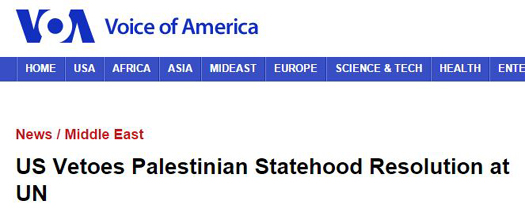
Voice of America Wrong on American Veto
Jan. 4, 2015 Update: Voice of America Corrects: U.S. Didn’t Veto Palestinian Statehood Bid
Voice of American incorrectly reports in the lead of its article on the failed Palestinian statehood bid in the United Nations:
The United States has vetoed a United Nations Security Council draft resolution on Palestinian statehood that demanded Israel withdraw from the occupied territories.
Likewise, the VOA headline incorrectly states that the U.S. vetoed the Palestinian resolution:

In fact, given that the resolution fell one short vote of the nine votes required to pass, the United States, which had voted against the draft, did not have to exercise its veto right. The American vote against a resolution is not a veto so long as the draft falls short of the nine countries in favor. As reported correctly by The New York Times:
So Mr. Kerry worked to line up enough abstentions from American allies like South Korea and Rwanda so that the United States would not have to wield its veto. . . .
By avoiding a veto, the United States also avoided a fresh irritant in its relations with Arab nations, some of which have joined the United States in the campaign in Iraq and Syria against militants from the Islamic State.
In addition, CNN accurately reports:
The United States voted against the resolution on the table and had been expected to exercise its permanent council member authority and veto the measure, had it passed.
December 30, 2014
Shavit’s Lydda “Massacre” Reaches Israel

Ari Shavit
Ari Shavit has won enormous adulation among American Jews for his book, My Promised Land: The Triumph and Tragedy of Israel, in which he movingly recounts the early years of struggle to establish Israel but which also alleges Jewish fighters committed a massacre in the town of Lydda during the 1948 War of Independence.
So striking was the Lydda story that The New Yorker excerpted a version of it as a stand-alone article — one critiqued by CAMERA for its inflammatory distortions and omissions.
CAMERA was hardly alone in challenging Shavit’s account. Scholar and President of Jerusalem’s Shalem College Martin Kramer deconstructed the implausible Lydda charges in a July 2014 Mosaic magazine article and now has presented much of this information to an audience of Israeli veterans of the 1948 war, including some who fought at Lydda.
Because Shavit’s book was published in English, most Israelis have been unaware of its massacre allegations. When Professor Kramer spoke to the veterans as part of a December 4 panel sponsored by the Galili Center for Defense Studies, the response to claims of a “revenge” atrocity against Lydda’s Arabs was shock and anger. Kramer recounts:
The reactions tumbled forth in immediate response to Shavit’s text. I heard gasps of disbelief and angry asides.
He reports the anguish of some of the audience:
At this point, none of them is up to challenging a well-connected media celebrity of Shavit’s caliber, and the persons specifically accused by him are gone. An elderly gentleman came up after my presentation and asked if I intended to publish my article in Hebrew. We ourselves can’t set the record straight anymore, he pleaded.
So, while Ari Shavit is reaping accolades across America for a book with shoddy, unsubstantiated charges of a Jewish atrocity, those who actually fought in the War of Independence hope their countrymen will come to understand one of their most celebrated journalists has gone abroad and defamed them all.
December 28, 2014
Degeneration of a New York Times Headline, Part II
The original New York Times headline last week about Palestinian violence on the Gaza Strip border with Israel was straightforward, precise and accurate: “Palestinian sniper attack on Israeli patrol at Gaza border sets off clash.”

Which is why we immediately took a screen shot, fully expecting it to change in short order. Indeed, by the next day, the updated headline carefully exonerated Palestinians from responsibility for the sniper attack and for setting off the clash.

Who was that sniper? Palestinian or Israeli? Casual readers who glance just at headlines would have no idea. An editor made the deliberate choice to no longer have the sniper identified as Palestinian.
This is the second time in recent weeks in which we have seen a New York Times headline become less informative with the passage of time.
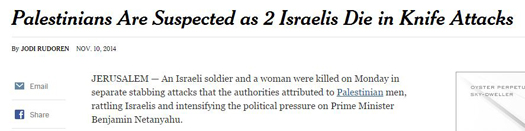
Last month, after a Palestinian fatally stabbed an Israeli soldier at a Tel Aviv train station, The Times initially ran a headline which clearly identified the perpetrator as Palestinian: “Palestinian Stabs Israeli Soldier at Tel Aviv Train Station.”
By the end of the day, after a second lethal Palestinian stabbing attack, the headline devolved into:

As we noted at the time:
The first, clearer headline is active (“Palestinian stabs”), while the passive language in the newest headline (“Palestinians are suspected”) downplays Palestinian culpability. The first headline states as fact that a Palestinian was responsible for the stabbing. According to the latest version , Palestinians are only “suspected.”
In the current headline, Israelis “die,” they are not “killed,” language which again downplays Palestinian responsibility for violence.
At The New York Times, editors consider it their job to eliminate clear, direct headlines about Palestinian violence.
December 24, 2014
National Geographic Misidentifies Judaism’s Holiest Site
The Independent is the latest media outlet to correct the false claim the Western Wall is Judaism’s holiest site. It follows earlier corrections at The Washington Post, Haaretz, and the BBC, among others.
Judaism’s holiest site is the Temple Mount, the site of the first and second Jewish temples which housed the Holy of Holies (the inner sanctuary where the Ark of the Covenant was located). The Western Wall, a retaining wall of the Temple Mount compound, obtained its holy status due to its proximity to the Holy of Holies. The National Geographic Society, with its focus on archeology and history, and which prides itself on being “one of the largest nonprofit scientific and educational institutions in the world,” should know this.
Yet it too recently misidentified the Western Wall as Judaism’s holiest site.

Stay tuned for news of a correction.
In addition, as one reader points out, a paragraph in the accompanying article (“Blessed. Cursed. Claimed,” by Paul Salopek) contains the following insidious nugget:
Weeks later, yet another round of Palestinian-Israeli fighting would flare. Rockets would scratch the skies. Israel would invade nearby Gaza.
Employing a common double standard, Salopek uses passive language to describe Palestinian belligerence (rockets “scratch”) versus active language for retaliatory Israeli strikes (Israel “invades”). And he erases Hamas out of the equation entirely.
Hat/tip RD
December 23, 2014
Fracking Strikes an Unexpected Blow at Iran

Bret Stephens pens an incisive editorial in the Wall Street Journal discussing the positive effects redounding from fracking technology (hydraulic fracturing of shale). Fracking has been the main driver for sharply reduced oil prices. This has had a salutory effect on the American economy; at the same time, the reduction in oil prices has had a negative impact on Iran and other regimes that heavily rely on oil revenues.
A reduced flow of money means the Iranians will face constraints in their activities underwriting terrorism, fighting proxy wars and building a nuclear weapons arsenal. The relaxation of sanctions and robust oil prices had provided a considerable boost to Iran in recent years. Its economy had turned the corner and was showing signs of improvement and the regime’s proxies were on the march in Yemen and elsewhere.
The credit for fracking according to Stephens belongs to that characteristically American figure, the stubbornly individualistic entrepreneur. He writes of fracking,
It didn’t happen because America’s big energy companies are uniquely skilled or smart or deep-pocketed: Take a look at ExxonMobil ’s 2004 Annual Report and you’ll barely find a mention of “fracturing” or “horizontal” drilling.
Nor, finally, did it happen because enlightened mandarins in the federal bureaucracy and national labs were peering around the corners of the future. For the most part, they were obsessing about the possibilities of cellulosic ethanol and other technological nonstarters.
Instead, fracking happened in the U.S. because Americans, almost uniquely in the world, have property rights to the minerals under their yards. And because the federal government wasn’t really paying attention. And because federalism allows states to do their own thing.
Stephens continues, “Fracking has now upended energy markets, pummeled petrodictators, confounded OPEC…”
December 19, 2014
An Update on the Bloodied Shoe Tweets

Yesterday, we wrote about some misinformation that was spread across Twitter by prominent journalists. Now that there have been corrections, that post could use an update. So here it is.
First, a summary of what we shared yesterday:
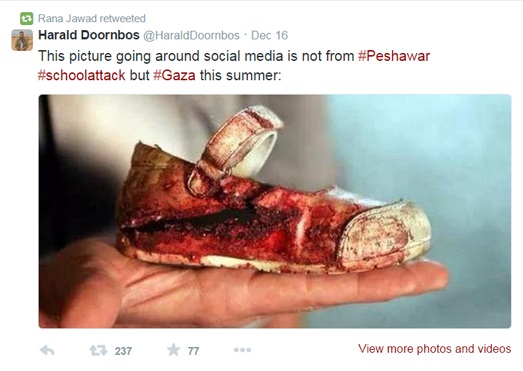
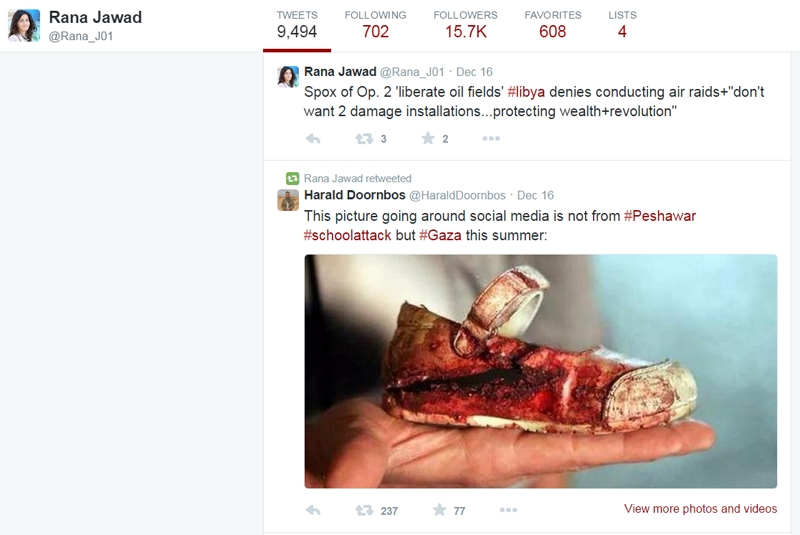
• BBC Watch pointed out that a journalist on Twitter inaccurately described a photo of a little girl’s bloodied shoe as having been taken Gaza during this summer’s fighting between Hamas and Israel. Ironically, the journalist’s misinformation came in the form of a “fact-check” type post, directed at those who had wrongly described the photo being from the recent attack in Pewshawar, Pakistan. BBC Watch also noted that a BBC journalist retweeted the photo — even though the BBC itself acknowledged the shoe belonged not to a Palestinian girl in Gaza, but rather to an Israeli girl in Ashkelon.
• We pointed out here yesterday that at least two additional journalists had shared the misinformation. After we informed the journalists of their error, some were evasive, while others didn’t immediately reply, perhaps because they had yet to see our call for a correction.
Now that enough time has passed for the dust to have settled, let’s look at how the journalists reacted after being informed that they had inadvertently spread misinformation to untold thousand of people. First, the best news:
Rana Jawad, the BBC journalist mentioned by BBC Watch, commendably fixed her mistake. She updated her 15,700 Twitter followers with a clear post that included the word “correction” and a link to BBC’s article describing the bloodied shoe as belonging to an Israeli in Ashkelon:
Correction to a RT from earlier this week: Here's the real story behind the picture. http://t.co/wvF0w0CLOe
— Rana Jawad (@Rana_J01) December 19, 2014
France24’s Julien Pain also cleared the record after CAMERA informed him that he had shared the misinformation. To his credit, Pain’s tweet to his 6,000 followers made clear the shoe was was not from Gaza, but from Ashkelon.
Not Gaza but Ashkelon #Israel “@HaraldDoornbos: This picture going around social media not from #Peshawar but #Gaza: pic.twitter.com/6lNZP8J9bC”
— Julien Pain (@JulienPain) December 19, 2014
We have another example of a clear correction by Syrian commentator Aboud Dandachi. In a Twitter thread today, he claimed the photo was from Iraq.
.@CiFWatch @Yair_Rosenberg @HaraldDoornbos Not even from Gaza,its from Iraq.
— Aboud Dandachi (@AboudDandachi) December 19, 2014
Upon being informed of the facts, he quickly corrected:
.@CiFWatch @Yair_Rosenberg @HaraldDoornbos Your right, I stand corrected, its from Ashkelon. Apologies, I'll save the link. Thanks
— Aboud Dandachi (@AboudDandachi) December 19, 2014
Two other journalists were not quite as effective in clearing the record.
The original source of the inaccurate information was Dutch reporter Harald Doornbos, who tweeted the following to his 40,500 followers:
(more…)December 18, 2014
Will Journalists Sharing Misinformation on Twitter Correct?
We get it. It’s really, really easy to share someone else’s Twitter posts — just a quick copy and paste, or a click on the retweet button. One imagines it’s even easier to share if the post in question refers to Israeli violence and if you’re a journalist with “unnecessary buttons” and a “distaste for Israel,” as Matti Friedman put it.
Admitting an error, on the other hand, is not always the easiest thing to do. But journalists have responsibilities, not least among them a responsibility to correct after inadvertently misinforming their audience.
When Dutch journalist Harald Doornbos, in a failed attempt at fact-checking, stated that a heart-wrenching photo of a small, bloody shoe circulating on Twitter was from Gaza and not, as many had claimed, from a recent attack in Pakistan, he simply replaced one error with another. Despite the implication that what was pictured was evidence of a Palestinian casualty at the hands of Israel, the photo was actually of an Israeli girl’s shoe, taken after she was injured in a Palestinian rocket attack on the Israeli city Ashkelon.
And as CAMERA-affiliate BBC Watch pointed out, his inaccurate tweet was shared by BBC journalist Rana Jawad, retweeted to her nearly 16,000 followers.

She wasn’t the only reporter to misinform readers with Doornbos’s tweet. So did France 24’s Julien Pain.
“@HaraldDoornbos: This picture going around social media is not from #Peshawar #schoolattack but #Gaza : pic.twitter.com/6lNZP8J9bC” #obs
— Julien Pain (@JulienPain) December 16, 2014
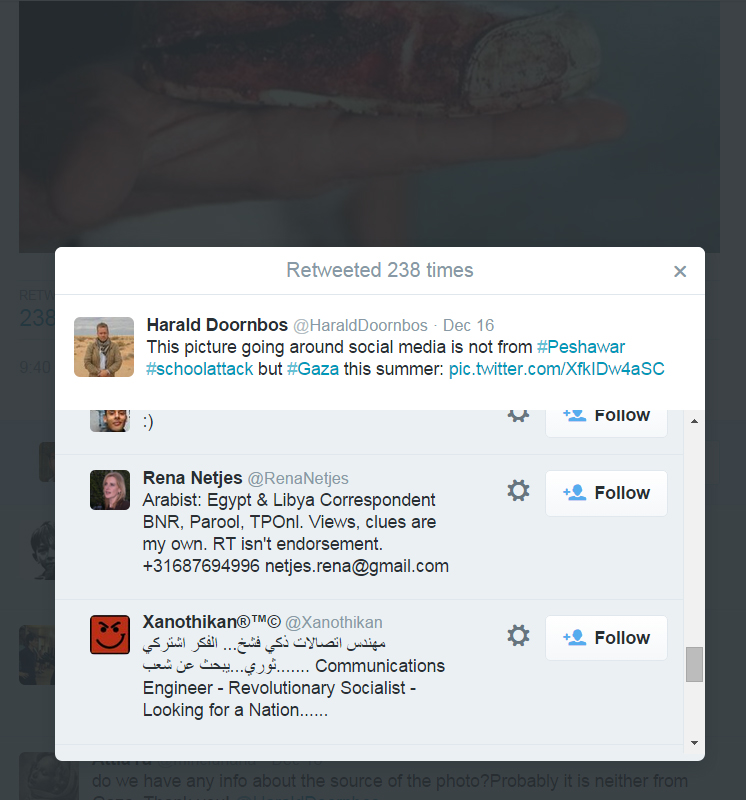
And so did Rena Netjes of the Dutch radio station BNR.

Mistakes happen. And mistakes left all four journalists (and perhaps others) in a position to demonstrate their adherence to journalistic norms calling for in accuracy and clear, forthright corrections when needed. So what did they do?
As of this writing, Doornbos, the originator of the misinformation, faded away as commenters under his tweet pointed out the actual source of the photo. He never informed to his 40,000 Twitter followers that the information he had shared was inaccurate, nor even deleted his tweet.
Jawad and Pain, both of whom were notified of the error they shared, have not yet updated their readers. (Though neither appears to have posted on Twitter since being notified, so the possibility remains that they haven’t yet seen the corrective information.
After CAMERA informed her of the misinformation, Netjes strangely replied that it was CAMERA that got it wrong:
Nope. You @CAMERAorg please remove your false accusation: http://t.co/xWOTTLt3o5
— Rena Netjes (@RenaNetjes) December 18, 2014
A CAMERA researcher asked for clarification, and documented that she did indeed share the inaccurate information:
Please do explain. Did you not retweet the false claim that shoe pic was "from…Gaza," when it's actually from Israel? @RenaNetjes @Cocoamok
— Gilead Ini (@GileadIni) December 18, 2014
Here's a screenshot. You did retweet. And I didn't see correction—maybe it was in Dutch? @RenaNetjes @Cocoamok pic.twitter.com/A1mW98ORQ7
— Gilead Ini (@GileadIni) December 18, 2014
Netjes replied that she did share a link to the BBC story explaining the origins of the photo.
@GileadIni @Cocoamok My point to retweet was that it wasn't from #peshawar. I later put the BBC article for the whole story
— Rena Netjes (@RenaNetjes) December 18, 2014
But it appears from an examination of her Twitter timeline that the only place she linked to the BBC story was in her tweet claiming CAMERA got it wrong — which would mean we got it right, and more importantly, would mean that she has never informed all her readers of the false information she had passed on to them earlier.
So far, not so good. But fortunately it’s never too late to clear the record. Will the four journalists do the right thing and broadcast a clear correction to all of their readers?
December 17, 2014
Hamas Still Hamas, Says Will Never Recognize or Relinquish “Even an Inch” of Israel

Remember when it was all the rage for some journalists to pretend Hamas recognizes Israel and wants a two-state solution, never mind what the Islamist group’s own leaders repeatedly and consistently said to the contrary?
There was The New York Times, which told us that a Hamas leader, in the words of its headline, “Calls for Two-State Solution.” (No, he didn’t.)
And don’t forget The Guardian, chroniclers of the “news” that Hamas “agrees to Israeli state.” (Wrong again.)
Alas, it seems Hamas leaders were never close readers of those newspapers. The organization stubbornly has continued to be clear about its ideology, as it did again just a few days ago. Over to you, MEMRI:
Speaking at a December 12 rally in Khan Younes, Hamas political bureau member Mahmoud Al-Zahhar said: “Anyone who thinks that we will recognize the existence of the [Zionist] entity or the 1967 borders is deluded… Palestine stretches from the Egyptian border in the south to Lebanon in the north, and from Jordan in the east to the Mediterranean sea in the west, and we will never recognize anything less than this.” He added: “If part of our land is liberated, we will establish our state in that part without relinquishing even an inch of the rest. Just as we liberated Gaza and established a genuine administration in it, [with] an army and security apparatuses that defend us, rather than the Israeli enemy [unlike those of the PA], we will do the same in the West Bank, as a prelude to attaining all of Palestine.”






Search:
Search this site: