
Recent Entries:
Month: May 2012
May 17, 2012
Church Bureaucrazy About Israel

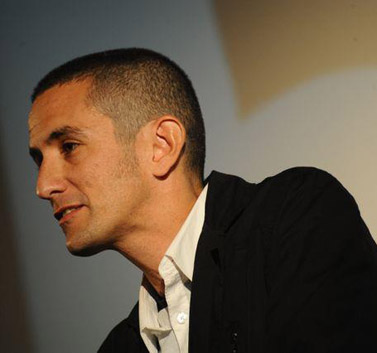
Eyes Wide Shut: Peter Makari, Executive for the Middle East and Europe of the Common Global Ministries Board of the United Church of Christ and the Christian Church (Disciples of Christ)(Photo: Dexter Van Zile)One of the charges CAMERA levels at mainline Protestant churches in the U.S. is that they exhibit a monomaniacal focus on Israel while ignoring the misdeeds and human rights abuses of its adversaries in the Middle East. This assessment is typically based on the resolutions submitted to the national assemblies of these churches. The problem is not limited to resolutions approved or debated at national church gatherings, however. Another place where this monomaniacal focus can be seen is on the newsfeeds of the churches.
Probably the worst offender is the Common Global Ministries of the United Church and the Disciples of Christ. This organization, which is the overseas arm of the two denominations mentioned above, sends missionaries and activists to countries throughout the world.
(more…)May 16, 2012
Presspectiva Letter in Ha’aretz on Teaching Peace

Uri Misgav didn’t question whether the idea of genuine peace existed on the Arab sideYishai Goldflam, editor-in-chief of Presspectiva, CAMERA’s Hebrew site, has a letter-to-the-editor today in Ha’aretz in which he takes Uri Misgav to task “for ignoring a crucial factor” in his column lamenting that Israel has “officially taken peace off its agenda.” Goldflam writes:
. . . Misgav is nostalgic for the days when we sang “Noladeti Lashalom” (I was born for peace ) and drew pictures of doves and olive branches. . . .
The point is that Misgav, for all his self-flagellation and bitterness, ignores a crucial factor for completing the equation – the party with which we would like to live in peace. While here, generations of children grew up on poems and songs that express a yearning for peace, what did our neighbors’ children learn? How many peace songs have been written by Arab poets? How many Arab kindergarten teachers taught their pupils how to draw a dove?
During the early days of the Oslo Accords, the Israeli school system took steps to psychologically prepare Israeli children for the approaching peace. The Palestinian school system, on the other hand, continued to brainwash its children with anti-Israel and anti-Semitic propaganda, as it continues to do to this day. . .
May 15, 2012
Oren: We Must Stand by the Facts

In The Wall Street Journal today, Israeli Ambassador Michael Oren wrote about the “systematic delegitimization of the Jewish state”:
Having failed to destroy Israel by conventional arms and terrorism, Israel’s enemies alit on a subtler and more sinister tactic that hampers Israel’s ability to defend itself, even to justify its existence.
It began with PLO Chairman Yasser Arafat’s 1974 speech to the U.N., when he received a standing ovation for equating Zionism with racism—a view the U.N. General Assembly endorsed the following year. It gained credibility on college campuses through anti-Israel courses and “Israel Apartheid Weeks.” It burgeoned through the boycott of Israeli scholars, artists and athletes, and the embargo of Israeli products. It was perpetuated by journalists who published doctored photos and false Palestinian accounts of Israeli massacres.
Israel must confront the acute dangers of delegitimization as it did armies and bombers in the past. Along with celebrating our technology, pioneering science and medicine, we need to stand by the facts of our past.
Emphasis is ours. If you can get past the pay wall, you can read it here.
May 15, 2012
“Fighting Distorted Media Coverage of Israel”

Dr. Manfred Gerstenfeld.In an interview with Dr. Manfred Gerstenfeld, CAMERA Executive Director Andrea Levin states:
Media coverage of the Middle East is often distorted. There are no enforceable codes of professional conduct which apply to the media. One can thus obtain change only in two ways. One is through private appeals for accuracy, balance and fair play. The other is through public exposure of journalistic misconduct.
Read the complete interview here.
May 14, 2012
Daily Beast Photo Flub [Updated]
Update: To its credit, the Daily Beast quickly corrected the caption after CAMERA informed editors of the error. We’ve added after the break an updated image of the photo as it currently appears.
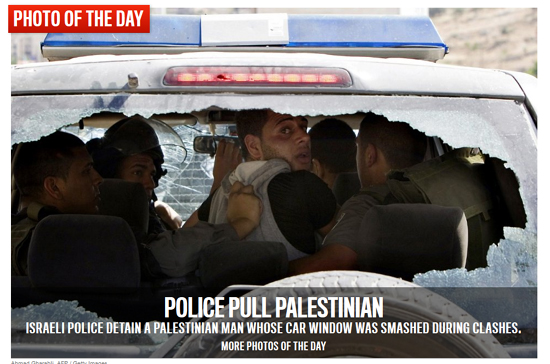
Arab demonstrators in the Jerusalem neighborhood of Silwan were busy smashing up Israeli police cars on Friday, and the Daily Beast has it covered. Well, sort of. Here’s their featured Photo of the Day, and the accompanying caption, as it now appears on their home page:

So a smashed up Israeli police car, damaged by Palestinian rioters, becomes a smashed up Palestinian car (damaged, perhaps, by the Israeli police officers). How do you like that? Maybe the Daily Beast caption-writer has a promising career as a used car salesman. (I hear he has a great deal on a roomy vehicle. If you don’t mind a little extra fresh air, and some broken glass.)
The original caption for the AFP photo by Ahmad Gharabli was:
Israeli riot police detain a Palestinian man in a car whose rear window was smashed during clashes between Palestinian youth and the Israeli police in the east Jerusalem neighbourhood of Silwan on May 12 [sic], 2012. . . .
(The incident actually occured on May 11, and was posted to the Newscom photo service site on May 11.) This more detailed caption also appears in the Daily Beast if you click on front-page photo with the erroneous, truncated caption. While the AFP did not falsely claim, like the the Daily Beast home page, that the damaged car belongs to a Palestinian, it was also not exactly forthright that it was an Israeli police car, damaged by Palestinians. But given AFP’s troubled history on photo captions, that’s not exactly a surprise.
Here’s a fuller photo of what appears to be the same damaged vehicle (the edge of the broken glass is identical in both pictures), in which you can clearly see the police license plate (red, with the Hebrew letter “mem,” for “mishtara,” police):

The above image is by Mahfouz Abu Turk of ZUMA Press, and its caption is identical to AFP’s.
(more…)May 13, 2012
Ha’aretz, Lost in Translation, XIII
As Ha’aretz today launches its new English-language Web site, publisher Amos Shocken announces:
Haaretz is dedicated to maintaining high journalistic standards in its presentation and interpretation of the riveting and complex reality of modern Israel. Haaretz’s role is vital not only as a trusted provider of information and insight but also as a gatekeeper of the liberal and democratic values on which this country was founded. Now more than ever, Haaretz has an important role to play in ensuring that Israel preserve its proper place among enlightened democracies, in fostering peace and reconciliation in the Middle East and in promoting greater understanding between Israel and the Jewish Diaspora. We invite our readers to be our partners in this great endeavor.
In the past few months, Haaretz has laid the groundwork for a significant enhancement of its online content, especially in English. With the introduction of our new, multi-platform digital subscriptions, Haaretz will extend and deepen its world renowned expertise in news gathering and analyses to many new arenas that are of special interest to our English-speaking readers.
But, as we observed earlier today following Ha’aretz‘s latest corrected “Lost in Translation,”
Ha’aretz can invest in all of the latest high-tech gadgets in the world, and employ some top notch Hebrew reporters, but as long as the English translators have free rein to distort the Hebrew coverage in accordance with their personal agendas, the English readers will be getting neither accurate nor quality content. If Ha’aretz is truly interested in high journalistic standards and accurate news coverage “of special interest to our English-speaking readers” it would put a stop to the “Lost in Translation” epedemic. Correcting errors on a case-by-case basis, after the fact, is simply treating the symptoms, not the underlying problem.
Today, when the ink has barely dried from the last “Lost in Translation” print correction, a new case crops up, underscoring the point. And, to make matters worse, the error is featured on Ha’aretz‘s newly-minted home page:

The article itself states:
The result is an almost unbearable experience for worshipers and tourists who congregate at Judaism’s holiest site. (Emphasis added.)
Only the Western Wall is not Judaism’s holiest site. The Temple Mount is. The BBC, Washington Post and others have all corrected this error in the past.
(more…)May 11, 2012
“Why The Jews – and the world – need Israel”

CAMERA’s Sarit Catz’s op-ed, “Why the Jews – and the world – need Israel“, published in The New Jersey Jewish News states:
Jews have always been creative and have always contributed to the societies where they lived. But planted in Israel, Jews have blossomed, Jews have flourished. Jews have created a dynamic, resilient country in Israel, and Israel has created a dynamic, resilient Jewish character in us, all of us. Even if we don’t live in Israel, Israel has changed us. Israel has changed what it means to be a Jew and changed it for the better.
May 9, 2012
The Washington Post’s ‘Little Kingdom’ is Four Times Bigger than Israel

Describing Jordan in an article headlined “Beneath the civility, Jordanians simmer; Growing frustrations threaten the stability of key U.S. ally” (May 8), The Washington Post referred to “this little kingdom….”
The land area of Jordan, Israel’s eastern neighbor, totals 34,500 square miles. Jordan’s population is 6.5 million. Israel comprises 8,019 square miles and its population totals 7.6 million (all figures from the CIA World Fact Book). That makes “this little kingdom” more than four times larger than the Jewish state.
Jordan ranks 112th by size out of more than 200 on the list of countries. Israel is 154th. If Jordan is, accurately, “this little kingdom,” then readers should expect journalistic descriptions of Israel as “this tiny democracy.”
But as CAMERA has noted, although The Post and other news media repeatedly refer to countries larger than Israel – often much larger – as small, little or even tiny, the Jewish state rarely if ever rates descriptions in the diminutive. This even though they would be accurate and often relevant.
Why the functional if not intentional double standard? One reason may be that if, as we have suggested, Israel is seen primarily through the filter of Palestinian complaints, it appears to be the larger party. And as the larger party, responsibility for existing problems and to make concessions to solve them would fall primarily on it.
But if Israel is placed in context of the surrounding Arab and even greater Islamic world, most of which unreconciled to Jewish equality and sovereignty, then it is the smaller, indeed tiny party. And primary responsibility to “take risks for peace” would lie with its neighbors.
May 9, 2012
Captured Bin-Laden Letters Claim “Moderate” Fatah Offered Tribute to Group Sympathizing with Al-Qaeda -[corrected]

CORRECTION: An earlier version of this post identified the Palestinian group communicating with al-Qaeda as part of al-Qaeda. While the group clearly sympathizes with al-Qaeda and has communicated with its leadership, there is no evidence that it is part of al-Qaeda.
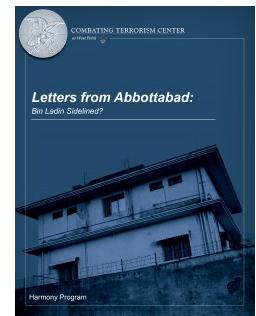
On May 3, 2012, West Point’s Combating Terrorism Center (CTC) released translations of Osama Bin Laden’s correspondence with other al-Qaeda figures that was seized in the raid that killed him. The translations reveal that an organization communicating and sympathizing with al-Qaeda had received an offer of tribute from Fatah, the Palestinian party governing the Palestinian Authority in the West Bank, which is widely depicted as moderate.
While David Gartenstein-Ross cautions that “this does not actually demonstrate tribute money being offered to ‘al-Qaeda,’ ” it nevertheless should raise some concern because the Palestinian Authority has received billions of dollars in aid from Western countries. The United States recently approved several hundred million dollars more in assistance.
The full translated passage in the CTC document reads:
The Fatah organization has also offered us funds purportedly to support jihad, but there is another reason, namely their fear of becoming the target of our swords.
These funds would go directly towards the purchase and manufacture of weapons, and to support operations which we will conduct, God willing. …UPDATE: Two CAMERA commenters alerted us to the fact that there is not a clearly established link between al-Qaeda and the group that purportedly received the funding offer, a Palestinian terrorist group that has called itself the Organization of al-Qaeda in Palestine (among other names). The CTC commented as follows:
There is also a letter dated 2006 forwarded to a certain `Abd al-Hamid. The actual letter was addressed to `Atiyya, consisting of legal questions from the group called Army of Islam (Jaysh al-Islam) based in Gaza. The gist of the letter makes it known that the group is in need of financial assistance “to support jihad,” and the questions largely pertain to the permissibility of accepting financial assistance from other militant Palestinian groups that are not purely fighting to establish God’s Law in the eyes of Jaysh al-Islam (e.g., groups that are nationalists or supported by Iran). The significance of the letter pertains to `Atiyya’s legal knowledge, but it does not point to a firm relationship between al-Qa`ida and Jaysh al-Islam. Atiyya comes across as cordial but distant. He responded strictly to the questions posed but refrained from giving any strategic advice. It is possible that Jaysh al-Islam was “testing the water” to see whether al-Qa`ida would lend them financial support, not least because Hamas was fighting against them.
Many news organizations reported on the trove of letters, but a Nexis search turned up only three major news organizations, the Daily Telegraph, the Christian Science Monitor and the Calgary Herald, that reported on the Fatah tribute offer.
Also of interest, British columnist Robert Fisk, American journalist Seymour Hersh (sp) and Canadian columnists Gwynne Dyer and Eric Margolis were apparently favored by Bin Laden. Fisk, who writes for the Independent and Dyer are frequent detractors of Israel.
May 8, 2012
BBC Justifies Self Censorship in the Face of Threats of Violence

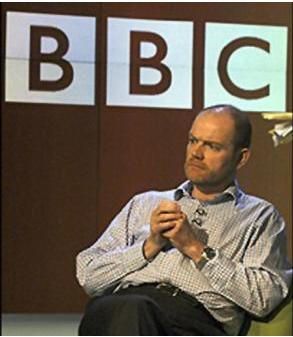
In an interview on free speech, Mark Thompson, director general of the BBC, implies that the threat of violence from religious Muslims influences the BBC’s decisions on which shows it airs. His acknowledgement and justification of self-censorship has to be disheartening to all defenders of free speech. The BBC is the world’s largest media organization and is sustained by the British government.
Questioned about the conflict between free speech and offending people’s religious beliefs, Thompson justifies censorship in criticizing some religious figures [but not others] by suggesting that such criticism can be more “heinous” than harming real people.
… they believe that their faith refers to things which have an objective reality. And so, for example, they regard blasphemy as causing objective harm. So it’s not just that a blasphemous statement or act would hurt their feelings or anger them because it went against their opinions; it would do actual objective harm. That offending of an act of sacrilege against the god head or religious figure, actually creates harm in the world as it
were and might be as heinous or more heinous than harm to a human being.Thompson then shifts from the abstract to the specific:
I think you have to tread really quite carefully and sensitively because of the character. The point
is that for a Muslim, a depiction – particularly a comical or demeaning depiction of the Prophet Muhammad – might have the force, the emotional force, of a piece of a grotesque child pornography. One of the mistakes seculars make is I think not to understand the character of what blasphemy feels like to someone who is a realist in their religious belief.Interviewer Timothy Garton-Ash: But it is an ace, isn’t it? And a rather nasty ace if people say, “I feel so strongly about that; if you say it or broadcast it, I will kill you.”
Thompson: Well clearly it’s a very notable move in the game, I mean without question. “I complain in the strongest possible terms” is different from “I complain in the strongest possible terms and I’m loading my AK47 as I write.” This definitely raises the stakes. But I think there’s two or three things going on, so manifestly a threat to murder, which by the way is quite rightly a crime, massively raises the stakes.
In more veiled language, Thompson also implies that such threats sway the BBC’s coverage of the Israeli-Palestinian conflict.
(more…)






Search:
Search this site: