
Recent Entries:
Month: August 2011
August 11, 2011
Is there a debate over Sabeel in the Netherlands?
According to this “tweet” from Sabeel Jerusalem’s twitter account, a group of pastors in the Netherlands are unhappy with their churches involvement with Sabeel Ecumenical Liberation Theology Center.

Snapshots has been unable to find any information regarding this petition, but if our readers can find any links about the controversy, they can provide details in the comments section posted below.
For background about why Sabeel would be a topic of debate for pastors in the Netherlands, read “Updating the Ancient Infrastructure of Christian Contempt: Sabeel” written by CAMERA analyst Dexter Van Zile and published by the Jerusalem Center for Public Affairs.
Update: A poster has kindly provided a link to an article providing some background about the debate in the Netherlands about Sabeel. The article, “How the Dutch Gaza Flotilla Backfired Politically,” written by Yochanan Visser and published by Pajamas Media reports that “a group of clerics and members from the Protestant Church in the Netherlands (PKN) organized a petition demanding an end to ties between the Protestant NGO Kerk in Actie and Sabeel after it was shown that officials of Kerk in Actie collaborated with Sabeel — an Arab-Christian group — in propagating blatant lies about Israel.”
August 10, 2011
In Memory — Bernadine Healy Fought Exclusion of Israel from ICRC

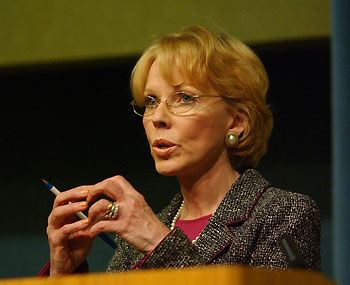
A fearless and outspoken former president of the National Institutes of Health and the American Red Cross, Dr. Bernadine Healy died August 6, 2011 of brain cancer. At the helm of the Red Cross, Dr. Healy championed efforts to end the exclusion of Israel’s Magen David Adom from membership in the International Red Cross, cutting US funding to the international body.
Two months after assuming command of the American Red Cross in September 1999, Healy flew to Geneva to address a large assembly of the International Red Cross movement. And, in the eyes of international officials, she charged in like a bull in a china shop.
”She comes in and makes a speech in which she harangues the assembled membership about the inequity of the exclusion of M.D.A. and how the American Red Cross is going to make inclusion happen now, whether we liked it or not,” said Christopher Lamb, an executive of the international federation. ”She spoke about the movement, describing everyone as cowards and failures and people who didn’t understand.”
Lawrence Eagleburger wrote in a Washington Post op-ed column
that Healy simply refused to turn ”a blind eye on a moral wrong.” And persuaded by her passion, the American Red Cross board went right along with her. It agreed to start withholding its $4.5 million annual dues to the international federation; that money is 25 percent of the federation headquarters’ budget.
On June 21, 2006, Israel was finally admitted as a full member to the ICRC. Dr. Healy’s unequivocal leadership years earlier gave crucial impetus to that outcome.
She will be remembered for many achievements, among them her moral clarity and courage.
August 10, 2011
EAPPI’s Narcissistic Grandstanding

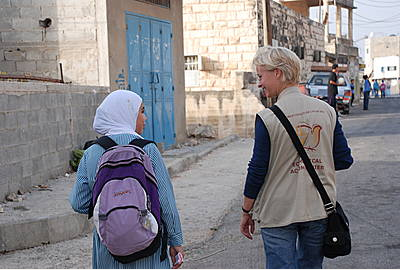
The WCC’s Ecumenical Accompaniment Program in Palestine Israel (EAPPI) provides its activists with attractive vests that are sure to impress the folks back home.Last week, the Presbyterian Church (USA) published an article about the World Council of Churches’ Ecumenical Accompaniment Program in Palestine Israel. CAMERA responded to the article, originally produced by Ecumenical News International, with a letter to The Layman, published by the Presbyterian Lay Committee.
The letter is republished below the jump.
(more…)August 8, 2011
Facts Blockaded in Washington Times Gaza Story

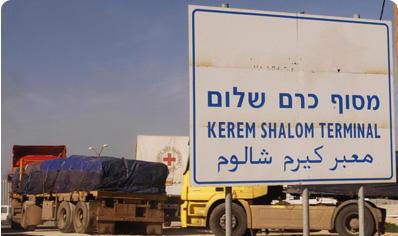
Associated Press reporter Ibrhaim Barzak writes that “…there are no longer acute shortages of foods or basic household items.” There never were such “acute shortages.” Since Israel and Egypt started the blockade in 2007, Israel regularly has transferred food and humanitarian supplies into the Strip. For example, according to the Israeli Foreign Ministry, between June 16, 2007 and Sept. 22, 2008 — before the May 2010 raid on the first anti-blockade flotilla referred to by The Washington Times — Israel permitted 35,542 trucks carrying 813,870 tons of food, medical supplies and other humanitarian aid to enter Gaza.
The AP dispatch never mentions Palestinian responsibility for the Israeli blockade. But this responsibility includes more than 11,000 mortars and rockets fired from Gaza by the ruling Hamas movement and other terrorist organizations at Israel after the latter’s unilateral withdrawal in 2005.
The article also notes that “there are restrictions on exports, along with entry of raw materials” but it does not tell readers why. Cement, iron and piping have been used by Hamas to build fortified positions, including underground bunkers, and rockets. However, since the first flotilla, monitored imports of truckloads of cement, iron, and other building supplies are regularly coordinated with international parties.
Gaza suffers because Hamas and its terrorist allies continue to threaten Israel’s security. The Washington Times/AP report missed the story’s central point. — by Sophie Linshitz, CAMERA Washington research intern.
August 8, 2011
Extremist Trends in Tahrir Square

In an August 2, 2011, Wall Street Journal report, we learn that “Mobs of ordinary Egyptians joined with soldiers to drive pro-democracy protesters from their encampment in Tahrir Square here Monday, showing how far the uprising’s early heroes have fallen in the eyes of the public.” Shadi Hamid, of the Brookings Institution’s Doha Center comments,
The liberal and leftist groups that were at the forefront of the revolution have lost touch with the Egyptian people…For some time they’ve been deceiving themselves by saying that the silent majority is on their side—but all evidence points to the contrary.
Making a similar observation, Randall Lane and Douglas Schoen, on July 26, 2011, reported on a Newsweek/Daily Beast poll of Egyptian voters:
The Muslim Brotherhood, Egypt’s largest Islamist group, is poised to win the largest share of the vote in parliamentary elections; the man who appears to have a clear shot at the presidency, Amr Moussa, has made his name criticizing Israel; and a large majority of respondents favor amending or revoking the cornerstone of regional stability, the Camp David Accords.
Subsequently, a New York Times, July 29, 2011, article covering the supposed “Friday of Unity” in Tahrir Square, describes, “Tens of thousands of Egyptian Islamists poured into Tahrir Square on Friday calling for a state bound by strict religious law and delivering a persuasive show of force.” The article goes on,
Some activists were already calling Friday’s demonstration a turning point — a remarkable display of the Islamists’ ability to monopolize space, be it Tahrir Square, the streets or the coming elections, and of their skill at organization and mobilization, which for secular activists served as a bitter contrast to their own shortcomings.
Confiming these extremist trends, Khaled Abu Toameh writes, in his August 5, 2011, analysis of the current situation in Egypt, “Extremist Islamic groups are working toward turning Egypt into an Islamic Republic.” He goes on to say,
The Salafis have become a major player in the Egyptian arena since the downfall of the Mubarak regime. Their supporters have been accused of targeting Churches and Christians, as well as secular, liberal-minded Egyptians. What is most worrying, however, is the fact that the Salafis and their erstwhile rivals, the Muslim Brotherhood, have joined forces in a bid to form a united front against the secular movements in Egypt.
Khaled Abu Toameh concludes with the determination that, “the Sinai Peninsula could soon become a separate Islamic emirate run by Salafis, Hamas and Al-Qaeda,” and that, “it is only a matter of time before Egypt turns into an Islamic Republic that is aligned with Iran, Hamas and Islamic Jihad.”
August 5, 2011
Nabi Saleh and a Photographer’s Charge Against the IDF

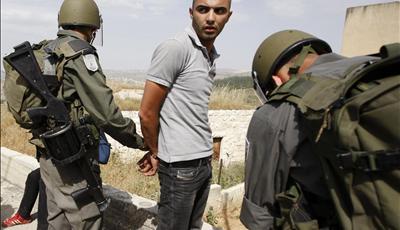
Israeli border police officers stand next to a detained Palestinian protester during clashes at a weekly protest in the West Bank village of Nabi Saleh, May 27, 2011 REUTERS/Mohamad TorokmanThe West Bank village of Nabi Saleh has become the focal point for what Palestinian activists there are calling the start of “something big…Like a third intifada.” The initial cause of the weekly protests was the seizure of a spring, and while Palestinians acknowledge that Israel’s Civil Administration “was ready to offer the spring back to the village in exchange for an end to the demonstrations,” they refused, escalating the confrontations and adopting a much more ambitious goal — “to bring down the occupation.” (See “Nabi Salih, A Growing Movement“)
Photographers gather every week in Nabi Saleh to record the clashes and B’Tselem has equipped Palestinian activists with cameras to document alleged abuses on the part of Israeli soldiers in the area. CAMERA has highlighted one instance in which a B’Tselem photographer abused the project, staging a scene in Nabi Saleh.
Now, an American-Israeli photographer charges Israeli soldiers with deliberately targeting him and other photographers in Nabi Saleh with tear gas and stun grenades. He accuses the soldiers of directing a sustained attack against the photographers for 3-5 minutes. No one was hurt, and no photographs or videos of the incident have been released. The IDF Spokesman’s Office claims that “full information on this incident was not submitted” making it impossible to examine the complaint. Meanwhile, an organization called the International News Safety Institute is lumping together this complaint against Israeli soldiers with one against NATO forces in Libya which carried out an airstrike on the Tripoli headquarters of the state television station, killing three members of the press and wounding 21.
August 5, 2011
Assad Murders, WCC Tweets

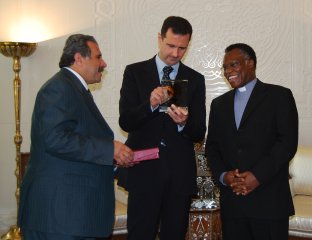
WCC Officials Meeting with President Assad in 2008BEIRUT – Syrian security forces are summarily executing people on the streets of Hama, a human rights group said yesterday, raising fears that bloodshed could escalate dramatically in the besieged city even as world condemnation of the violence continues to mount.
That’s the opening paragraph of an article published by Washington Post on Aug. 4, 2011.
While the WaPo talks of “world condemnation” there is one organization that has remained virtually silent over the violence in Syria: The World Council of Churches.
U.S. Secretary of State Hillary Clinton estimates 2,000 people have died at the hands of the Assad regime, and the best the WCC can do is offer a couple of tweets that fail to mention who is actually responsible for the violence.
When will the WCC name and shame the killers in Syria?
The organization has published at least three articles about the massacre in Norway, which resulted in more than 90 appalling deaths, but aside from four tweets, has said nothing about the Assad regime’s responsibility for the deaths of more than 20 times that number.
Three feature-length articles for approximately 90 Norwegians.
Four tweets for 2,000 Syrians.
Does the WCC value the lives of Norwegians over Syrians?
August 3, 2011
Unfit to Print?

Some might see it as a wise political move. Others might say it’s capitulation.
We can all agree, though, that Benjamin Netanyahu’s leaked decision to soften his opposition to references to the “1967 lines” thus far has been completely ignored by the New York Times.
Why would a newspaper so obsessed with the Arab-Israeli conflict ignore this reported development, when so many others — the Irish Times, the Hindustan Times and the Times of Oman, never mind the Washington Post, AP, AFP and Reuters — agree it is newsworthy? Does the New York Times feel it must first find a way to spin the story to fit its preferred narrative? Is it so desperate to avoid publishing a headline like “Palestinian Authority dismiss Israeli ‘peace proposal’“?
The newspaper may argue, in its defense, that it was waiting for uncertainty to be resolved. After all, the unnamed Israeli official who spoke with journalists appears to have been floating the idea as a trial balloon, and as such, information about the exact nature of Israel’s proposed compromise is vague and even contradictory.
But this is hardly the first bit of inconvenient information concealed by the Times. It chose not to report, for example, that France has explicitly sided with Israel’s position that the Palestinians recognize its right to exist as the Jewish state. Its readers, then, would not know that French Foreign Minister Alain Juppe said at a recent press conference,
France has a very clear position that joins that of Spain and all of our European partners: It is that there will be no solution to the conflict in the Middle East without recognition of two nation-states for two peoples. The nation-state of Israel for the Jewish people, and the nation-state of Palestine for the Palestinian people. There is no getting away from this.
Newsworthy? Of course it is. Palestinian rejection of the principle of two states for two peoples has been one of the central sticking points between the parties. And consequently, when senior Palestinian official Nabil Shaath insisted after Juppe’s press conference that the Palestinians will “never accept” the principle — in other words, that they are opposed to what most of the world understands as the two-state solution — this was also newsworthy. And it was also ignored by the New York Times.
August 3, 2011
“Peace Partners” in Their Own Words

In Ha’aretz, July 29, 2011, Mahmoud al-Zahar, a prominent member of Hamas, a terrorist organization which has the stated goal of destroying the Jewish state, is quoted as calling President Mahmoud Abbas’s UN bid for statehood within Israel’s borders a “political scam.” The Ha’aretz article states,
He (Mahmoud al-Zahar) is equally unequivocal on the so-called two-state solution, which aims at an Israeli state and a Palestinian state existing side by side.
‘We are not going to recognize Israel. That is very simple. And we are not going to accept Israel as the owner of one square centimeter…’How does Fatah, which formed a unity government with Hamas this past spring, and is often held up as a “partner for peace” with Israel, weigh in on this “two-state solution?” Nabil Shaath, Head of Foreign Relations in Fatah declared in a July 13, 2011, broadcast, “We will never accept the ‘Two States for Two Peoples’ solution to the Palestinian-Israeli conflict.”
Fatah is regularly cited as the “moderate” group.
August 1, 2011
Praying the Wrong Way
Not the Al-Aqsa Mosque 
Writing in the Aug. 1 Jerusalem Report about the status of Jerusalem in Islam, Danny Rubenstein claims that “Muslim’s pray in the direction of the Al-Aqsa mosque, the third most important mosque in Islam after Mecca and Medina.”
Of course, the qibla, or Muslim direction of prayer, is toward Mecca, not Jerusalem. And consequently, Muslims only pray “in the direction of the Al-Aqsa mosque” if it happens to lie in the same direction as Mecca.
The Jerusalem Report knows about the error, and we’ll update you if they publish a correction.




Search:
Search this site: