
Recent Entries:
Month: March 2017
March 3, 2017
Iranian Film Depicts Destruction of U.S. Navy

A filmmaker in Iran has released a 90-minute movie depicting the destruction of U.S. Naval forces by Tehran.
Associated Press correspondent Nasser Karimi reported on the film’s release (“Iranian film hails demise of U.S. Navy in imagined Gulf battle,” March 2, 2017). Iranian director Farhad Azima created the animated film, entitled “Battle of the Persian Gulf II.” The movie is a sequel to an earlier work about the 1980’s Iran-Iraq War.
According to the AP:
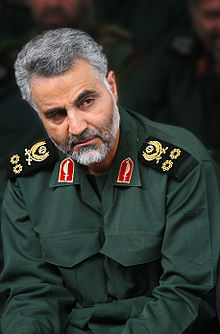
“In the film, a character who closely resembles Gen. Qassem Soleimani, head of Iran’s elite Quds Force, leads a single vessel against more than a dozen American warships. When a U.S. commander orders him to surrender or die, he replies: ‘General, I am not a diplomat, I am a revolutionary!’
“He [Soleimani] warns that any American soldiers taking part in an attack on Iran ‘should order their coffins,’ before his forces destroy the whole U.S. fleet.”
The movie depicts the U.S. Naval ships as being obliterated “with a barrage of rockets, some of which tear American flags from their masts.” The battle follows an imaginary U.S. attack on an Iranian nuclear facility.
Azima asserted that the film was made with no government involvement from Tehran and that money was raised from “ordinary people” in Iran. Yet, the ruling mullahs exercise considerable censorship and control over Iranian life; it’s unlikely that the movie was made without their tacit approval.
The AP dispatch claimed that, since the 2016 U.S. Presidential election, “tensions are rising again” between the U.S. and Iran. However, this is not the first time in recent months that Iran has threatened U.S. armed forces.
In November 2016, an Iranian ship “pointed its weapon” at a U.S. Naval helicopter in the Strait of Hormuz (“Iranian ship threatens U.S. helicopter, media MIA,” CAMERA, Dec. 5, 2016). Iran also has threatened U.S. ships, in August 2016 and January 2017, among other instances (“Official: U.S. Navy ship fires warning shot at Iranian boats,” CNN, Jan. 9, 2017). Capt. Jeff Davis, a Pentagon spokesman, told CNN in January 2017 that there were a total of 35 instances of Iranian ships acting belligerent towards U.S. vessels in 2016.
March 1, 2017
Guardian Refuses to Correct False Claim that Journo Drove Through Mt. of Olives “Tunnel”
(Cross-posted from UK Media Watch)
Earlier in the month we examined a Feb. 13th Guardian article written by Sarah Helm, “It’s too late to stop the senseless capture of Palestinian land”, a propagandistic tour de force which amplified the prophetic anti-Zionist musings of a Palestinian “cartographer“ named Khalil Tufakji.
There were multiple errors and misleading claims in Helm’s report, but one we particularly focused on is found in the following passage:
I’ve been listening to Tufakji since the mid-1990s and everything he foresaw has so far come true. He pointed out where a tunnel would be drilled through the Mount of Olives to connect settlements – it seemed impossible but we are now driving through it.
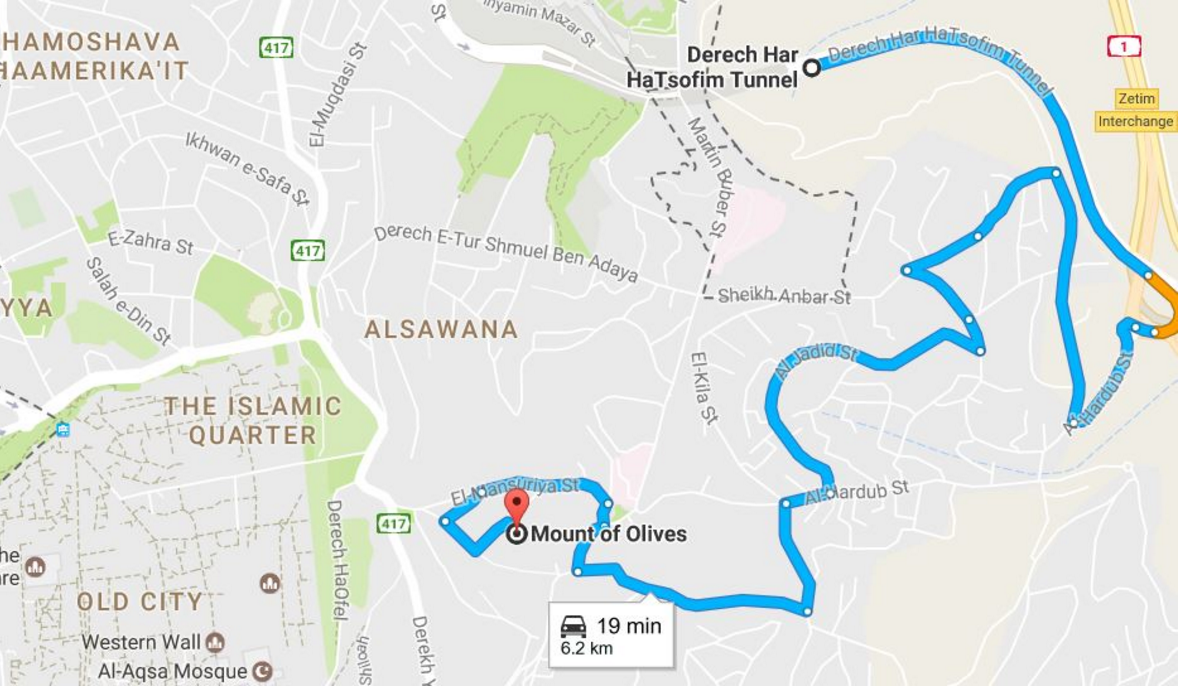
As we noted at the time, whilst it’s unclear where precisely Helm was driving, she certainly wasn’t driving through the historic 3,000 year old Jewish cemetery adjacent to Jerusalem’s Old City – for the simple reason that there is no such tunnel at that location! We considered that Helm may have conflated the fake Mount of Olives tunnel with the real Mount Scopus tunnel (Derech Har HaTsofim Tunnel) quite a few kilometers away.

We complained to Guardian editors and, ten days later, we received a reply, implicitly acknowledging that the journalist was in fact driving through Mount Scopus, as we surmised. However, instead of correcting the grossly misleading text, editors decided to argue that though Helm was driving through Mount Scopus Tunnel, it’s not wrong to refer to Mount Scopus as Mount of Olives.
Here’s their full reply:
We understand that the tunnel known as the Mount Scopus tunnel goes through the Mount of Olives ridge.
The description here by the Jerusalem expert Eli Schiller states in part that: “The Mount [of Olives] has three prominent peaks: Mount Scopus, 826 m, A Tur (Church of the Ascension) 816m, and Mount of Corruption, 746m”.
Schiller also states: “Today Mount Scopus is part of the Mount of Olives, and there is no necessary justification to give each different terminology.”
For the purposes of the article, we think it is sufficient to leave the reference to a tunnel through the Mount of Olives as it is.Let’s be clear about what this represents. Editors knew they couldn’t argue the facts in ordinary language (using regular maps), so they pivoted to an obscure geological justification — concerning what constitutes the broader Mount of Olives ridge — for Helm’s claim that she drove through a tunnel at Mount of Olives.
Of course, the sentence about driving through Mount of Olives would have immediately evoked, to the overwhelming majority of Guardian readers, a very specific visual of the iconic and historic Mount of Olives cemetery. They certainly wouldn’t have considered – let alone researched – the geological nature of the area in question. If they had decided to investigate the claim further, they would have more likely just consulted a regular map (like Google Maps, seen above), and seen that Mount of Olives (in the ordinary use of the term) represents a distinct and unique Jerusalem location.
Indeed, the context and aim of the passage about the tunnel “through Mount of Olives” written by the Guardian journalist seems clear: to support her Palestinian protagonist’s narrative that Israel is encroaching on and desecrating Palestinian land and historical sites in the holy city – making peace impossible and war inevitable. A tunnel through Mount Scopus simply would not have had the desired rhetorical impact as a tunnel through Mount of Olives, and certainly wouldn’t have helped support the story of Israeli malevolence she wanted to tell.
No amount of sophistry or obfuscation can change the fact that the claim by the Guardian journalist was egregiously and substantively misleading to readers, and thus in violation of the accuracy clause of the Editors’ Code.
We have appealed the Guardian decision and will update you as warranted.

— by Adam Levick

Search:
Search this site: