
Recent Entries:
Month: August 2016
August 17, 2016
Israel Busts Terror Cells Sponsored by Hezbollah, Recruited via Facebook

Israel has arrested Palestinian terrorists in the West Bank (Judea and Samaria) and the Gaza Strip who were recruited by Hezbollah through social media. Hezbollah is the Lebanese-based, Shiite Muslim, U.S.-designated terrorist group.
According to The Times of Israel, two separate Palestinian terror cells had “planned to carry out suicide bombing and ambush IDF patrols in the West Bank (“Hezbollah terror cells, set up via Facebook in West Bank and Israel, busted by Shin Bet,” Aug. 16, 2016).”
The Shin Bet, Israel’s domestic security agency, thwarted the plot “earlier this summer.” The case was only publicly revealed on August 16, 2016.
Times of Israel correspondent Judah Ari Gross reported that the head of the West Bank terror cell, a Palestinian Arab named Mustafa Kamal Hindi, “told interrogators that he’d been recruited through a Facebook page, ‘Palestine the Free,’ where Hezbollah posted ‘anti-Israel and pro-jihad content.’” Hindi and four other members of his cell were detained by Israeli authorities in June 2016.
The Gaza Strip cell consisted of three Palestinians. Gross noted:
“Mehmed Fa’iz Abu-Jadian, a resident of the Gaza Strip and member of Hezbollah’s Unit 133, reached out to Usama Nu’af Sid Najm, a 36-year-old resident of Qabalan, south of Nablus, through Facebook.
After making initial contact through the social media, Abu-Jadian instructed Najm to use a computer encryption program in order to contact Hezbollah operatives in Lebanon, according to the investigation.
Najm also agreed to recruit others to join Hezbollah and eventually carry out a suicide bombing on an Israeli bus ‘in exchange for $900,’ the Shin Bet said.”
Gross said that Najm was attempting to set up a branch of the Popular Front for the Liberation of Palestine (PFLP), a U.S.-designated terrorist group that, like Hamas and Hezbollah, among others, receives extensive Iranian support.
The Gaza cell used Facebook to set up initial contacts and later moved to emails, phone calls and eventually encrypted communications. The group planned to carry out a shooting attack on Israeli soldiers in the Jenin area. The Shin Bet stated that Hezbollah has made “multiple attempts…to recruit operatives among the country’s [Israel’s] Arab population through a Facebook profile that posted anti-Israel and pro-Palestinian sentiments.”
CAMERA has previously highlighted how Facebook has allowed terrorist-sponsored media to operate on its platform, while blocking articles by pro-Israel commentators, such as Bernard-Henri Levy (see, for example “Facebook Allows Hamas News Agency to Operate Freely,” Oct. 26, 2015). Hezbollah’s use of the social media network is disconcerting.
As CAMERA’s July 2016 backgrounder noted, Hezbollah is a well-armed terrorist organization that remains committed to Israel’s destruction (“Hezbollah Backgrounder: 2016,” July 19, 2016). Hezbollah has made clear who its principal benefactor is.
According to the Middle East Media Research Institute (MEMRI), a non-profit organization that translates Arab and Iranian media Hezbollah chieftain Hassan Nasrallah stated in June 24, 2016 speech: “Hizbullah’s budget—its salaries and expenditures, [the money that pays for] its food and drink, weapons and missiles—[all come from] Iran. Is that clear? As long as Iran has money we have money.”
In a July 8, 2015 Op-Ed in The Hill (“Iran becoming a responsible international player—the mother of all mirages”), a Washington D.C.-based publication, CAMERA pointed out that many media outlets have erroneously labeled Iranian rulers as “moderate.” Yet, as the arrests of Hezbollah-supported terror cells indicate, Iran—and its proxies who ‘share’ the group’s goals—are anything but.
August 15, 2016
New York Times Casts Olympians’ Anti-Israel Hostility As Mutual Animosity

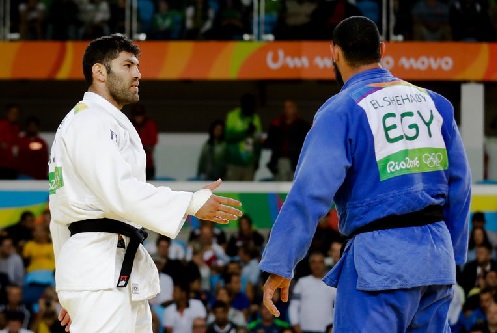
In a sports story on the Egyptian judoka who refused to shake hands with his Israeli opponent, The New York Times misleadingly depicts a pattern of anti-Israel hostility on the part of Muslim and Arab Olympians as “animosity between Israeli and other Middle Eastern athletes,” as if the two sides are equally engaged in hostile acts directed against the other side. In his Aug. 13 article about Islam El Shehaby’s snub of Or Sasson (“Egyptian Refuses Handshake After Losing to Israeli“), Victor Mather writes:
There is a history of animosity between Israeli and other Middle Eastern athletes at the Olympics, including in judo.
Mather helpfully goes on to cite examples, all of which tellingly point to one directional hostility: Arab and Muslim athletes snubbing Israeli competitors. First, he cites last week’s incident in a Lebanese team prevented an Israeli team for boarding a bus. Then, he notes that last Tuesday, a Saudi judo player forfeited a match, reportedly to avoid competing against an Israeli. Finally, The Times’ Mather cites a 2004 incident in which Iranian judoka Arash Miresmaeili apparently binged in order to be disqualified so as to not to face off against an Israeli.
Indeed, Israeli Olympians are consistently on the receiving end of Arab and Muslim animosity so why misleadingly characterize the hostility as “animosity between Israeli and other Middle Eastern athletes”?
See also “AFP Headlines Conceal Egyptian, Lebanese Bad Sportsmanship at Olympics“
August 12, 2016
AFP Headlines Conceal Egyptian, Lebanese Bad Sportsmanship at Olympics

Lebanese and Egyptian athletes have been reproached for bad sportsmanship after a series of anti-Israel stunts at the Rio Olympics. AFP headline writers, though, appear to be going out of their way to obfuscate the facts.
As CAMERA’s UK Media Watch has noted, when Lebanese Olympic delegation barred Israeli athletes from boarding a bus, an act for which they were reprimanded by the International Olympic Committee, an pitiful AFP headline announced: “Israeli and Lebanese teams compete for bus.” The euphemistic language miserably failed to summarize the story, and obscured the discriminatory behavior of the Lebanese delegation.
And today, after an Egyptian judoka refused to shake the outstretched hand of his victorious Israeli challenger, earning boos from the audience, AFP again fell short. Its headline: “Egyptian judoka jeered after Israeli handshake snub.”
The headline is perhaps less awful than the earlier one. But the language is still unnecessarily vague, and inexplicably so coming from a major professional media organization. To describe the incident as involving an “Israeli … snub” suggests it was the Israeli who snubbed his opponent, and not the opposite. And if it was an Israeli snub, was it also an Israeli jeer?
It’s possible that some readers will be able to extrapolate from the AFP headline what actually happened. Others certainly won’t.
The Poynter Institute has described headlines as “often the most important element on the page.” A Columbia School of Journalism document says they “may be more important than any paragraph in a normal story.” So why can’t AFP get it right?
There’s no good excuse for bad sportsmanship in the Olympics. And there’s no good excuse for bad headlines about the bad sportsmanship.
August 11, 2016
AFP Headline on Stabbing Says Less With More

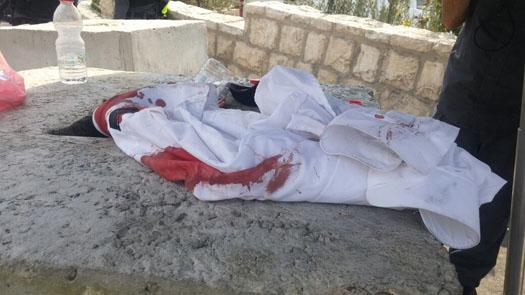
The shirt belonging to the 18-year-old Jew injured in a Palestinian stabbing attack today (Photo from Israel Police)Poynter Institute, a leading journalism organization, has noted that headlines are “often the most important element on a page.” Many hurried readers never get beyond the headlines, and so the headline may be the only information they learn about the story. For these reasons, accuracy and clarity is particularly vital when it comes to headlines.
Headlines from two leading wire services, the Associated Press and Agence France Presse, about a Palestinian stabbing attack today in Jerusalem demonstrate how different headlines about the same event can provide more or less information, and give a clear, or less informative, snapshot of events. Wire service headlines are particularly influential because newspapers and websites around the world reproduce them.
AFP’s headline is: “Jewish man stabbed in suspected Jerusalem ‘terror’ attack: police”

AP’s headline states: “Palestinian stabs, wounds Israeli teen in Jerusalem”

The differences between the two are striking.
1) AFP’s headline does not identify the perpetrator. AP’s does (Palestinian). Therefore, AP gives more basic information critical to the story. AFP gives less.
2) AFP uses the passive voice (“Jewish man stabbed”). AP uses the active voice (“Palestinians stabs”). Passive voice obscures the perpetrator.
3) AFP’s headline is nine words. AP’s is just seven. AP uses less to say more. AFP wastes words. The headline identifies police as the source of the information that a Jewish man was stabbed, so it is redundant to label the stabbing as a “suspected” terror attack. Moreover, police spokesman Micky Rosenfeld was definitive in his characterization of the attack as terror. He did not refer to a “suspected” terror attack. (In addition, the scare quotes on the word “terror” aren’t necessary, because, again, the headline already attributes the information to the police.)
August 11, 2016
LA Times Errs on Western Wall, Still Silent on Stolen Aid
Aug. 15 Update: CAMERA Prompts Los Angeles Times Correction on Western Wall

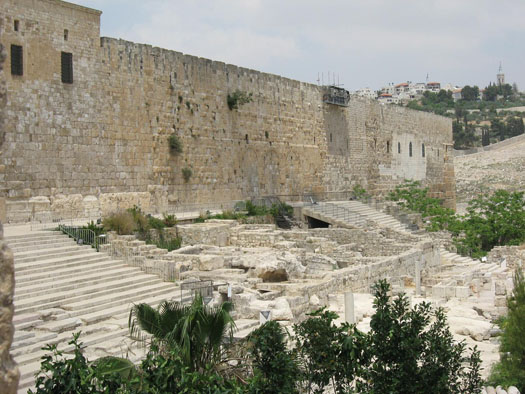
The Temple Mount’s southern wall, one of several extant remains of the Temple complexEven as it continues to churn out coverage on Israel and the Palestinians, including an article today on opposition to women leading prayer at the Western Wall, The Los Angeles Times still ignores Hamas’ diversion of tens of millions of dollars donated from multiple international aid organizations, a huge story with profound implications for humanitarian aid in Gaza and other areas of conflict.
Meanwhile, today’s story on the Western Wall, by Joshua Mitnick, errs: “The wall, with its giant stone blocks, is the last remnant of the Jewish Temple complex built two millenniums ago. . . ”
In fact, It is not the last remnant of the Temple complex. There are numerous extant remnants. The southern, eastern and northern retaining walls are also still extant. Surviving features abutting the southern walls include a broad stairway leading up to the Temple Mount’s entrance and two gates, known as the Huldah Gates, which provided access to the Temple Mount (Hershel Shanks, Jerusalem: An Archaeological Biography, p. 143). Some of the interior part of the Herodian Double Gate (which is one of the Huldah Gates) is also still intact. There are also surviving underground remnants of the Temple complex, including the area known as Solomon’s Stables. In addition, an area called “Robinson’s Arch,” in the south-western corner of the Temple complex, still remains. In his book, Shanks provides details concerning numerous other remnants.
On Sept. 24, 2004, The Los Angeles Times corrected the very same error:
Western Wall–An article in Monday’s Section A about a visit to Jerusalem by pop star Madonna described the Western Wall in the Old City as the sole remnant of Jews’ Second Temple. It is the principal remnant of the temple complex accessible to worshipers, but other archeological elements survive.
Other media outlets which have previously corrected the same error include the Associated Press and Haaretz.
August 10, 2016
‘Pragmatic’ Iranian Official Boasts of ‘Tsunami’ in Nuclear Activity—Media M.I.A

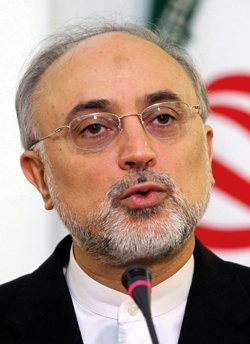
The head of the Atomic Energy Organization of Iran (AEOI), Ali Akbar Salehi, rejected claims that his country would decelerate its nuclear activity, instead promising a “tsunami” in Tehran’s nuclear industry. Despite the fact that the AEOI is tasked with operating Iran’ nuclear facilities, Salehi’s remarks on Aug. 9, 2016 received scant coverage by major U.S. news media outlets.
Speaking before the Professional Center for Journalism, an Iranian non-profit organization, Salehi disputed rumors that Iran’s nuclear activity was dissipating. Iran’s one-time foreign minister told the audience, “With all my scientific, technological and administrative experience in the nuclear field for some 50 years, I insist that the nuclear industry has not been shut down and the work is going on. (“Iran’s Atomic Energy Chief Rejects Rumors of Waning Nuclear Activity,” The Algemeiner, Aug. 9, 2016)”
Salehi added that Iran’s President, Hassan Rouhani, would be meeting with Russian leader Vladimir Putin to discuss, among other things, the construction of two new nuclear power plants for the Islamic Republic. The AEOI chief said that the $10 billion project, once approved by Moscow and Tehran, would create a “tsunami” in Iran’s nuclear industry.
Although Salehi’s comments were made before the Professional Center for Journalism, they were little noted by the U.S. news media. A Lexis-Nexis search of The New York Times, The Washington Post, The Washington Times, USA Today and The Baltimore Sun, among other print outlets, showed no mention of Salehi’s remarks.
The failure to report Iran’s nuclear chief promising growth in Tehran’s nuclear program is conspicuous. As CAMERA has noted (see, for example “Watchdog: Iran Nuclear Deal Prevents Public Reporting of Violations,” March 10, 2016), media coverage of Iran’s nuclear program—while often flawed—has been extensive. Reporting was particularly substantial in the months before, during and after the July 2015 JCPOA (Joint Comprehensive Plan of Action) in which the United States, Germany, France, Russia, the United Kingdom, China and Iran reached an agreement over the latter’s alleged nuclear weapons program.
Salehi himself is no stranger to the press. Reuters hailed his August 2013 appointment to head the AEOI, characterizing him as a “pragmatist (“Iran appoints pragmatist Salehi to head nuclear program,” Aug. 16, 2013). The news service quoted Mark Fitzpatrick, the director of the non-proliferation and disarmament program at the International Institute for Strategic Studies, a U.K.-based think tank. Fitzpatrick called Salehi’s appointment “wise…Salehi was the best of [former Iranian President Mahmoud] Ahmadinejad’s ministers, a pragmatist who understands how the world works. It made sense to keep him on in some capacity.”
Salehi may indeed be pragmatic in working to achieve his—and the mullahs—self-stated goals of increasing Iran’s nuclear capabilities. As Richard Rorty, a deceased philosopher of pragmatism, once noted, “Truth is what your contemporaries let you get away with.”
Iran’s nuclear chief revealed a truth about his country’s nuclear pursuits—one that seems to contravene the spirit of the Iran nuclear deal. And his contemporaries in the press failed to report it.
Where was the coverage?
August 10, 2016
LA Times Silent on International Aid Going to Hamas
The New York Times last week published an in-depth article, more than 1,100 words, about the Gaza director for World Vision, a Christian aid organization, who was charged with funneling over $40 million to the Hamas terrorist organization. Before the Times reporters had completed that story, their paper’s website already posted this Associated Press article about Mohammed el-Halabi, the World Vision employee.
The Times continued its strong coverage on the subject with a long article in print today about a United Nations aid worker similarly charged with helping Hamas in Gaza. The charges are significant enough that Australia and Germany have halted their support for World Vision projects in Gaza and the West Bank.
Yet, The Los Angeles Times print edition published not a single word about the employees working for World Vision, the United Nations Development Program and Save the Children, another international aid group, who have been arrested for funneling aid money to Hamas. (The Los Angeles Times website did run three Associated Press news stories, inexplicably in the nation section, though the stories are international. Please see clarification below.)
The LA Times’ utter failure to cover this critical story is all the more glaring in light of the paper’s publication today of an article about the slow reconstruction of homes in Gaza since the 2014 war between Israel and Hamas (“2 years after Gaza war, still no homes“). Given the vital role that international organizations, including the United Nations, play in the rebuilding of homes in Gaza, the oversight is all the more indefensible.
As The New York Times reported, the United Nations Development Program, where Waheed Al Bursh was employed as an engineer, “is helping rebuild thousands of homes and other buildings destroyed by airstrikes” in 2014. Al Bursh was charged with providing material assistance to Hamas, including helping to build a jetty for the terror group.
According to The New York Times, a statement by the Shin Bet, Israel’s internal security forces, said that Al Bursh “had also persuaded his managers to prioritize the rebuilding of homes in an area ‘populated by Hamas members.'”
The implications of widespread abuse of international aid funds are profound. As Ashley Jackson, a research associated at the Overseas Development Institute in London told The New York Times: “Working in the Palestinian territories was hard before, and I can’t imagine what it is going to be like now.” Robert Piper, a UN humanitarian worker, likewise lamented: “If proven by a due legal process, these actions deserve unreserved condemnation; Gaza’s demoralized and vulnerable citizens deserve so much better.”
As Naji Sharrab, a political science professor at Al Azhar University in Gaza, candidly told The New York Times: “Hamas has complete authority to interfere and control all the organizations working in Gaza.” Hamas’ authority to interfere also affects the organizations’ efforts to rebuild, though The Los Angeles Times completely ignored this factor in its account of the “multiple headwinds holding up the massive project.”
Aug. 12 Clarification and UpdateThis post was amended on Aug. 12 to reflect the fact that The Los Angeles Times website did publish Associated Press stories on the World Vision in its “Nation” section, though the stories are international news. CAMERA regrets the oversight concerning the online edition. These wire stories did not appear in the print edition.
In addition, an editor at the foreign desk responded to CAMERA’s concerns about the paper’s failure to cover Hamas’ diversion of international aid. The editor stated that the paper’s correspondent in Israel is on vacation and thus The Times is unable to cover the story. Of course, the print edition has in the past relied on wire services to fill in on their coverage of Gaza, so it’s not clear why editors did not run a wire story in this case as well. Associated Press articles about Gaza which appeared earlier this year in The Los Angeles Times print edition include “”Romeo and Juliet,’ Gaza-style; Rift between Hamas and Fatah takes center stage in altered Shakespeare play” (May 14, page A4); “Gaza grapples with sewage crisis, spill poisons coast and Israeli blockade makes matters worse” (May 8, page 14); “Laughter as a medical aid, Palestinian clowns offer relief to kids in Gaza hospitals” (April 3, page A9); and “Gaza’s zoo animals die of hunger, disease; ‘People have a hard time finding food, much less the animals, a zookeeper laments” (Jan. 31, page A6). Surely if a Gaza theater production and the fate of Gaza’s zoo animals merit coverage in the print edition, then so does a large scale funding scandal involving multiple international aid groups and tens of millions of dollars which jeopardizes humanitarian aid in the Gaza Strip.
August 4, 2016
Did World Vision Employee Spy for Hamas?
In June, Israel arrested Mohammed El-Halabi, director of World Vision’s operations in Gaza. World Vision, as most Snapshots readers know, is a Christian charitable organization that seeks to improve child welfare throughout the world.
Today, the story broke that Halabi is charged with siphoning funds and materials intended to help children in the Gaza Strip and redirecting these funds and goods to the terror organization Hamas. The news is shocking. But there’s one aspect of the charges against Halabi that has not got much play: Halabi allegedly used his status as a World Vision employee to spy for Hamas. A statement issued by the Israeli government detailing Halabi’s alleged crimes includes the following passage:
In addition to the financial and logistical aid that El-Halabi provided Hamas, he also exploited his visits to Israel, which were permitted due to his legitimate work for World Vision, to engage in serious terrorist activity – locating and marking [via GPS] sites near the Erez Crossing that potentially could be used as egress points for Hamas attack tunnels.
If this allegation is true, it indicates that Halabi used his status as an employee of an NGO to spy on behalf of a terror organization.
August 4, 2016
Fatah Claims Murders as Accomplishments

Fatah, the movement which dominates the Palestinian Authority (PA), claimed murder and terror attacks as achievements on behalf of Palestinian Arabs in a list posted on the social media site Facebook.
According to Palestinian Media Watch (PMW), a non-profit organization that monitors Arab media in eastern Jerusalem, the West Bank (Judea and Samaria) and the Gaza Strip, Fatah published the catalog of what it considered to be accomplishments on August 2, 2016. In it, PMW noted, “Fatah did not cite even once peace-seeking or peace-promoting achievement, but only listed Fatah acts of violence and terror.”
PMW reported that a partial inventory of Fatah’s self-selected attainments include: “Fatah has killed 11,000 Israelis,” “Fatah has sacrificed 170,000 Martyrs (Shahids)” and “Fatah led the Palestinian attack on Israel in the U.N.”
Specific terrorist attacks were also highlighted by Fatah. For example, the 1988 bus hijacking and murder of three Israeli civilians traveling to work in Dimona. Fatah has celebrated the Dimona attack before—even producing a 2015 full-length feature film entitled The Revolutionists of the Land, glorifying the “great operation.”
As a recent CAMERA Op-Ed in the Washington Examiner (“Missing the Palestinian after-terror after party,” July 6, 2016) noted, Palestinian celebrations of anti-Jewish violence are not new. In fact, they are common.
Although Fatah often glorifies terrorist attacks, the movement—and its leader PA President Mahmoud Abbas—frequently have been mislabeled by many media outlets as “moderate” (see, for example “Where’s the Coverage? ‘Moderate’ Fatah a Partner in Terror,” July 9, 2014).
The same day that Fatah published its list of “achievements,” Israel announced a new scientific breakthrough. The Times of Israel reported that “civilian airline pilots flying through fog or other limited visibility conditions will soon be able to benefit from an optical system designed by Israeli defense industry leader Elbit Systems (“Israel tech enables pilots to see through fog”).
As CAMERA has often noted (see, for example “Where’s the Coverage? Israeli Technology Gives Sight to the Blind,” Nov. 6, 2013), Israel is a leader in developing technology which, among other things, fights cancer, helps those with visual impairments and disabilities and provides water in regions where it’s scarce. If your national liberation movement is about building, this is what you celebrate. If it’s about destroying, then you honor murder.
August 3, 2016
‘Moderate’ Hamas Media Favorite Calls for ‘Small Stabs to All Parts’ of Israel

A top operative of Hamas and news media favorite named Ghazi Hamad has recommended “small stabs to all parts of Israel” as a strategy against the Jewish state. Hamad is currently the deputy foreign minister of Hamas, the U.S.-designated terrorist group that rules the Gaza Strip.
According to the Middle East Media Research Institute (MEMRI), a non-profit organization that translates Arab and Persian media, Hamad suggested a war of attrition against Israel in an Op-Ed he wrote for the Alwatanvoice.com, an online Palestinian news outlet based in the Gaza Strip.
Hamad—a former spokesperson for Hamas—has frequently been treated as a credible source by many media outlets. A Lexis-Nexis search showed that The New York Times alone quoted Hamad—often uncritically—no less than 18 times between 2006 and 2016. Despite, or perhaps because of the frequency with which he has been quoted, some U.S. news outlets seemingly have been taken in by the Hamas operative.
In a Sept. 12, 2006 story, The New York Times uncritically quoted Hamad’s false claim that “the charter of Israel’s conservative Likud Party calls for an Israel on both banks of the Jordan River.” The Times offered a correction eight days later (“Don’t Bank on Hamad’s Word,” CAMERA, Sept. 20, 2006).
In yet another example of the media giving Hamad undue credibility, Edmund Sanders, The Los Angeles Times Jerusalem bureau chief, wrote that Hamad was “considered a leading moderate voice in Hamas” in a June 8, 2012 interview (“LA Times Soft-Pedals Hamas Terrorist Agenda,” CAMERA, June 20, 2012). But it seems that Sanders may have been confusing moderation with pragmatism; as MEMRI reported, Hamad’s ultimate objective is precisely what Hamas spells out in its charter—the destruction of the Jewish state and the genocide of its citizens.
In his Altwatanvoice Op-Ed, Hamad criticized Hamas’ “boasting” about future large-scale wars against the Jewish state. MEMRI noted that Hamad said, “Wars do not require words, speeches, or predictions—rather they require observation, understanding, and judgement.”
In place of fiery rhetoric, the Hamas operative advocated smaller, more strategic attacks against Israelis. Hamad exhorted:
“Throughout history, and according to experience, rules and principles dictate how the resistance movement operates, and it does so based on sporadic attacks and retreat, striking at the underbelly, and avoiding direct conflict as much as possible—meaning that we must conduct ‘guerrilla warfare.’”
Hamad clarified that although he believed in avoiding an open war with Israel, he did “not [want] to avoid conflict, but rather to achieve better results in fighting the enemy.”
Perhaps anticipating criticism for his stance from possible Hamas rivals, Hamad wrote, “Before anyone [hastens] to formulate exaggerated slogans about me, let me reiterate that resistance is a legitimate and undisputed right.” As CAMERA has noted (see, for example “New York Times Magazine Cheerleads for Terror,” March 20, 2013), “resistance” is a term frequently used by Palestinian Arabs to describe—and justify—anti-Jewish violence, virtually always criminal under international law.
In his commentary, Hamad pointed out one way to “stab” Israel: “exhaust it and place it under intense public pressure, while the price that the Palestinian side must pay [for guerilla warfare] is less harmful and painful.” That “intense public pressure” against Israel is aided by news media too willing to see a man advocating strategic terrorist attacks as opposed to immediate full-scale warfare as a “moderate.”





Search:
Search this site: