
Recent Entries:
Month: May 2015
May 19, 2015
Haaretz Errs on Arabic-Speaking Saints
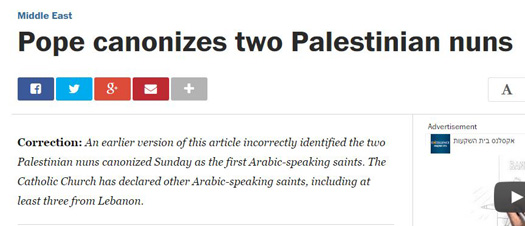
In an article about the recent canonization of two Arab nuns from the Holy Land, Mariam Baouardy and Marie Alphonsine Danil Ghattas, Haaretz errs (“Pope to canonize two Palestinian nuns“): “They will be the first Arabic-speaking saints . . . ”
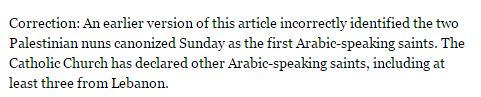
As The Washington Post has made clear in a prominently placed correction, there are at least three other Arabic-speaking saints.

One of them St. Charbel Makhlouf, a Maronite Catholic priest, born Yussef Antoun Makhlouf in Lebanon in 1828. “He was canonized in 1977 by Pope Paul VI, who had earlier hailed the Lebanese Maronite saint as an ‘admirable flower of sanctity blooming on the stem of the ancient monastic traditions of the East,'” Catholic News Agency reported.
On a related matter, stay tuned for a detailed CAMERA post on how the media identifies the two nuns as Palestinian, though they likely did not identify as such.
May 20 Update: Haaretz Commendably Corrects
Haaretz editors have commendably removed the erroneous claim that the two women are the first-Arabic speaking saints, and the following correction is appended to the bottom of the article:

May 19, 2015
Follow Up, AP Correction on Pope’s Disputed “Angel of Peace” Comment

Following communication from CAMERA, several leading media outlets have followed up on their initial reports which unequivocally stated that Pope Francis called Palestinian President Mahmoud Abbas “an angel of peace.” Yesterday, CAMERA staff was in touch with editors at The New York Times, the Associated Press, Reuters and Agence-France Presse to ask how their reporters definitively concluded that those were the Pope’s words when some Italian media outlets, such as La Stampa‘s Vatican Insider, reported that the Pope exhorted the Palestinian leader, “may you be an angel of peace.” (Other Italian media outlets were consistent with the English reports.)
We also pointed to the statement of Father Federico Lombardi, the Vatican’s chief spokesman, in which he told The Times of Israel that though he was in the room during the meeting, he did not know the Pope’s exact words. CAMERA asked the media outlets if they had a better informed source than Father Lombardi. The Vatican has not released any transcript or official wording documenting the informal remarks, and the audio recording is not clear enough to definitively determine what was said.
Meanwhile, CAMERA posted its own analysis late in the day yesterday (“Pope Francis Remarks to Abbas Prompt Firestorm and Uncertainty“), which concluded:
In sum, much of the criticism [by bloggers and media monitors] directed at coverage of the Pontiff’s remarks is based on the assumption that he said one thing or the other. In light of what can be gleaned from various reports and of the Pontiff’s previous remarks about Abbas, it’s reasonable to conclude that he said both and that media outlets picked up on the most provocative interpretation.
Most of the media outlets that CAMERA contacted with questions about their initial reporting have commendably followed up with either new reports detailing the uncertainty around the comments, or with a correction.
The follow up articles examining the uncertainty of the Pope’s remarks and the surrounding controversy include those by The New York Times (“Vatican Seeks to Quiet Uproar of Pope’s ‘Angel of Peace’ Remark“) and AFP (“Pope ‘angel of peace’ Abbas comment was encouragement: Vatican“). Reuters has also indicated that an article examining the disputed the statement is under way.
In addition, The Associated Press issued the following correction:
In a story May 16 about Pope Francis meeting with Palestinian President Mahmoud Abbas, The Associated Press erroneously omitted two words when quoting the pope. Francis told Abbas “you are a bit an angel of peace,” not “you are an angel of peace.” The original Italian quote was, “Lei e un po un angelo della pace.”
In response to CAMERA query as to how the AP reached this new wording, we received the following statement from Paul Colford, Director of AP Media Relations:
AP Rome correspondent Nicole Winfield was in attendance and covered last week’s exchange between Pope Francis and Palestinian President Mahmoud Abbas.
After others questioned AP’s report that the pope said to Mr. Abbas, “you are an angel of peace,” AP reviewed written notes and a videotape of the meeting that supported Winfield’s English-language translation of the pope’s remarks, except for the omission of two words, the Italian “un po,” or “a bit.”
A correction distributed by AP on Monday evening shows these two words within the pope’s comment as it was originally reported by AP: “you are a bit an angel of peace.”
May 14, 2015
Bialik and Bibi on “Revenge”
After Palestinian kidnappers murdered three Israeli teens last June, Benjamin Netanyahu quoted a verse by the well-known Jewish poet Hayim Biyalik. The quote — “Vengeance for the blood of a small child, Satan has not yet created,” Benjamin Netanyahu wrote on Twitter, before adding that the same applies to the three murdered youths — was circulated widely, mostly by critics of Israel who cast the reference as a clear call for Israelis to take revenge on Palestinians.
But as CAMERA has pointed out in a letter in the Washington Post and in a recent article about The New York Times’ misrepresentation of the Bialik poem, those critics are wrong. The opposite is true.
In “On the Slaughter,” the poem cited by Netanyahu, Bialik “rejects human revenge and envisions a natural revenge that will take place by itself,” explains poet and professor Hamutal Bar-Yosef, who is described in Haaretz as “a leading figure in the field of Hebrew literature.”
That’s hardly only an ivory tower interpretation. Menachem Begin, the founder of Netanyahu’s Likud Party and someone Netanyahu has described as a “role model,” also referenced the poem in a 1979 speech:
… as far as children are concerned, we always remember the famous verse of our great poet, Bialik: “Revenge like this, the revenge for the blood of a child, Satan himself did not yet create it.” Nobody can take revenge for the blood of a little child. Nobody. We don’t want to retaliate — we want peace for our people, security for our people, and for our children.
Begin’s speech was about about the need for Israel to militarily fight terrorism — the very same context as Benjamin Netanyahu’s Bialik citation. It was delivered before a well-known Israeli professor, Benzion Netanyahu, the current prime minister’s father. And it was later republished in a 1981 book edited by none other than Benjamin Netanyahu.
Nobody can convincingly argue, then, that Benjamin Netanyahu did not understand Bialik’s words. Nor can anyone credibly say Netanyahu’s reference to Bialik’s poem was a call for Israelis to pursue vengeance on their own. Those suggesting otherwise, including Haaretz, The Forward, and The New York Times, owe readers a clarification.
* And a clarification of our own: This post initially stated, incorrectly, that Begin’s speech was delivered before both Benjamin Netanyahu’s brother and father. Only his father was there.
May 13, 2015
BDS Activists Lose in Ithaca, Anti-Israel Defamation Continues

Jim Murphy, a local radio host and supporter of the BDS campaign in Ithaca, which suffered a setback when a local food coop rejected an anti-Israel boycott proposal last night.The governing board of the GreenStar Cooperative Market, a food coop located in Ithaca New York, handed the BDS movement a set back last night when it rejected a proposal to impose a boycott on Israeli-produced goods. Advocates of the proposal, who had falsely claimed that Sabra Hummus was named after the Sabra and Shatilla massacre, suffered the defeat after the coop’s council concluded that the boyct proposal violated New York state human rights law which prohibits companies participating in boycotts based on national origin.
William Jacobson, a blogger at Legal Insurrection, and a law professor at Cornell University (located in Ithaca) who has been documenting the controversy, states “This is a very important victory, and one in which the NY Human Rights Law played a central role. As such, it has serious implications for other boycott attempts singling out Israeli products based on national origin.”
Ithaca is a hotbed of anti-Zionist activism. Alison Weir, a well-known anti-Israel propagandist will be speaking at the Unitarian church in Ithaca this evening (May 13, 2015. The event has drawn criticism from the Ithaca Coalition for Unity and Cooperation in the Middle East (ICUC-ME), which has written a letter to the church council.
(more…)May 11, 2015
Germany Confronts its History

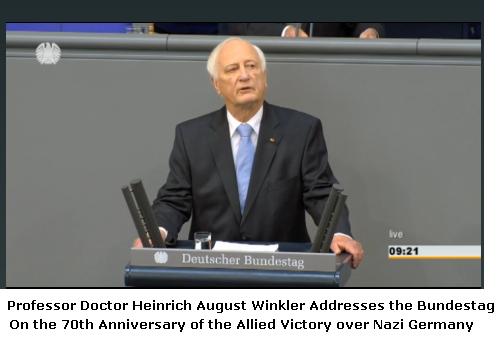
The past week witnessed commemorations of the defeat of Nazi Germany 70 years ago. The German legislature, the Bundestag, featured an address by eminent historian, professor doctor Heinrich August Winkler, Chairman of the Department of History at Humboldt University in Berlin. Winkler pulled no punches in his sweeping assessment of German responsibility for the cataclysmic war. But equally important his measured words are a warning to all generations.
Quoting philosopher Ernst Cassirer, Winkler describes Hitler’s political ascendance as the “triumph of myth over reason.” Viewing the xenophobia and outbreak of anti-Semitism in the world today, Winkler concludes, “Cassirer’s words still have relevance today.” He warns,
In politics we are always living on volcanic soil. You must be prepared for abrupt convulsions and eruptions. In those critical moments of man’s social life, the directions of forces that resist the rise of old mythical conceptions are no longer sure of themselves. In these moments the time for myths has come again. The myth never really disappeared… lurking in the dark, waiting for its hour… this hour comes as soon as the other binding forces of man’s social life… lose their sense and are no longer able to combat the demonic, mythical power.
In just five and a half years, more than 50 million people perished in World War Two, including 8 million Germans. But Winkler makes it absolutely clear
the Holocaust is the central fact of twentieth century German history.” (Winkler’s emphasis)
Yet it took many decades for Germans to come to terms with the Holocaust. Immediately after the war, a statement by German churches did not even acknowledge the Holocaust. Winkler credits Jewish scholars for the gradual recognition of the importance of the Holocaust.
Winkler notes the importance of the fact that “markers, plaques and memorials dedicated to the Jews and other victims of the Nazis were placed there not by the state, but by civic institutions.”
While emphasizing that Germans today should not feel guilt over what was done by prior generations, Winkler affirms that succeeding generations have a responsibility to be “conscious” of their country’s history and not allow memory of the atrocities to fade. He adds that these responsibilities are also “incumbent upon those who become Germans.”
“Foremost” among their obligations is the “special relationship with Israel.”
Despite Germany’s great cultural contributions throughout the centuries, Winkler observes that its most influential social groups rejected enlightenment concepts of inalienable human rights, sovereignty of the people and representative democracy. Hostility to these principles, that were enshrined in the American and French revolutions, only eroded after the catastrophe of 1933-1945.
The Allied victory in 1945 “liberated the Germans from themselves.” Successful German unification was “only possible because it had broken from its past political traditions…” This included “recognition of the post-war Polish-German border” that accepted the removal of German sovereignty from historically German territories in the east. Winkler, himself, was forced to flee his native Konigsberg in East Prussia, which was destroyed by Soviet forces and renamed Kaliningrad.
According to Winkler,
[It] took time to overcome the apologists for German history who regarded the German people as Hitler’s third victims. It took decades for millions of German refugees from Eastern provinces to recognize that their suffering was a consequence of Germany’s use of military force and come to terms with this.
Upon the conclusion of his lengthy address, Winkler received a standing ovation from the German legislature. German Chancellor Angela Merkel and Bundestag President Professor Doctor Norbert Lammert attended the commemoration and address by Winkler.
Much of what Winkler described has significance beyond the exceptional case of Germany. Was anyone in Iran or the Arab world paying attention? Unfortunately, the answer is probably not.
For that matter, few in the United States are aware of Winkler’s address to the Bundestag. That is because The New York Times, NPR, PBS and the major news networks did not cover it. Only C-span aired it.
May 9, 2015
George Galloway Defeated for Re-election to UK Parliament

Anti-Israel demagogue Galloway, commenting on his defeat in the May 2015 election said, “The venal and the vile, the racists and the Zionists will all be celebrating.” Apparently a factor in his defeat was the charge that he misappropriated government funds for his private charity, Viva Palestina [long live Palestine].
CAMERA has monitored Galloway’s WBAI/Pacifica New York call-in talk-show program. Pacifica is an egregiously biased, lunatic fringe network consisting of five owned (including WBAI) U.S. radio stations and approximately 200 affiliate stations. Apparently, Galloway’s program has been aired only on WBAI but this would make it available to several millions of listeners in the New York, New Jersey area. The network has received funding (your taxpayer dollars) from the Corporation for Public Broadcasting (CPB). The latest CPB figures readily available are $1,591,869 in FY 2009 and $1,408,504 in FY 2010 granted to Pacifica.
In 2012, typically defaming Israel, Galloway aired a whopper of a lie about scientist Albert Einstein’s attitude toward Zionism. This program, Mother of All Talk Shows!, is apparently no longer carried by WBAI. If so, that would be one small step toward media accuracy.
Also In 2012, CPB’s inspector-general found Pacifica in violation of corporation accounting standards. In 2013, CPB’s ombudsman reported WBAI officials failed to respond to complaints of incessant fund-raising, including offering quack medical cures as donor premiums.
May 8, 2015
Israel Aids California’s Water Conservation
Writing in USA Today, Michele Chabin (“Israel’s guide to water,” May 8, 2015) reports how Israel is helping drought-stricken California. The article reminds readers there is much more to Israel than the Israeli-Palestinian conflict.
As Chabin notes, “Israel, subject to intermittent droughts for decades, has pioneered a number of water-saving techniques. It long ago figured out how to grow crops in the desert and for decades has advised the developing world on how to manage scarce water resources.”
Following its own drought six years ago, Israel began a campaign to educate the public about water conservation, increased recycling of used water, and boosted desalination efforts. Today, these efforts have led to purification of 85 percent of all household wastewater, 40 percent of drinking water from desalination (a process in which salt and chemicals are removed from seawater), and farmers growing less thirsty crops and using additional water-conserving technologies. In the replanted Yatir Forest on the edge of the Negev Desert, Israeli foresters have even developed methods to keep millions of pine trees alive on less than four inches of rain a year.
With decades of success in managing droughts, Israel, USA Today notes, “is eager to share its latest know-how with drought-ridden states like California.”
IDE Technologies, an Israeli company, is now helping to design a desalination plant in Carlsbad, California that would provide 300,000 residents with 50 million gallons per day of drinking water.
Chabin quotes UCLA Professor Yoram Cohen as saying that for a variety of reasons—size, pricing, and permitting—Israel’s model can’t be duplicated in much larger California. Yet, the professor noted that Golden State could still learn lessons on combating water shortages from Israelis.
Covering Israel’s handling of its water shortage—and detailing the applicability of these lessons for California—gives readers a fresh perspective in what sometimes seems like a flood of stories fixated only on Israel as seen through the lens of Palestinian complaints. — Sean Durns
May 8, 2015
A Closer Look at Who Funds Breaking the Silence

A previous post on May 6 observed that Breaking the Silence, the Israeli group that uses alleged soldier testimonials to accuse the Israeli defense forces of misconduct toward Palestinian civilians, is amply funded by European “humanitarian” organizations.
This raises the question as to why these European donors dedicate so much funding to exposing alleged misconduct by a few Israeli soldiers when the money would have greater humanitarian impact if it were used to sustain the countless victims of Islamic extremism and societal breakdown in the surrounding region. What makes the European fixation on Israel so baffling is that Israel already has in-place institutions to deal with such misconduct. The Israel Defense Forces enshrined a rigorous moral code to which its soldiers and officers are accountable. After every significant military operation, as a matter of routine, investigations into allegations of misconduct are pursued.
The largest donors to Breaking the Silence include European religious-based organizations and governmental groups who justify their support for Breaking the Silence, and other groups that seek to undermine Israel’s standing, on humanitarian grounds. But are these groups fully forthcoming about their motivations? Is there more to this than just empathy for Palestinians, who are already at the top of the list as beneficiaries of financial and political support from western governments and non-governmental organizations and who enjoy the unique privilege of having a UN organization, UNRWA, solely dedicated to their needs?
One of the largest donors to Breaking the Silence is a Catholic organization from the Flemish portion of Belgium. A little history here is revelatory.
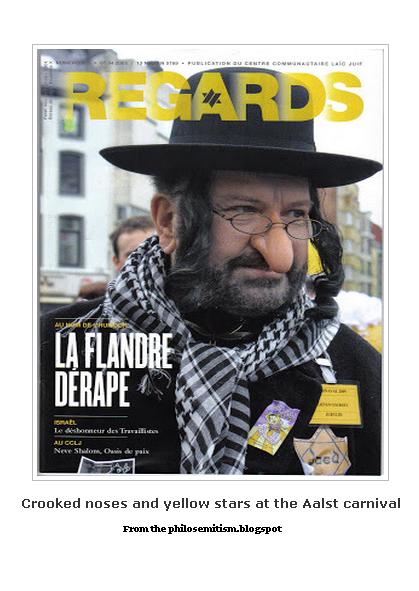
The Israeli newspaper, Arutz Sheva, published on May 7, 2015 an article,”Flemish Leader Disowns WWII Nazi Collaboration.” The article describes how the current leader of the right-wing nationalist Flemish party, the New Flemish Alliance, expressed contrition over the role his forebearers played in collaborating with the Nazis. In recent years, a number of nationalist parties in Europe have gone down this same road, disavowing the historic associations with virulent anti-Semitic movements.
Many of these parties, including the New Flemish Alliance’s precursor, the Flemish National League (VNV), were a fusion of Fascist ideology and reactionary elements within the Catholic Church.
This ideological amalgam has been pushed to the margins in European society since World War II. The nationalist and western cultural components increasingly find common ground with the Jewish national state that came into existence in 1948. Post-war leadership of the Catholic Church has gone to great lengths to reject elements that perpetuate hatred of Jews. But that doesn’t mean that the beliefs that formed the building blocks of that political fusion have dissipated.
Has the anti-Jewish core simply undergone a metamorphosis to be more congruent with the leftist-orientation that dominates European culture today? Do residual elements of the Catholic-Fascist amalgam continue to pursue their enmity towards the Jews under the deceptive guise of pursuing “justice” for the Palestinians by incriminating Israel?
More investigation is warranted to reveal what lies under the surface of the expansive support in Europe for groups like Breaking the Silence, that empower disaffected Israelis to undertake the task of undermining the moral and legal standing of the only state in the Middle East whose actions are guided and constrained by a full-fledged embrace of western values.
May 7, 2015
Amnesty International Rejects Proposal to Investigate Anti-Semitism
Amnesty International, a human rights non-governmental organization (NGO), purports to do research and lobbying on behalf of those suffering from human rights violations. Indeed, they proudly claim, “we investigate and expose the facts, whenever and wherever abuses happen.”
These facts and abuses, however, apparently do not extend to incidents involving Jews. At its annual conference, Amnesty International rejected a proposal (468-461) to research the recent uptick of anti-Semitic behavior and expression in the U.K.
Amnesty’s UK press officer, Neil Durkin, argued that the proposal – the lone proposal rejected at the conference – had a “single focus” that was not aligned with their broad, indiscriminate purview.
Durkin’s “single focus” argument fails to hold water because the organization performed a “single focus” study on anti-Muslim discrimination in Britain in 2012.
The proposal regarding anti-Semitism was put forth based on reports by the All-Party Parliamentary Group Against Anti-Semitism and the Community Security Trust – two agencies that track attacks against Jews.
The studies revealed that such incidents doubled in frequency in 2014 – to 1,168 total cases – and reached their highest point since 1984, when they began tracking such incidents. In fact, corresponding with Operation Protective Edge, July alone had 314 incidents. In total, nearly one half of the 1,168 recorded incidents included explicit references to Gaza or Palestinians. This data reveals that attacks against Jews were prompted by both anti-Semitic and anti-Israel sentiments. Moreover, the data establishes that anti-Semitism is rising at a rate that should concern a human rights NGO to the degree that a report is necessary. Failing to address the anti-Semitism spike is failing to “investigate and expose the facts, whenever and wherever abuses happen.”
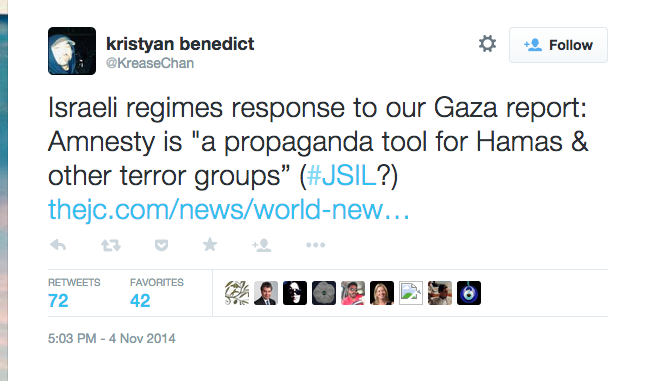
Amnesty and its employees exhibit a pattern of anti-Israel and anti-Jewish bias. In November an Amnesty employee explicitly linked Israel and ISIS on twitter and was not disciplined or censured in any way.

Kristyan Benedict is a UK Campaigns Manager at Amnesty International. His tweet (shown above) uses a hashtag: #JSIL, intended to evoke “Jewish State of the Levant.” The hashtag specifically references ISIL (Islamic State of Iraq and the Levant), the alternative name for ISIS (Islamic State of Iraq and Syria). Despite a very negative response on Twitter, and more importantly, his horribly offensive and inaccurate comparison, Mr. Benedict was not disciplined by Amnesty.
Especially given this context, the fact that Amnesty rejected the proposal minimally demonstrates that they are not beholden to their own standards of researching and reporting all abuses of human rights. More likely, it reveals that, to them, human rights may be a fundamental issue deserving of research and lobbying…just so long as Jews are not the victims.
May 6, 2015
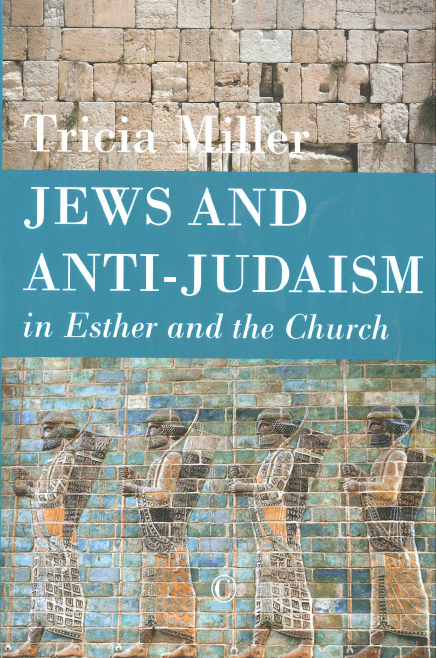
CAMERA Researcher Authors Book About Esther, Anti-Judaism and Israel

CAMERA Senior Research Analyst Dr. Tricia Miller has written a book that uses an academic approach to demonstrate the relationship of historic theology to current events concerning Israel in order to encourage Christians to support Israel’s right to exist and defend itself against those who seek its destruction. Jews and Anti-Judaism in Esther and the Church shows how the anti-Judaism that is a central feature in the Book of Esther relates to contemporary issues within the ongoing Arab-Israeli conflict.
Published by James Clarke and Co. Ltd, a long-established British academic publisher specializing in historical and theological books, Jews and Anti-Judaism in Esther and the Church has been lauded by experts and scholars. Reverend Dr. Petra Heldt, a professor at the Rothberg International School at the Hebrew University of Jerusalem, declares:
This is the most careful study of the book of Esther and its anti-Jewish interpretations in the Church I have read. By placing the book of Esther in the context of realpolitik and hermeneutics that are filled with Jewish resistance to attempted genocide, Tricia Miller addresses the history of Christian anti-Judaism, the errors of replacement theology, and anti-Zionism as the new anti-Judaism. The book reads like a detective story which, by way of excellent exegetical scholarship and sound academic perception of history, puts the contemporary issue of the contested legitimacy of the State of Israel into the context of the universal right and obligation of self-defence. This investigation represents progressive thinking and the reality of strong bridges built between Jews and Christians in recent times.
Jews and Anti-Judaism in Esther and the Church is due to be released on May 28, 2015. For more information or to pre-order the book, please click here.



Search:
Search this site: