
Recent Entries:
Month: February 2015
February 10, 2015
CNN’s Zakaria Puts Foot in Mouth Again with Israel-ISIS Analogy

Fareed Zakaria’s take on Feb. 9, 2015 cited the Irgun, a covert Jewish group in British Mandatory Palestine, as an inspiration for ISIS’ (Islamic State in Iraq and Syria) terrorism. Irgun was one of three Jewish underground military organizations in 1945-1948 that fought to bring about the end of the U.N. Mandate and the establishment of a Jewish state. Zakaria has demonstrated a compulsion to see Israel darkly, regardless of facts (examples here, here, here), and this is one more piece in the pattern.
Here, Zakaria implicitly equates ISIS to Irgun — Islamic fundamentalists who commit mass murder of children, trade captured minority women as “wives” and “execute” prisoners by beheading and immolation to Jewish nationalists who usually attempted to avoid non-combatant casualties.
ISIS slaughters and enslaves as many as it can of those opposing its ideology bent on establishing a world wide caliphate under sharia (Islamic law). The Irgun aimed primarily at destroying property, typically targeting British and British-affiliated facilities, although there are historical accounts of it killing and wounding Arabs in reprisal attacks that were criticized by many Palestinian Jews.
It used violence to attempt to compel Great Britain either to fulfill its responsibility under the League of Nations/U.N. Mandate for Palestine and let Jewish refugees, particularly those in Europe displaced by the Holocaust, in or to terminate the mandate and get out. The Irgun was not trying to force non-Jews to convert or, unlike ISIS’s dreams of a regional if not worldwide “caliphate,” impose Jewish rule over the Middle East and beyond.
Zakaria said, “The group [ISIS] well understands that the primary purpose of terrorism is to induce fear and overreaction… The Irgun knew that they could not defeat the mighty British Army so they decided to blow up buildings and create the appearance of chaos.”
On Irgun, Zakaria scavenges a 40-year-old article by historian David Fromkin. Writing in Foreign Affairs (“The Strategy of Terrorism” in July, 1975 issue). Fromkin recounted what an Irgun founder said in 1945 at a meeting in New York:
“His organization would attack property interests. After giving advance warning to evacuate them, his small band of followers would blow up buildings. This, he said, would lead the British to overreact by garrisoning the country with an immense army drawn from stations in other parts of the world. But postwar Britain could not afford financially to maintain so great an army either there or anywhere else for any extended period of time… the plan of attacking property without hurting people proved to be unrealistic. Accidents inevitably occur when violence is unleashed …The bloodshed caused by the Irgun isolated it politically and alienated the rest of the Palestinian Jewish community… Yet despite its flaws, the strategy was sufficiently ingenious so that the Irgun played a big part in getting the British to withdraw.”
The Irgun did play a part in raising the cost to Great Britain — depleted of manpower, impoverished by World War II and facing challenges in colonies such as India — of hanging on to its Palestine Mandate. But in doing so, its tactics were far from ISIS’ use of self-publicized wholesale and retail barbarism to outdo its parent, al-Qaeda, in imposing sharia, harsh Islamic religious law, on as much territory as possible. Zakaria’s Irgun-to-ISIS analogy, hijacking Fromkin’s article that essentially dealt with other issues in the rise of modern terrorism, is one more symptom of his underlying Israel-obsessive syndrome.
What’s the secret of Zakaria’s charmed life on CNN? Viewers see what CNN management still won’t; in addition to past plagiarism and insufficiently cited sources, his misplaced appeals to authority and tortuous analogies do not make Zakaria a foreign policy expert. Rather, they undermine his pretense to being one.
February 10, 2015
Church of England Lowers the Boom on Stephen Sizer
Rev. Dr. Stephen Sizer, a profligate purveyor of hostility toward Jews and Israel, has finally been held to account in a meaningful way. It took a lot longer than it should have, but when the Church of England finally decided to act, it really lowered the boom, extracting a promise from Rev. Sizer that he would bring his antisemitic antics to an end or resign. In a letter to his bishop, Sizer promised not to post any more links or even make any more public statements about the Middle East – ever – and to stay off social media for the next six months. Sizer said that if he breaks his promise, he will resign as vicar an Anglican Church in Virginia Water, England.
Sizer made this promise to Right Reverend Andrew Watson, the newly appointed Bishop of Guilford, who is shown in a video above making the announcement about Rev. Sizer’s promise.
(more…)February 6, 2015
Iranian Statements Taunting the United States Ignored by Most of the Media

According to conservative media sources, officials of an increasingly emboldened Iran have taken to delivering derisory statements about the United States and its handling of negotiations over the Islamic State’s nuclear program.
The Washington Free Beacon reports on Feb. 5, 2015,
Mohammad Reza Naghdi, the commander of the Basij, a paramilitary group operating under the wing of the Iranian Revolutionary Guard Corp (IRGC), recently claimed that the “Americans are begging us for a deal on the negotiation table,” according to comments published in Persian and independently translated for the Washington Free Beacon.
Naghdi added that American officials routinely “plead” with Iran in talks and that the United States is negotiating from a position of weakness, according to his comments, which follow earlier reports claiming that Iran’s leading negotiator “frequently shouts” at U.S. officials.
The Free Beacon also cites Associated Press dispatches indicating that the United States is “conceding ground to Iran in talks” and that “regional experts say that the Iranians feel that they are in a position of power in the talks and believe that the Obama administration is desperate to ink a deal.”
Separately, Iran’s PressTV (the English language mouthpiece of the Islamic Republic) on Feb. 5, 2015 carried the translated comments of Deputy Chief of Staff of the Iranian Armed Forces Brigadier General Massoud Jazayeri, who stated, “Gone are the days when the U.S. was a superpower, but some still haven’t realized it.”
The Washington Post published an editorial on Feb. 5, 2015, acknowledging a perceived loss of resolve in the American negotiating position, writing,
First, a process that began with the goal of eliminating Iran’s potential to produce nuclear weapons has evolved into a plan to tolerate and temporarily restrict that capability.
But a Google search using key words The New York Times and words relating to the above-mentioned stories, did not turn up coverage of these comments by Iranian officials by the Times. Instead, the Times’ coverage of the Iranian nuclear program overwhelmingly consists of extensive criticism of Israeli Prime Minister Benjamin Netanyahu’s acceptance of an invitation to speak before the United States Congress and related criticism of the Congress for “sabotaging” the Obama administration’s negotiating gambit with the Iranians by threatening to impose more stringent sanctions on Iran against the President’s wishes. In contrast to the Free Beacon’s piece, the Times published an article on Feb. 5, 2015, “Iran’s President Accuses the West of Distorting Atomic Plans,” quoting Iranian President Hassan Rouhani that Iran “neither covets nuclear weapons nor aspires to have them.”
The World’s largest media organization, the BBC, also exhibits little interest in the comments reported by the Free Beacon or PressTV. A review of the BBC World web site finds little recent discussion of Iran, although, the web site advertises a special program hosted by Middle East editor, Jeremy Bowen, known primarily for his antagonism toward Israel, on life in Iran, that airs on Feb. 6, 2015. It will be interesting to see if the BBC perspective differs in any substantial way from the Times. These two major news organizations often reflect the same political agenda and priorities when it comes to their handling of the Middle East.
February 5, 2015
Where’s the Coverage? PA Official Calls Netanyahu a Nazi

The Palestinian Authority is run by Fatah, the political party of President Mahmoud Abbas. Fatah Central Committee deputy secretary and the head of the Palestinian Supreme Council for Sport and Youth Affairs, Jibril Rajoub, recently compared Israeli Prime Minister Benjamin Netanyahu to Adolf Hitler, saying the Likud prime minister follows “the Nazi model.” The Times of Israel reported that Rajoub:
…charged in a Russia Today TV interview that Israel “practices official terrorism, violates human rights, and ignores all UN resolutions.”
“Netanyahu is a distorted replica of the Nazism of the 1940s,” Rajoub said in the interview, translated by US-based media watchdog MEMRI. “He has found himself isolated, because people realize the danger that his racism and fascism poses to peace and global stability. He reacts to the crisis in this fascist, Nazi, racist manner.”
Even coming as we mark the 70th anniversary of the liberation of Auschwitz, the media has completely ignored this outrageous statement. Why?
If there’s an argument that Rajoub is not an important Fatah minister and therefore his comments should be disregarded, that’s not the case. Only a few weeks ago, a media student criticized Rajoub after the Palestinian soccer team lost a game. Palestinian intelligence services arrested him for “insulting a public official”. That’s clout.
Or, perhaps one could contend that this comment is out of character for Rajoub. This is also not the case. This remark is by no means the first outrageous statement from the Fatah official who once said, regarding Israel, “We as yet don’t have a nuke, but I swear that if we had a nuke, we’d have used it this very morning.” This, too, was ignored by the news media.
Jibril Rajoub has been called “moderate” by many major news outlets. Perhaps the fact that his comments do not in any way support this “moderate” description and do not fit with the media narrative is the answer to our question… Where’s the coverage?
Watch video of Rajoub’s comments:
February 4, 2015
Vaccines, Racists, and the Discriminatory Standard

Some politicians are saying some things about vaccines and the role the government plays in public health. And here’s what The Wall Street Journal stated yesterday on that subject:
Government doesn’t “force” parents to vaccinate children. The states impose penalties (such as barring attendance in public schools) on those who pose a risk to public health by refusing vaccinations against infectious diseases.
Yes, in the United States, government often penalizes those who don’t vaccinate their children. It’s been that way for a long time. Why, then, hasn’t US immunization policy been described as racist in the pages of major newspapers? You see, The New York Times and The Wall Street Journal have both relayed the absurd charge that Israel’s policy penalizing families that don’t immunize children amounts to anti-Arab discrimination.
Again and again, The Times has treated as credible the comically absurd list of supposedly discriminatory laws promulgated by the anti-Israel advocacy group Adalah. Israel has “50 discriminatory Israeli laws,” a recent Op-Ed claimed, citing Adalah. Same thing on the news pages. Wall Street Journal fact-checkers also gave a pass to the same charge.
But even a cursory examination of the charge would show that Adalah’s list includes, along with other completely innocuous statutes, Israel’s law that withholds certain benefits from families (of any ethnicity or religion) that don’t immunize their children. (You can read more about those charges here.)
Discriminatory? Of course not. And it’s safe to say that no other country is slurred in this way for policy meant to ensure immunizations. Israel is singled out with rhetorical abuse for rather mundane public health policy. Editors at major newspapers are playing along. How’s that for discriminatory?
February 3, 2015
‘Medical Marijuana without the High’? Washington Post Gets It
It’s the kind of feature article one is unlikely to read, see or hear in many major news outlets, but The Washington Post gave the top half of its first “The World” section page on Feb. 2, 2015 to “Medical marijuana without the high; Israel is at forefront of research, but export of plant doesn’t appear to be on the horizon”. And The Post was two years behind The New York Times, which ran a major feature on the topic, “Safed Journal: Studying Marijuana and Its Loftier Purpose,” by Jerusalem correspondent Isabel Kershner, on Jan. 1, 2013.
A four-column by five-inch Reuters color photograph, with the cutline “A worker tends to cannabis plants at a plantation where researchers say they have developed a marijuana that will not get patients high” illustrates this latest coverage by The Washington Post, correspondent Anne-Marie O’Connor’s 1,120-word report. It told readers that “in a greenhouse in the mountains of the Galilee, a technician in a lab coat is coddling a marijuana seedling that is coveted for life-saving medical benefits for epileptic children, doctors say—without the high.
“Named ‘Rafael,’ for a healing angel called upon by Moses, this varietal of cannabis is for people who don’t want to be under the influence, and it is available in oral doses in Israel.”
The Jewish state, The Post adds, “has become a world leader in science on the medical uses of marijuana”—including treatment of Crohn’s disease, basal cell carcinoma, Parkinson’s and other illness. One of Canada’s leading producers of medical marijuana, “MedReleaf, is tapping Israel’s expertise in a 2014 partnership it signed in May 2014 with Tikun Olam, whose name means ‘Healing the World’ in Hebrew.”
But, according to the dispatch, the Israeli government has not yet allowed producers to export their products, only their expertise. While agricultural officials are said to favor product exports, their security counterparts do not. Nevertheless, “Israel’s medical cannabis research and development is drawing global interest, including an Australian firm and a leading American researcher.
A newsworthy Israeli story that had nothing to do with the Palestinian Arabs, and both The New York Times, frequently criticized by CAMERA for a chronic anti-Israel tilt in coverage and commentary, and The Washington Post,, itself sometimes prone to filter news through “the Palestinian narrative,” recognized and played it prominently.
Correction: An earlier version of this SNAPSHOT said The Post’s medical marijuana report was the kind of Israel-related coverage readers were not likely to see in The New York Times, among other media. The Times covered the story on Jan. 1, 2013. We regret the error.
February 3, 2015
Updated: New York Times Understates Hamas Rocket Attacks, Relocates Hezbollah Attack
Update: NY Times Corrects: Thousands, Not Hundreds, of Rockets Targeted Israel
In recent days, The New York Times has misreported attacks by both Hamas and Hezbollah directed at Israel. Today, The Times grossly understates the number of rockets that Palestinians in Gaza fired at Israel during this summer’s conflict (“Leader of War Crimes Inquiry Into 2014 Gaza Conflict Resigns“). Somini Sengupta refers to “the Gaza conflict, in which Palestinian militants fired hundreds of rockets into Israel.”
In fact, Palestinians launched thousands, not hundreds, of rockets at Israel during this summer’s conflict. Israel identified 3,852 rocket hits on Israeli territory. The Iron Dome intercepted another 735 rockets. These figures do not include the hundreds of mortars that Palestinians fired at Israel. Nor does it include the rockets that Palestinians fired at Israel, but which fell short, landing in the Gaza Strip.
Last week, The Times’ Isabel Kershner correctly cited the number of rockets that Palestinians fired at Israel this summer, writing on Jan. 28 “. . .Hamas and other militant groups fired thousands of rockets into Israel . . . ”
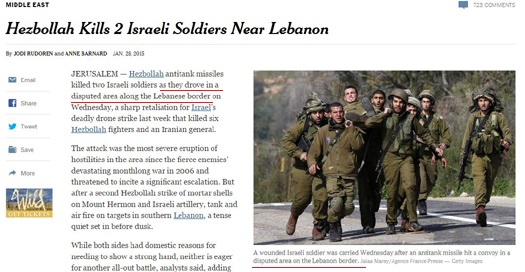
In a separate article last week, The “Paper of Record” incorrectly reported that Hezbollah’s fatal attack on Israeli soldiers last Wednesday took place on the disputed strip of land called Mount Dov/Shabaa Farms, next to the border with Lebanon. In fact, the attack took place near, but not on, Mount Dov.
The Times reported (“Hezbollah Kills 2 Israeli Soldiers Near Lebanon,” Jan. 29):
Hezbollah antitank missiles killed two Israeli soldiers as they drove in a disputed area along the Lebanese border on Wednesday . . .
The Israeli soldiers were killed at Shebaa Farms — known in Israel as Mont Dov — a strip claimed by Israel, Lebanon and sometimes Syria near the intersection of all three and adjacent to the Golan Heights.
A photograph accompanying the article also had a caption identifying last week’s attack as having taken place in a “disputed area.”

In addition, a Times correction yesterday inaccurately states:
An article on Thursday about the death of two Israeli soldiers in a missile attack by Hezbollah, the Lebanese Shiite movement, as they drove in a disputed area near the Lebanese border misstated the surname of one of the soldiers in some editions. . . .
The map (below), provided by Israeli army spokesman Peter Lerner, shows the location of the attack on Route 999, near, but not on, Mount Dov.

Thus, the attack did not take place in a “disputed area,” nor did it occur on Shebaa Farms. Lerner has confirmed this information with CAMERA by telephone. Also, on its Web site, the IDF notes that the attack took place “near Mt. Dov.”
(more…)





Search:
Search this site: