
Recent Entries:
Month: March 2014
March 9, 2014
Ha’aretz No Longer a Newspaper
Ha’aretz has now completely crossed the line from a newspaper to a propaganda mouthpiece.
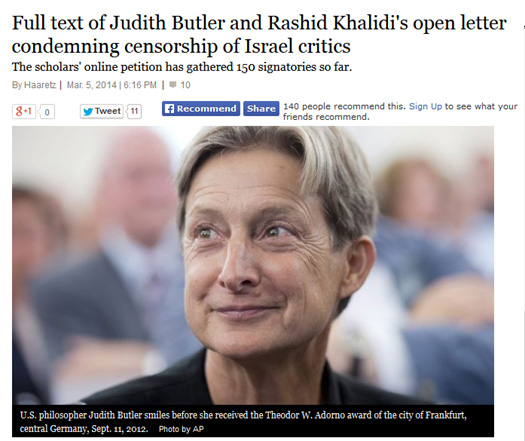
Judith Butler, a Berkeley professor, and Rashid Khalidi, PLO spokesman-cum-Columbia professor, published an Internet petition in which they condemn what they call attempts to silence, intimidate and threaten critics of Israel. Israel’s “critics,” they emphasize, are those who support the anti-Israel BDS (boycott, divest, sanctions) campaign. BDS advocates, as have been previously demonstrated, are not pro-Palestinians, they are anti-Israel. They are not in favor of a two-state solution. Rather they advocate for a one-state solution — a Palestinian state from the river to the sea.
There is nothing particularly remarkable about this anti-Israel petition. Such initiatives are commonplace. Noteworthy, however, was Ha’aretz‘s decision Thursday evening to post the Khalidi/Butler petition in full on its English Web site under the headline:

Ha’aretz published the petition without any preface or explanation. It appeared as a full, bona fide article, with a headline, a subheadline and text (the petition), including the 150 names that signed on to the document. Had editors linked to the petition as part of an article about the document, the item would have carried some news value. The current item, however, which contains absolutely zero reporting, analysis or context, is not journalism. It is free publicity for prominent anti-Israel polemicists who support the boycott of the Jewish state. Ha’aretz is blatantly carrying out the work of anti-Israel organizations.
Has Ha’aretz decided to come out of the closet, shrugging off any pretense of being a news organization? What other explanation is there for this very bizarre and very un-journalistic act? Pro-Israel and anti-Israel groups routinely publish petitions. Why did Ha’aretz pick this petition in particular, publishing its “full text” as if it were a speech by the Prime Minister at the United Nations? Could it possibly be because Ha’aretz editors support the petition penned by two anti-Israel activists calling for the boycott of Israel (not settlements)?
Furthermore, six hours after the “full text” appeared, Ha’aretz’s English site posted a news article about the boycott petition. Why wasn’t the news article published six hours earlier? Was it added after an editor realized that there is no justification for publication of the “full text” of any petition, for any cause, without providing context? More importantly: why does the petition still appear as a standalone item on Ha’aretz‘s Web site?
Ha’aretz, apparently, is not at all ashamed that it has abandoned journalism in favor of blatant anti-Israel activism.
— By Yishai Goldflam
(For the Hebrew version of this post, see Presspectiva.)
March 6, 2014
Fact Check: Netanyahu Did Not Invent Expectation of Recognition of Jewish State
Last time The New York Times published an Op-Ed by Ali Jarbawi, the author’s overzealous attack on Israel put the newspaper in the unwelcome position of having to correct a factual error. (No, The Times admitted in a Feb. 5 correction, Ariel Sharon did not actually enter the al Aqsa mosque.)
It’s a shame the newspaper had to publish a correction, but one might expect that the editors have learned from the mistake — “fool me twice,” the saying goes — and now more carefully check Jarbawi’s facts.
Any such expectations were dashed today, when The Times published a new Op-Ed by Jarbawi. Speaking of the Israeli expectation that Palestinian negotiating partners will accept the principle of two states for two peoples — the Palestinian and the Jewish peoples — Jarbawi, a former Palestinian Authority official, stated:
This demand did not exist in past talks; in fact, it didn’t exist until the thought occurred to Prime Minister Benjamin Netanyahu, most likely because he was looking for a way to sabotage the peace process, which he could then blame on the Palestinians while continuing to usurp our land.
But this simply isn’t true. As Tablet Magazine recently pointed out, the expectation that Palestinians would reciprocate Israeli recognition of a Palestinian state by recognizing a Jewish state is hardly new:
In fact, according to the Palestine Papers — a massive trove of leaked documents published by Al Jazeera, which record a decade of Israeli-Palestinian negotiations–the demand was broached by none other than Tzipi Livni…in 2007.
Representing Israel’s liberal Kadima-led coalition in Annapolis prior to Netanyahu’s election in 2009, Livni raised the subject of Israel’s Jewish character with the Palestinian negotiating team. …
…the Palestine Papers are in the public domain, and available to any reporters seeking to fact-check whether Netanyahu was the first to ask that the Palestinians recognize Israel as the nation-state of the Jewish people, just as Israel will recognize Palestine as the nation-state of the Palestinian people.
But the chain reaches even further back than 2007.
Read the entire Tablet piece here.
As to Jarbawi’s list of reasons why Palestinians shouldn’t be expected to acknowledge the national rights of the other party to the conflict — basically non-issues such as the question of what will happen to the citizenship of Israeli Arabs if Palestinians accept the legitimacy of the Jewish state (the short answer: nothing will happen) — we’ve already discussed that here.
March 6, 2014
Christian Science Monitor Photo Caption Misleads

The March 10, 2014 edition of the Christian Science Monitor Weekly [CSM] carries an upbeat article “Go-getters in Gaza” which highlights the entrepreneurial ambitions and striving for normalcy of young Gazans. Eight photographs are shown. One of the photographs shows a young girl in a scout uniform. The caption reads,
PROUD A Girl Guide shows off her uniform. Girl Guides of Palestine, established in 1919 under British rule, aims to promote positive behaviour among young women.
The problem is the history this caption conceals. The first troops of the Girl Guides of Palestine were established by Annie Landau and Helen Bentwich at the Evelina School for Girls in Jerusalem. Landau, a British Zionist, ran the school for many years. The school was named after Evelina Rothschild, who belonged to the Rothschild family that funded Jewish settlement projects in what was to become Israel. This is confirmed in a book published in 1922, The Handbook of Palestine edited by Sir Harry Luke, Edward Keith-Roach. The CSM caption implicitly expropriates for the Palestinian Arab legacy what was actually, initially, a British-Jewish legacy and then expanded to include Arabs.
For more information on the school and the founding of the Girls Guides of Palestine, see
The Best School in Jerusalem: Annie Landau’s School for Girls, 1900-1960 By Laura S. SchorMarch 5, 2014
Where’s the Coverage? “Settlements” Not an Obstacle to Peace

In a recent interview with Jeffrey Goldberg, widely perceived as blaming Israel for the Israeli-Palestinian conflict, President Obama never addressed the issue of incitement by Palestinian Authority leaders, media and educational materials to hatred of and violence against Jews and Israelis. He never mentioned the PA policy to celebrate terrorists as heroes and to glorify killers by naming public squares and soccer tournaments after them.
President Obama did, however, refer a number of times to Israeli “settlements.” He agreed that “settlements are illegitimate” and even threatened:
But what I do believe is that if you see no peace deal and continued aggressive settlement construction — and we have seen more aggressive settlement construction over the last couple years than we’ve seen in a very long time — if Palestinians come to believe that the possibility of a contiguous sovereign Palestinian state is no longer within reach, then our ability to manage the international fallout is going to be limited.
However, as Evelyn Gordon points out in Commentary, “on this issue, Obama’s ‘facts’ are flat-out wrong.” The article continues:
In reality, as a simple glance at the annual data published by Israel’s Central Bureau of Statistics reveals, there has been less settlement construction during Benjamin Netanyahu’s five years as Israeli premier (2009-13) than under any of his recent predecessors.
During those five years, housing starts in the settlements averaged 1,443 a year (all data is from the charts here, here and here plus this news report). That’s less than the 1,702 a year they averaged under Ehud Olmert in 2006-08, who is nevertheless internationally acclaimed as a peacemaker (having made the Palestinians an offer so generous that then-Secretary of State Condoleezza Rice couldn’t believe she was hearing it). It’s also less than the 1,652 per year they averaged under Ariel Sharon in 2001-05, who is similarly lauded internationally as a peacemaker (for having left Gaza); the fact that even Sharon out-built Netanyahu is particularly remarkable, because his term coincided with the second intifada, when demand for housing in the settlements plummeted. And it’s far less than under Ehud Barak, who is also internationally acclaimed as a peacemaker (for his generous offer at Camp David in 2000): One single year under Barak, 2000, produced more housing starts in the settlements (4,683) than the entire first four years of Netanyahu’s term (4,679).
Whether settlement construction is “aggressive” or not, it is certainly not an obstacle to peace.
Imagine a deal is negotiated and a border is established somewhere. Put it anywhere. Put it on the 1949 armistice line. Put it right through the middle of Ma’ale Adumim, if you want. Then some new Israeli towns will be on the Israeli side of the border and some will be on the Palestinian side. So what? What is the problem with that?
“Settlements” are only an obstacle if you accept that no Jews can live in a Palestinian state; that Palestine must be, as the Nazis wanted Europe to be, Judenrein (Jew-free). Twenty percent of Israelis are not Jewish – most of them Arabs – yet zero percent of Palestinians can be Jewish? That would be crazy. But none other than the “moderate” Mahmoud Abbas himself, among other Palestinian officials, have said just that. Abbas declared, “I would not agree to having Jews among the NATO forces [that might secure a peace agreement], or that there will live among us even a single Israeli on Palestinian land.”
That kind of hatred and bigotry…? THAT is an obstacle to peace. Yet… Where’s the coverage?
March 5, 2014
Can We Trust The Images We See in Relevant?

Relevant, a magazine that bills itself as a lifestyle magazine for young Evangelicals in the United States, has published a cover story about violence in the Holy Land and what Christians can do to bring it to an end. It arrived in the mailboxes a week before the upcoming Christ at the Checkpoint Conference in Bethlehem.
There’s no arguing that the magazine’s cover (shown above) is compelling, even if it offers a mixed message.
The text includes a passage from the Beatitudes, “Blessed Are the Peacemakers.” This text, interestingly enough, is a bit faded so as to allow consumers to have a fuller view of a young Palestinian man throwing a firebomb.
He’s a bit dirty and scruffy, but otherwise he looks, well, pretty cool. The way Relevant depicts him, the firebomb thrower is imbued with an danger, drama and glamour.
It’s like he’s a rock star or something. It’s radical chic revisited.
We contacted Relevant’s founder, Cameron Strang, and challenged him on the appropriateness of using a photo such as this for the cover.
Relevant, like a lot of magazines, such as Esquire or Cigar Aficionado, is aspirational, meaning it gives readers a view of the life that they want to live or aspire to. Aspirational magazines give readers a view of what they – and their lives – are supposed to look like.
Clearly, Relevant falls into this category. Peruse its pages and you’ll see lots of images of rock stars and celebrities that have either grown up in the Evangelical community or who are willing to talk, at least a little, about their religious faith with the editors of the magazine that serves this community. The magazine’s motto is “Faith, Culture & Intentional Living.” It’s Rolling Stone for young Evangelicals.
The advertising of the magazine shows a lot of scruffy-looking but earnest young Evangelical men who are trying to make their way in the world. In fact, they look a lot like the protagonist/narrator in Porter Speakman’s movie, With God on Our Side.
Relevant is filled with articles giving career and spiritual advice to young Evangelicals. One article chides young people, (“millenials”) to choose “gratefulness over entitlement.” Another writer advises readers “When you are in your twenties, your first three jobs should be considered your master’s program.”
Against this backdrop, it seemed irresponsible to publish a photo like that glamorizes someone throwing a firebomb.
In response to CAMERA’s challenge, Strang told us to read the article (which he wrote). The article, Strang said, is about ending the violence that was being depicted. (There are problems with the article, too, which CAMERA will get to in a subsequent article.)
Even if the article in question were a fair and comprehensive assessment of the Arab-Israeli conflict (which it isn’t), Strang’s response doesn’t cut it. Imagery and text both tell their own stories, and in this instance, the glamour attributed to the firebomb thrower on the magazine’s front cover threatens to overwhelm the message of peace offered in the text.
CAMERA raised another concern. At first glance, the photo on the front cover seemed staged because it seemed more like a work of art than an act of journalism (and yes sometimes, the two overlap). But the timing and positioning of the photo seemed too perfect. (As events progressed, our concern shifted from whether or not the photo was staged, but whether or not it was altered by Relevant. More about that below.)
(more…)March 5, 2014
Mitnick, the U.S., and ‘Illegal’ Settlements

American policy on the legality of the settlements has been consistent for decades. And Joshua Mitnick’s coverage of that policy has also been consistent. Consistently wrong, that is. Back in 2006, Mitnick wrote in the Christian Science Monitor:
The US and most countries consider Maaleh Adumim and dozens of other Israeli settlements illegal under international law because they were established on territory under military occupation.
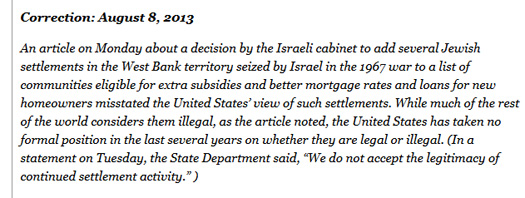
The United States does not consider West Bank and eastern Jerusalem settlements illegal. At the time, the Monitor failed to correct the error. Had it done so, Mitnick may not have written the other day in the Wall Street Journal:
Most of the international community considers Israeli building in the West Bank and East Jerusalem to be illegal, including the U.S. . . .
U.S. policy has not changed since Mitnick’s 2006 article. In fact, there has been no change in U.S. policy on the question of the legality of settlements since President Carter’s departure from the White House. Although the Carter administration did consider the settlements illegal, subsequent administrations did not. President Reagan had explained: “As to the West Bank, I believe the settlements there – I disagreed when the previous Administration referred to them as illegal, they’re not illegal” (New York Times, Feb. 3, 1981). Other presidents, including Bill Clinton and George W. Bush, also did not term settlements “illegal.”
In February 2011, the United States vetoed a United Nations Security Council resolution which labeled the settlements “illegal.” In the Feb. 20, 2011 “Meet the Press” broadcast, then US Ambassador Susan Rice indicated that the appearance of the word “illegal” was one of the reasons why the US rejected the resolution.
Last August, The New York Times was the most recent media outlet to correct this very same error:

Will The Wall Street Journal follow the commendable lead of The Times and set the record straight?
March 4, 2014
The New York Times Persists in Emphasizing IDF Defensive Strikes While Downplaying Palestinian Terrorism

CAMERA’s monograph, Indicting Israel: New York Times’ Coverage of the Palestinian-Israeli Conflict, noted the newspaper’s consistent emphasis on Israel’s defensive military strikes while downplaying Palestinian violence. During our 6-month study, Palestinian attacks –including those that killed Israelis – were never featured prominently, but the newspaper repeatedly highlighted Israeli military actions or vandalism by radical Israelis. While 12 headlines implicated Israel for killing Palestinians none referred to Palestinians killing Israelis even though 14 Israelis were killed by Palestinians during that time. (See: Indicting Israel, Chapter 4 “Violence Double Standards”, page 57)
Well, it seems this pattern of coverage is endemic to The New York Times. Correspondent Jodi Rudoren, recently back from a speaking jaunt in the U.S., just published an item about an IDF air strike on an Islamic Jihad rocket squad about to fire missiles into southern Israel. The problem is, the article was headlined “Israeli Airstrike Kills 2 in Gaza” and introduced as follows:
An Israeli airstrike killed two Palestinian men in the Gaza Strip and wounded two children on Monday evening, according to the Israeli military and Palestinian health officials, continuing the increased violence between Israel and Gaza this year.
“Continuing the increased violence between Israel and Gaza this year?” Who is the party “continuing” the violence, the terrorists trying to launch another attack or the soldiers preventing the attack? The paragraph suggests it is the latter. And how is there any equivalence between the two? Rudoren falsely implies tit-for-tat, morally equivalent violence on both sides. The correspondent further adds to this impression by declaring:
Despite a 15-month cease-fire between Israel and Hamas, the militant Islamic movement that rules the Gaza Strip, the past two months have seen a steady simmer of strikes on both sides.
Surely a defensive air strike to thwart an imminent attack on Israeli territory cannot be considered equivalent in any way to terrorists targeting civilians, and the IDF’s protection of its civilians is certainly not the same as the Islamic Jihad terrorist group trying to inflict as many deaths and as much damage as possible on Israelis.
But with its emphasis on Israeli actions–both in the headline and lede paragraph– and by equating the terrorist attacks with Israeli defensive actions, the newspaper distorts the story of Palestinian aggression and Israeli defense.
March 4, 2014
Ha’aretz Lost in Translation on Strip Search
Yesterday we described how Ha’aretz headlines (in English Feb. 26 online and Feb. 28 in print), an editorial (in Hebrew and English, Feb. 28) and an Op-Ed (Uri Misgav, English and Hebrew) all reported as fact that Israeli Arab teacher Ezies Elias Shehadeh was subjected to a strip search in the Eilat airport although Ha’aretz‘s own Orly Vilnai earlier reported that the Israel Airport Authority emphatically has denied the allegation, agreeing that she received a body search, but not a strip search.
Earlier this week, CAMERA’s Israel office asked Ha’aretz editors to either produce substantiation confirming Shehadeh’s or to publish a clarification noting that the Israel Airport Authority rejects the allegation. Editors yesterday said they would follow up.
Meanwhile, today, in an apparent case of “lost in translation,” the English edition repeats the disputed claim as fact. A page-one Jonathan Lis story in English reports:

The Hebrew edition, to its credit, did not claim that she had been forced to strip, referring vaguely to the “incident involving the teacher Ezies Shehada.”
CAMERA continues to call on Ha’aretz to either substantiate Shehada’s claim or clarify that the airport authority disputes her account of a strip search.
March 2, 2014
When Media Cover for Palestinian Terror Groups

A Swiss Air flight hijacked in 1970 by the PFLPMartin Kramer has excellently exposed how The New York Times covers for Rashid Khalidi (“New York Times: soft spot for Rashid Khalidi?”). (In case it’s not clear, the job of a serious newspaper is to cover the PLO spokesman-cum-professor, not cover for him.)
On the other side of the Atlantic, another major media outlet was likewise busy covering for some not-so-nice types. Reporting on the killing of a Palestinian suspected of involvement with a series of a terror attacks, who was shot to death when he refused to surrender during an arrest operation, Agence France Presse stated on Friday:
Neighbours said the dead man was a member of the leftist Popular Front for the Liberation of Palestine.
Leftist as in the Israeli Meretz-types who advocate for an immediate Israeli-Palestinian peace deal? No, not so much like that.
The PFLP spearheaded international airlines hijackings in the 1960 and 1970s, carried out hundreds of terror attacks against Israel including the assassination of Israeli Tourism Minister Rechavam Ze’evi, calls for the destruction of Israel, and has been designated a terrorist organization by the European Union as well as the United States.





Search:
Search this site: