
Recent Entries:
Month: July 2012
July 18, 2012
The Geographically-Challenged Amira Hass

The Teva Naot factory, on Kibbutz Naot Mordechai, in the upper GalileeAmira Hass should enroll in a geography course. In her article yesterday (“Disney Family Member Renounces Her Investments in Israel’s Ahava Cosmetics,”) she writes that Shamrock Holdings, the Disney family firm,
also has a stake in the Teva Naot footwear company, which is located in the Gush Etzion settlement bloc south of Jerusalem. . .
But there is just one small problem. Teva Naot’s factory is not located in Gush Etzion, but in Kibbutz Naot Mordechai, in the upper Galilee. Despite the fact that Israeli reporter Amira Hass lives in the West Bank city of Ramallah, she apparently relied on erroneous and misleading reports from foreign BDS advocates regarding Teva Naot. Last year, BDS activists promoted a boycott of the Montreal Naot store on the false allegation that “Naot’s soles come from the industrial zone of Gush Etzion, which is an illegal settlement located in the heart of the West Bank on occupied territory.” In fact, the shoes’ soles are made in Germany and Spain.
After that lie was exposed, BDS activists latched onto another excuse to boycott Naot shoes, sold internationally: the presence of an outlet store in Gush Etzion. (Naot also has outlet stores in Tiberias and the visitor’s center at Masada.)
Hass, apparently, has confounded the location of one of the chain’s three outlet stores with the location of “the Teva Naot footwear company.” That’s like saying the Hershey Company, of Hershey, Pennsylvania, is located in New York City (where it has a popular store.)
This kind of sloppiness, and the lack of fact-checking of information supplied by partisan sources, will not come as a surprise to those familiar with Hass’ writing. We suggest that next time, at the very least, she open a map.
For the Hebrew version of this article, visit Presspectiva.
July 9, 2012
Jewish Self-Criticism A Weapon in the Hands of Israel Hater, Noushin Framke

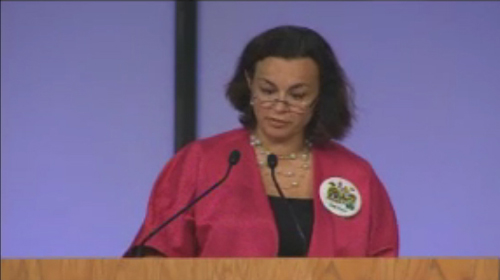
Noushin Framke, above, encouraged Hamas to keep Gilad Shalit as a bargaining chip. (Screenshot from PC(USA) video feed of General Assembly.)By a two-vote margin (333-331), the General Assembly of the Presbyterian Church (USA) denied anti-Israel activists a trophy – the passage of an overture that calls upon the denomination to sell its stock in companies that manufacture products used by the Israeli military.
The passage of a divestment overture by the PC(USA) might have reinvigorated anti-Israel activism in liberal Protestant churches in the U.S., which in the past few years, have been somewhat quiescent in their attacks on Israel.
The defeat of the overture in question, which called for the denomination to sell its stock in Motorola, Caterpillar and Hewlett-Packard, is a good thing.
Still, there are reasons to be concerned about what is going on inside the PC(USA) because anti-Israel activists did win a consolation prize – the passage of another overture, this one calling on the denomination to boycott Israeli products produced in the West Bank.
This overture, which passed with a vote of 457 to 180, was approved after Noushin Framke, a prominent anti-Israel activist in the PC(USA) was asked to speak to the assembly by the people moderating the event. Framke told the assembly that Peter Beinart, an American Zionist Jew who is offended by Israeli policies in the West Bank, supports such boycotts.
Framke’s invocation of Beinart’s support for a boycott of products is emblematic of a process by which anti-Zionists use Jewish self-criticism to isolate the Jewish state in the arena of public opinion. Framke (pictured above) thinks the Jewish state should not exist.
(more…)July 8, 2012
The NYT and Hebron History Fit to Print

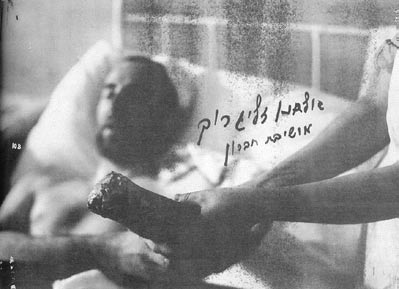
Elhanan Zelig Roch lost a hand in the 1929 Hebron massacre, in which Arabs killed 67 JewsLess than two weeks after The New York Times’ highly selective history of the West Bank village of Battir (Beitar), the “Paper of Record” brings us a selective history of the city of Hebron. Jody Rudoren’s July 6 article about a Hebron area meeting of Jewish and Muslim spiritual and community leaders, along with rightest European Parliament members, recounts:
Hebron, home to about 150,000 Palestinians and 900 Jews, has been practically the opposite of peaceful since Israel began occupying the West Bank in 1967. Its Cave of the Patriarchs was the site of a massacre in 1994 when Baruch Goldstein, a doctor from the large neighboring settlement of Kiryat Arba, killed 29 Muslims praying at the mosque. It was the only city excluded from the Oslo accords, and it was the subject of its own pact in 1997 separating the two communities and restricting their movements. Clashes continue, sometimes daily.
Of course, Hebron’s bloody history began long before “Israel began occupying the West Bank in 1967.” Before the 1994 Hebron massacre of 29 Muslim residents, at the hands of Baruch Goldstein, there was the 1929 Hebron massacre of 67 Jewish residents, at the hands of their rampaging Arab neighbors. The survivors fled for Jerusalem, and the holy city of Hebron was emptied of Jews for the first time in centuries.
But, like with the recent Battir story, The New York Times ignored the Jewish history of the contested site, choosing to supply readers only the Palestinian history.
July 8, 2012
AFP Doctors Swiss Report on Arafat’s Death, Polonium
An AFP news story and photo captions falsely allege that a Swiss report concluded that Yasser Arafat had been fatally poisoned. For instance, there are these photo captions:

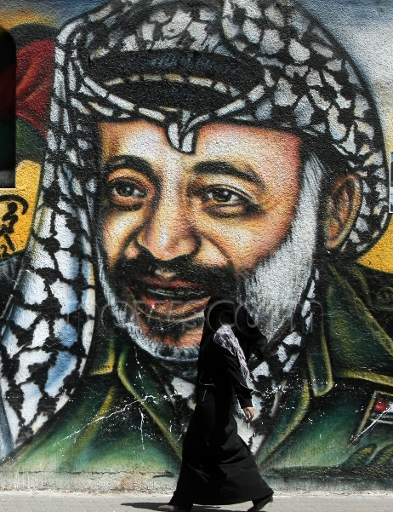
A Palestinian woman walks past a mural of late Palestinian leader Yasser Arafat in Gaza City on July 4, 2012. Arafat, who died in 2004, was poisoned by polonium, according to the findings of laboratory research carried out in Switzerland and cited in an Al-Jazeera report on July 3. AFP PHOTO/MAHMUD HAMSMAHMUD HAMS/AFP/GettyImages
A file picture dated November 16, 2003 shows late Palestinian leader Yasser Arafat smiling to reporters outside his office in the West Bank city of Ramallah. Yasser Arafat, who died in 2004, was poisoned by polonium, according to the findings of laboratory research carried out in Switzerland and cited in an Al-Jazeera report on July 3, 2012. AFP PHOTO/JAMAL ARURIJAMAL ARURI/AFP/GettyImages (Emphases added.)There was also a July 3 AFP article headlined “Arafat poisoned by polonium: Report,” which begins:
Yasser Arafat, who died in 2004, was poisoned by polonium, according to the findings of laboratory research out in Switzerland and cited in an Al-Jazeera report on Tuesday.
But the Swiss report does not conclude that Arafat died of poisoning. Francois Bochud, head of the Institute of Radiation Physics at the University of Lausanne, the research institute which conducted the study, has repeatedly made clear that that conclusion cannot be drawn from his work.
(more…)July 6, 2012
Where’s the Coverage? Jewish Refugees Expelled from Arab Countries

This month the United Nations marks World Refugee Day with concerts, film festivals and other events on five continents. Yet, as Israel’s ambassador to the U.N. Ron Prosor writes in his Huffington Post article, “The Middle East’s Greatest Untold Story,” very little if any mention will be made of the 850,000 Jews expelled from Arab countries since the rebirth of the state of Israel.
Year after year Palestinian refugees attract more attention and resources at the U.N. than Britney Spears at a paparazzi convention, yet not a single syllable about the Jewish refugees expelled from Arab countries can be found in any of the 1,088 U.N. resolutions on the Middle East or the 172 U.N. resolutions dedicated to Palestinian refugees.
[…]The historic Jewish presence in the Arab World must be recognized. The grave injustices inflicted upon them must be acknowledged. The crimes committed against them must be rectified.
July 4, 2012
Palestinian Photojournalists Protest
The Western media continues to ignore Palestinian protests against talks with Israeli Vice Premier Shaul Mofaz, their violent repression on the part of Palestinian police, and the intimidation of Palestinian journalists. Yesterday, photojournalists protested outside the Palestinian Ministry of Interior. Western media outlets, which rely so heavily on Palestinian stringer photographers, are ignoring the following:


Palestinian Photojournalists hold banners and cameras outside the office of the Palestinian Interior Ministry in the West Bank city of Ramallah, July 03, 2012. Journalists protested against the assault by Palestinian police during their coverage of the Palestinian protest against the visit of vice Prime Minister of Israel Shaul Mofaz to Ramallah (Issam Rimawi/ZUMA Press/Newscom)July 3, 2012
Illuminating the Situation of Palestinians in Syria

A New York Times Op-Ed by Rod Nordland and Dalal Mawad on July 1, 2012 describes aspects of the Palestinian situation rarely discussed in The Times’s usual coverage of the Palestinians.
The article describes a recent spate of assassinations of Palestinian officials in Syria. One victim was a Hamas official. Another was an officer in the Palestine Liberation Army (PLA).
While Hamas immediately blamed Israel for the assassination of the Hamas official, the article suggests that it was most likely carried out by the Syrian regime itself to send a message to Hamas. The authors point out that the Syrian regime has served as Hamas’s benefactor and host of its senior leadership for many years. But recently due to the regime’s violent suppression of domestic, mostly Sunni, opposition, Hamas has balked at offering support to the Syrian regime and chosen to relocate outside of Syria. The Muslim Brotherhood, of which Hamas is an offshoot, has long been suppressed in Syria, at times brutally, yet only recently has Hamas found it necessary to cut its ties with the Syrian regime.
The assassination of the PLA Colonel is also illuminating. The PLA, according to the authors, is “nominally a branch of the PLO,” yet it is “incorporated into the Syrian military.” Most interesting though is how the authors characterize the situation of the Palestinians in Syria, who are generally described as refugees. The authors write:
Syria prides itself on being one of the few Arab countries to offer Palestinians full civil rights. They can own property and hold government jobs, for instance…
One middle-aged Palestinian, concerned with what regime change will bring, states,”It is hard for us to forget that Syria deals with us as ordinary citizens…”
The article then contrasts this cautious view of the future with those expressed by younger Palestinians.
Many other Palestinians in Syria, especially younger ones, diagree. With so many civil rights, they were raised essentially as Syrians, and they find it hard not to be swept up in the fervor on the streets.
The picture presented by the authors is one of the Palestinians participating in Syrian life in a relatively normal manner, though with some concerns. This is a more nuanced picture than the conventional depictions of Palestinian refugees as living in squalor, isolated from the population at large and with fewer occupational opportunities.
July 2, 2012
Where’s the Coverage? The Ignored Palestinian Protests
Normally, the Western media giants deem Palestinian protesters clashing with security forces newsworthy. Normally, the media takes a keen interest in all developments and setbacks regarding Israeli-Palestinian talks.
And so, the media’s total lack of interest in recent Palestinian demonstrations against talks with Israel is noteworthy on two counts. Over the weekend, and continuing today, Palestinians have been demonstrating in Ramallah and in other West Bank locations. On Saturday, seven were arrested. Ten were hospitalized, including a local journalist beaten as he tried to cover the events.
The Palestinian Authority’s Minister of the Interior has called for an investigation. But the major media outlets, usually so quick to run photos of Palestinian demonstrators, has almost entirely ignored the story. Not a word from the Washington Post, Los Angeles Times, CNN, New York Times, International Herald Tribune and others.
Editors, all too eager to print photos of Palestinians demonstrating against or clashing with Israeli forces, have lost their interest in the latest round of Palestinian protesters. The reason? Perhaps because the protesters are not facing off against Israeli soldiers, but against Palestinian police. Initially, they protested Palestinian plans (now cancelled) to meet with Israeli Vice Premier Shaul Mofaz.
The western media, usually saturated with images of Palestinian protesters, has virtually none of this weekend’s clashes, which started as protests against engaging in peace talks with an Israeli, and which morphed into anti-(PA) police violence. Here are some of the protest images not covered by the international media:

Palestinian policemen scuffle with protesters opposing a meeting between Palestinian President Mahmoud Abbas and Israeli Vice Prime Minister Shaul Mofaz, in the West Bank city of Ramallah, Sunday, July 1, 2012. A scheduled high-profile meeting between Palestinian President Mahmoud Abbas and Israeli Vice Prime Minister Shaul Mofaz has been postponed indefinitely, a senior Palestinian official said Saturday. The rare high-level talks would have been a step toward resuming formal peace negotiations, although expectations were low that they would produce any breakthrough. (AP Photo/Nasser Shiyoukhi) Palestinian protestors hold banners and national flags during a protest against a scheduled meeting between Palestinian President Mahmoud Abbas and the Israeli Vice Prime Minister Shaul Mofaz in the West Bank city of Ramallah, on 01 July 2012. A senior Palestinian official announced that the meeting had been postponed 
Ramallah, West Bank, Palestinian Territory – Palestinians help a wounded man, injured in a protest against a scheduled meeting between Palestinian President Mahmoud Abbas and the Israeli Vice Prime Minister Shaul Mofaz in the West Bank city of Ramallah, on 01 July 2012. A senior Palestinian official announced that the meeting had been postponed See also Elder of Ziyon.
July 1, 2012
The LA Times, UNESCO and the Holy Sites

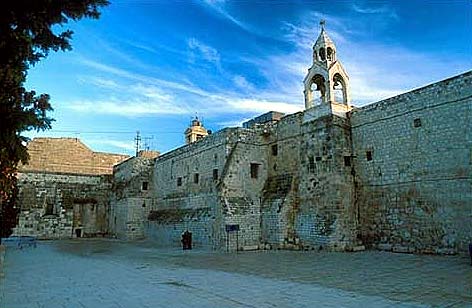
The Church of the Nativity. UNESCO’s own expert panel recommended against adding it as a World Heritage siteThe Los Angeles Times’ coverage of the controversy surrounding Unesco’s decision to list Bethlehem holy sites as World Heritage sites comes up short. While it notes Israeli Prime Minister Netanyahu’s view that “UNESCO is driven by political considerations and not cultural ones,” it ignores a key point of evidence substantiating that position.
As reported in many media outlets, but not the LA Times, U.S. ambassador to UNESCO, David Killion noted the decision was made “against the official recommendation of the International Council on Monuments and Sites, the expert advisory body that evaluated the site.” The expert panel’s recommendations are almost always heeded.
(Hat tip: Stephen Silver)
July 1, 2012
What Gideon Levy is Missing in Nazareth

Students at the Nazareth Academic InstituteAs is often the case, Ha’aretz‘s Gideon Levy is again loose with the facts. Today he writes:
The fact that for 64 years no new Arab city has been founded or developed, no industrial zone established, and no Arab university has come into being does not show equality.
Gideon Levy should find the time to go to Nazareth. He would be happy to learn that Israeli billionaire Stef Wertheimer is building the Nazareth Industrial Park, to serve the city’s Arab population.
Watch Israel 21C’s video about the park:
As for Arab universities, he should make a stop at the Nazareth Academic Institute. Its Web site explains:
Established at the initiative of the Arab community in Israel, Nazareth Academic Institute (NAI) seeks to increase access to higher education for young Arab women and men in Israel and foster a participating citizenship in the country .
The institute has operated for 5 years (2003-2008) as a branch of the University of Indianapolis, USA. Offering baccalaureate degrees in Communications, Computer Science and Chemistry, NAI has produced 228 graduates, 70% of them are women .
On November 1st 2010 the Nazareth Academic Institute proudly opened its first academic year as an independent Israeli College, accredited by the Israeli Council of Higher Education .
NAI is an egalitarian institute, open to Jews and Arabs alike and operating in harmony of citizens of all backgrounds. Uniquely in Israel and the Middle East, It is jointly managed by Arabs and Jews. Arabic, Hebrew and English are its languages of study.
Were Levy genuinely interested in advancing Israeli Arabs culturally and economically, as he claims in his Op-Ed, he would do well to promote the positive initiatives in these fields, rather than pretending they don’t exist.






Search:
Search this site: