
Recent Entries:
Month: June 2011
June 12, 2011
NY Times Public Editor Weighs In on Coverage

New York Times Public Editor Arthur Brisbane’s column yesterday on the paper’s coverage of Arab-Israeli conflict, and criticism of the paper’s coverage, can be summed up: both sides complain, and our coverage is by and large fair. Brisbane asserts: “The complaints I get vary widely. Some are on substantive issues, but often they turn on the use of a phrase or a word, or placement in the paper.”
In a sampling of complaints he has received, Brisbane ignores the substantive issues that Times editors have failed to correct. Take, for instance, Ethan Bronner’s report that Israelis viewed Netanyahu’s trip to the United States as a failure, whereas polling data showed the opposite. Or Mahmoud Abbas’ falsehoods about his personal history and events in 1948. Or consider David Kirkpatrick‘s attribution of Egypt’s blockade of Gaza to Israel.
Furthermore, Brisbane is mute about the Times’ sustained downplaying of Palestinian genocidal incitement against Israelis and Jews. Perhaps because there is no comparable counter-example of an ongoing failure to report on an Israeli wrongdoing. It’s easier to chalk up the criticism of the paper’s coverage of the Palestinian-Israeli conflict to the “third rail” phenomenon — “touch it and burn” — than it is to expose, and correct, the paper’s systemic shortcomings.
(Hat tip: Stephen S.)
June 9, 2011
When Palestinians Kill Palestinians – Not Newsworthy?
Tribune Co. newspapers, including The Chicago Tribune, Los Angeles Times and Baltimore Sun reported the deaths of up to 20 Palestinian Arabs in Syria’s Yarmouk “refugee camp” in their June 8 editions. The Washington Post and New York Times did not.
Under the headline “Violence at Palestinian camp funerals in Syria leaves 20 dead” in both The Los Angeles Times and Chicago Tribune, and “Up to 20 die in clashes at Palestinian funerals” in The Baltimore Sun, special correspondent Roula Hajjar reported on the intra-Palestinian bloodshed:
“Tension rose during a funeral procession when mourners in the camp denounced the Popular Front for the Liberation of Palestine-General Command, alleging that the faction had persuaded the mourners’ relatives to participate in Sunday’s deadly demonstrations near the Syrian-Israeli border …. Demonstrators, holding the faction responsible for Sunday’s deaths, attacked the group’s headquarters and burned two cars …. In retaliation, faction gunmen opened fire on the mourners, killing 14 to 20 people, the Palestinian sources said.”
Hajjar referred to the PFLP-GC as a “militant Palestinian faction” and noted it “is backed by Syria and based in Damascus.” Reuters (“Pro-Syrian group kills 11 refugees – sources”) said in a June 7 dispatch that “like several other Palestinian facts in Syria, the PFLP-GC, which is headed by veteran guerrilla leader Ahmad Jibreel, is regarded as a terrorists organization by the United States.”
The Tribune report quoted an anonymous Palestine Liberation Organization official who supported charges that Syria was fomenting Palestinian demonstrations on Israel’s borders to distract attention from its bloody suppression of widespread internal unrest. “Once again, the Palestinian struggle has fallen victim to the agenda of an Arab regime,” he said.
The June 8 edition of The New York Times did include a 12-paragraph article headlined “Arsonists Damage and Deface Mosque in West Bank Village,” for which Jewish settlers were suspected. The Post published as its lead World Digest news brief a six-paragraph item headed “West Bank: Jewish settlers suspected in mosque fire. But neither edition covered the Palestinian-versus-Palestinian fighting.
June 8, 2011
Rooftop Productions Uses Fabricated Ben Gurion Quote in Movie
In its 2010 movie “With God on Our Side,” Rooftop Productions assails Christian Zionists for their allegedly unreflective support of Israel. In a particularly jaundiced summary of Israeli history, Christopher, the young narrator, reports the following:
In a letter to his son in 1937 David Ben Gurion, who would later become the first Prime Minister of Israel, stated “The Arabs will have to go, but one needs an opportune moment for making it happen, such as war.”
It’s a compelling quote that fits in nicely with producer Porter Speakman’s agenda, but it’s a fabrication. It’s a fake quote that was debunked well before the 2010 release date of “With God On Our Side.”
In 2006 Benny Morris wrote a letter describing the quote as “an invention, pure and simple.” To see the letter, go here.
As Christopher, the narrator, recites the fabricated quote, Speakman splashes the text across the screen in images that can be seen below.
(more…)June 8, 2011
Time’s Shoddy Coverage (cont)
Not only bureau chief Karl Vick’s biased polemics mislead readers on the facts about Israel. Even short bits in the magazine’s “Briefing” section can’t (won’t) get the story straight. A June 13, 2011 brief reads:
Egypt Opens the Door to Gaza
ISRAEL Since 2006 the Gaza Strip has been sealed off from the world–its borders tightly controlled by an Israeli government wary of Gaza’s rulers, the Islamist outfit Hamas. But on May 29, Egypt loosened Israel’s grip on Gaza by lifting the restrictions on Palestinians seeking to cross from Gaza to Egypt. Though only a small number have gained entry so far, Egypt’s willingness to aid Gazans signals a diplomatic shift since the popular uprising that ousted its longtime dictator (and ally of Israel) Hosni Mubarak. Gaza’s other borders remain shut, but a new “freedom flotilla” carrying humanitarian aid will set sail soon to test Israel’s ongoing blockade.
Not exactly. Egypt didn’t loosen “Israel’s grip on Gaza” — it loosened Egypt’s grip on Gaza. Since 2007 Egypt has had full control of the border.
A February 2008 breach of that border saw Palestinians storm through the Egyptian-policed lines. The UK’s Telegraph noted “Without an airport or a sea port, the border with Egypt is Gaza’s only link to the outside world not directly controlled by Israel.”
That “Islamist outfit” Time refers to is, of course, the terrorist regime that long used the Egypt-Gaza border as a massive smuggling route, bringing weaponry into the Strip to attack Israel — despite the withdrawal of all Israelis in 2005.
As for the so-called freedom flotilla ostensibly planning another landing in Gaza, Time tips its biased hand here too, casting the project as focused on delivering “humanitarian aid.” The previous, 2010 flotilla was a propaganda stunt with the largest vessel, the Mavi Marmara, and several others carrying no aid at all.
June 7, 2011
Is Gaza Occupied?
Is the Gaza Strip currently “occupied territory”? Is Time Magazine‘s Israel coverage objective? Read all about it.
June 3, 2011
After Most of the Media Moves On, Some Insightful Reporting on Egypt
Two recent articles present disturbing information about where Egypt may be heading.
Lee Smith in The Tablet reveals that the conventional media narrative of how events unfolded in the first days of the unrest did not square with existing realities. Smith argues that Mubarak’s role in promoting economic reform and keeping anti-Western elements at bay has been underappreciated. The sweeping away of the Mubarak regime unleashed anti-Western forces that will be increasingly important in shaping post-revolution Egypt. Smith envisions an accomodation between the Muslim Brotherhood and the Egyptian army. He warns of trouble from the irrational anti-Semitism that pervades Egyptian society. The worsening supply situation of the main staple of the Egyptian diet, wheat, will also continue to stir unrest.
Lester Brown in the New York Times adds a new dimension to the impending food crisis in Egypt. He describes how countries both immediate and far away compete for the Nile river’s water in order to grow wheat to feed their own populations. The problem is multi-faceted, as it involves not only the burgeoning populations of Ethiopia and Sudan, both upstream from Egypt, but also a new form of colonization of Africa by wealthier nations like China, South Korea and Saudi Arabia that lack sufficient fertile land to feed their own population’s Westernized diets. Vast tracts of African land have been purchased by Asian nations to grow crops. Brown warns that Egypt, which is dependent upon the Nile river for its sustenance, is directly threatened by the diversion of Nile water to irrigate new cropland upriver.
Already, earlier this year, drought in China threatened Egypt’s supply of wheat. Some, like Spengler (David Goldman), have pointed to the wheat crisis as a crucial underlying factor in Egypt’s unrest.
June 3, 2011
BBC Covers the Farhoud
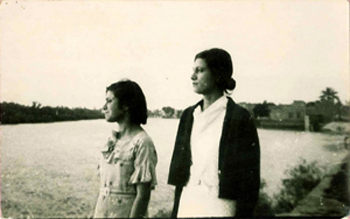
Jews in Baghdad before persecution compelled them to leave their homes 
On June 1, the BBC published an article recalling, in gruesome detail, the massacre of Iraqi Jews that took place 70 years earlier to the day.
The piece is noteworthy. In 2007, CAMERA filed a formal complaint with the BBC after the broadcaster whitewashed mistreatment of the Jewish community in Iraq, describing only a rosy existence for Jews while ignoring the 1941 massacre, known as the Farhoud, and generally downplaying persecution. The BBC online news desk initially refused to amend the article, but later acknowledged that the piece should be changed. The BBC’s Editorial Complaints Unit, too, upheld CAMERA’s complaint and agreed the story “had shortcomings on the facts.”
The piece as originally published is part of an all–too–common media trend of pretending, facts be damned, that Jewish citizens of Arab countries were always treated respectfully and as equals.
Hopefully, the more recent piece represents a new willingness to look soberly at Arab persecution of the Middle Eastern Jewish communities, which eventually led to the exile of nearly a million Jewish refugees.
In the article, “Farhud memories: Baghdad’s 1941 slaughter of the Jews,” reporter Sarah Ehrlich notes that
Thousands of armed Iraqi Muslims were on the rampage, with swords, knives and guns.
The two days of violence that followed have become known as the Farhud (Arabic for “violent dispossession”). It spelt the end for a Jewish community that dated from the time of Babylon. There are contemporary reports of up to 180 people killed, but some sources put the number much higher. The Israeli-based Babylonian Heritage Museum says about another 600 unidentified victims were buried in a mass grave.
“On the first night of Shavuot we usually go to synagogue and stay up all night studying Torah,” says Haddad, now a veteran ophthalmologist in New York.
“Suddenly we heard screams, ‘Allah Allah!’ and shots were fired. We went out to the roof to see what’s happening, we saw fires, we saw people on the roofs in the ghetto screaming, begging God to help them.”
The violence continued through the night. A red hand sign, or hamsa, had been painted on Jewish homes, to mark them out.
Search:
Search this site: