
Ethan Bronner Reveals the Deal on Journalism in the Middle East.
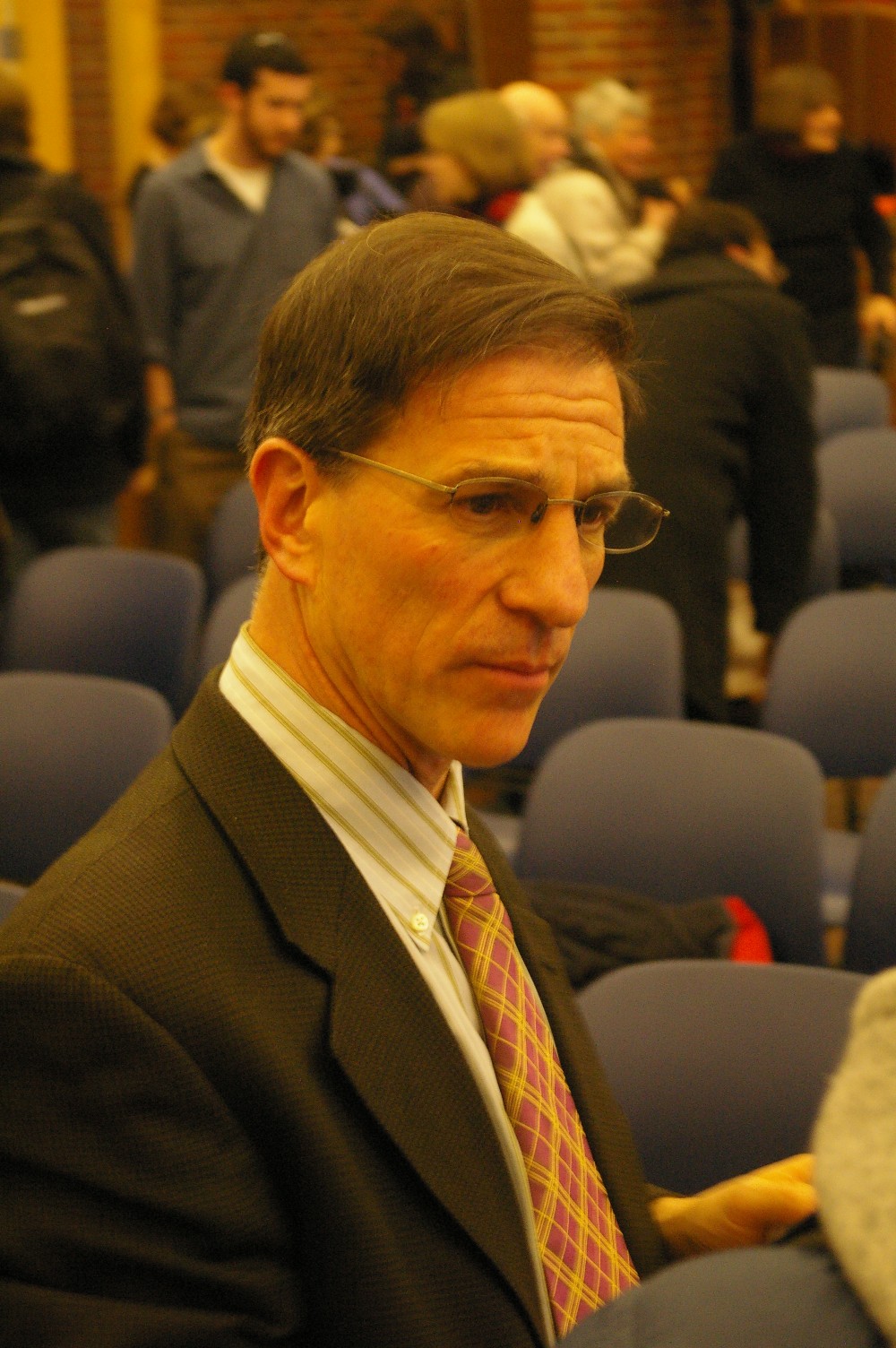
Ethan Bronner, Jerusalem Bureau Chief for the New York Times at Brandeis in February (Photo: Dexter Van Zile)
One of the biggest problems with coverage of the Arab-Israeli conflict is the failure of journalists to acknowledge and correct for the fundamental differences between Israel and its adversaries. Israel is an open society with a free press and as a result, its actions are subject to much greater scrutiny than its adversaries.
Ethan Bronner, the Jerusalem Bureau Chief for the New York Times acknowledged this problem during a recent talk at the Brandeis University. Speaking at the school in Waltham, Mass., on February 2, 2010. During his talk, Bronner stated that covering Israel is “kind of a a piece of cake, to be honest.”
He continued:
It’s pretty easy. You have enormous access to officials. You have pretty good access to the military and you have a very very open robust debate going on all the time.
And when you arrive for example in Israel as a reporter you go to the government press office they give you a list of the phone numbers of all the ministries and within about five minutes you can get the cell phone numbers of the various ministers and that is not true in Palestine or in the Arab world generally. You will get phone numbers for people, but there isn’t that same robust debate. There is very little investigative journalism, basically none, in Palestine and there are no columnists complaining about the situation the way they are in Israel.
And since we as foreign correspondents spend our time sort of creaming off the conversation that goes on inside a society, it means there’s a lot to cream on one side and very little to cream on on the other. This means that when you or others complain about unfair coverage of Israel, my advice would be “Don’t complain about our not writing positive things about Israel. Complain about our not writing enough negative things about their enemies” because I think therein lies the imbalance which is difficult and does need to be corrected. It’s hard to do because one society is more closed than the other and to remind you we rely on we live off controversy and tension. So Israel, you know, is all day long exposing itself with those questions.
The fact is that you could in the morning turn on the radio – you’d have to have two radios to do this exercise properly – for the army radio and then the Voice of Israel state radio. From six to about noon, there’s nothing but talk and each one is interviewing members of Knesset, members of the government, officials, ministers and experts and everyone’s yelling at each other all day long.
All you have to do is sit, take notes on it, go for a siesta, write your story. You don’t have to leave your bed. (Laugher)
I’ve never done that. I’m not telling you I’ve ever done that. I’m just telling you you could do it if you wanted to do it.
In the rest of the Arab world, it’s very difficult to get into a lot of countries, to Sudan, to Syria, to Saudi Arabia, to Iran.
The Times has had enormous difficulty to get into Iran since the election. And before the election there were two years that went by before we could get into Iran and so there is an imbalance there too, in terms of our coverage in the region.
And the other problem is that once you get inside once you do get your 10-day visa, it’s quite common for you to ask to see people and not get to see anybody significant and on the ninth day of your 10-day visa you’ll get a phone call telling you that the deputy agricultural minister will happy to be have tea with you on your way to the airport the next day, so it’s quite problematic in terms of getting real information from the rest of the region.
It’s not true in Jordan. It’s not true in Lebanon. It’s not true everywhere. It is true in much of the region and it’s a problem. And of course in those societies there isn’t a great deal of self-examination. It’s against the law in some places and so what you find in the press of the Arab world is a discussion of what’s going on in Israel.
It’s unbelievable.
If you go to buy The Jerusalem Post take a cab to the Allenby Bridge, go up to Amman, buy The Jordan Times – they’re mirror images of each other. Both want to know “Is there a future for Kadima?”
It’s unbelievable.
(No Ethan, it’s not unbelievable — at least not to people who know what’s going on in the Middle East. It might, however, come as a surprise to people who rely solely on the New York Times for their information about the region.)


More from SNAPSHOTS
Reuters Falsely Links Jerusalem Embassy, Two-State Solution
January 9, 2019
The Jerusalem office park which houses Guatemala's embassy Multiple recent Reuters articles incorrectly report that moving the Brazilian embassy from Tel Aviv to Jerusalem is a dramatic move away from the two-state solution. For instance, [...]
American Lutheran In Jerusalem Affirms that IDF Soldiers Are “Stormtroopers,” Backtracks
December 19, 2018
Rev. Carrie Ballenger Smith is a pastor at the Church of the Redeemer in Jerusalem. She ministers to the English-speaking congregation that meets at the Lutheran church, which is located in the Old City of [...]
The Washington Post Ignores Antisemitic Attack in Los Angeles
November 29, 2018
The Washington Post has warned about a “rising tide of antisemitism.” But as CAMERA has highlighted, The Post’s coverage of antisemitism has frequently been selective and is often politicized. More recently, the newspaper even ignored [...]
Think Tank: Iran Was Closer to Building a Bomb Than Previously Thought
November 23, 2018
A Nov. 20, 2018 report by a Washington D.C.-based think tank, the Institute for Science and International Security (ISIS) argues that Iran’s illegal nuclear weapons program was “more advanced than Western intelligence agencies and the [...]
AFP Headline Casts Palestinian Assailant as Victim
November 21, 2018
Agence France Presse yesterday published a throwback headline, bringing us back to the period almost two years ago in which media outlets serially produced headlines which depicted Palestinian attackers as the victims. The wire agency's [...]
More Hypocrisy and Anti-Semitism From Linda Sarsour
November 19, 2018
In an earlier CAMERA exposé, we pointed out the self-serving allegiances and disgraceful hypocrisy of Linda Sarsour (of Women's March fame). We demonstrated how she poses as a universal activist who embraces all marginalized people [...]
Small Steps: Improved NY Times Language on Target of Hamas Rockets
November 15, 2018
Earlier this week, we pointed out how a New York Times article about fighting between Israel and Hamas neglected to inform readers that Palestinian rockets were fired indiscriminately toward civilians in Israeli towns and cities. [...]