
Ethan Bronner Reveals the Deal on Journalism in the Middle East.
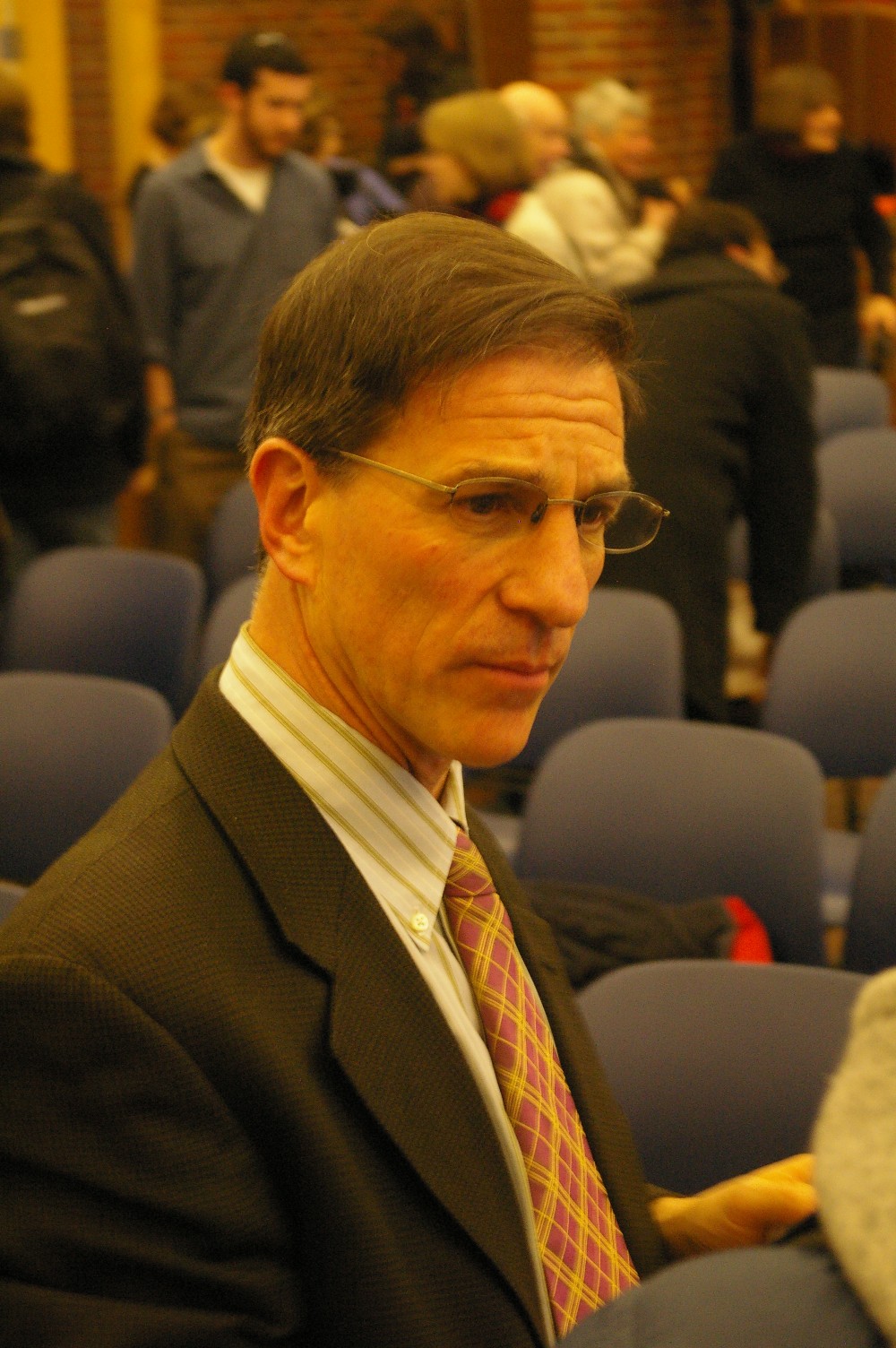
Ethan Bronner, Jerusalem Bureau Chief for the New York Times at Brandeis in February (Photo: Dexter Van Zile)
One of the biggest problems with coverage of the Arab-Israeli conflict is the failure of journalists to acknowledge and correct for the fundamental differences between Israel and its adversaries. Israel is an open society with a free press and as a result, its actions are subject to much greater scrutiny than its adversaries.
Ethan Bronner, the Jerusalem Bureau Chief for the New York Times acknowledged this problem during a recent talk at the Brandeis University. Speaking at the school in Waltham, Mass., on February 2, 2010. During his talk, Bronner stated that covering Israel is “kind of a a piece of cake, to be honest.”
He continued:
It’s pretty easy. You have enormous access to officials. You have pretty good access to the military and you have a very very open robust debate going on all the time.
And when you arrive for example in Israel as a reporter you go to the government press office they give you a list of the phone numbers of all the ministries and within about five minutes you can get the cell phone numbers of the various ministers and that is not true in Palestine or in the Arab world generally. You will get phone numbers for people, but there isn’t that same robust debate. There is very little investigative journalism, basically none, in Palestine and there are no columnists complaining about the situation the way they are in Israel.
And since we as foreign correspondents spend our time sort of creaming off the conversation that goes on inside a society, it means there’s a lot to cream on one side and very little to cream on on the other. This means that when you or others complain about unfair coverage of Israel, my advice would be “Don’t complain about our not writing positive things about Israel. Complain about our not writing enough negative things about their enemies” because I think therein lies the imbalance which is difficult and does need to be corrected. It’s hard to do because one society is more closed than the other and to remind you we rely on we live off controversy and tension. So Israel, you know, is all day long exposing itself with those questions.
The fact is that you could in the morning turn on the radio – you’d have to have two radios to do this exercise properly – for the army radio and then the Voice of Israel state radio. From six to about noon, there’s nothing but talk and each one is interviewing members of Knesset, members of the government, officials, ministers and experts and everyone’s yelling at each other all day long.
All you have to do is sit, take notes on it, go for a siesta, write your story. You don’t have to leave your bed. (Laugher)
I’ve never done that. I’m not telling you I’ve ever done that. I’m just telling you you could do it if you wanted to do it.
In the rest of the Arab world, it’s very difficult to get into a lot of countries, to Sudan, to Syria, to Saudi Arabia, to Iran.
The Times has had enormous difficulty to get into Iran since the election. And before the election there were two years that went by before we could get into Iran and so there is an imbalance there too, in terms of our coverage in the region.
And the other problem is that once you get inside once you do get your 10-day visa, it’s quite common for you to ask to see people and not get to see anybody significant and on the ninth day of your 10-day visa you’ll get a phone call telling you that the deputy agricultural minister will happy to be have tea with you on your way to the airport the next day, so it’s quite problematic in terms of getting real information from the rest of the region.
It’s not true in Jordan. It’s not true in Lebanon. It’s not true everywhere. It is true in much of the region and it’s a problem. And of course in those societies there isn’t a great deal of self-examination. It’s against the law in some places and so what you find in the press of the Arab world is a discussion of what’s going on in Israel.
It’s unbelievable.
If you go to buy The Jerusalem Post take a cab to the Allenby Bridge, go up to Amman, buy The Jordan Times – they’re mirror images of each other. Both want to know “Is there a future for Kadima?”
It’s unbelievable.
(No Ethan, it’s not unbelievable — at least not to people who know what’s going on in the Middle East. It might, however, come as a surprise to people who rely solely on the New York Times for their information about the region.)


More from SNAPSHOTS
Professor John Quigley Falsely Condemns Israel and U.S. Support in His Syndicated Column
April 30, 2019
John B. Quigley In his widely distributed April syndicated opinion piece mainly about ISIS, the Islamist terrorist entity, John B. Quigley, an Ohio State University law professor, argues that claims of an imminent ISIS resurgence [...]
The New York Times’ Slow Reaction to Hamas Crackdown on Palestinian Protesters
April 4, 2019
The New York Times took a slight jab at Hamas, the terrorist organization that rules the Gaza Strip, in a recent story about Hamas's crackdown on Palestinian protesters who spoke out against its policies in [...]
CNN’s Zakaria Deals With U.S. Proclamation Recognizing Golan As Part Of Israel
April 3, 2019
Fareed Zakaria hosted an eight-minute discussion of the Golan matter at the end of his weekly (weekend) program, “Global Public Square “ (GPS) hour-long Cable News Network (CNN) broadcast. The broadcast, on both CNN and [...]
NY Times Reporter David Halbfinger Editorializes Israel as “Brutal”
March 6, 2019
New York Times Jerusalem bureau chief David Halbfinger Israel, according to the New York Times, is a brute. A March 3 news analysis piece—not an opinion piece—by the newspaper's Jerusalem bureau chief David Halbfinger uses [...]
Palestinian Malevolent Indoctrination Exposed; Mainstream Media Are Indifferent
February 26, 2019
Palestinian Media Watch (PMW), an Israel-based non-governmental organization, analyzes and presents in English to the world the ongoing inflammatory indoctrination of Palestinians in Arabic particularly via Palestinian Authority (PA) television (West Bank). PMW is a [...]
Did WCC Activists Attend A Birthday Party Promoted by Palestinian Extremist Organization?
February 4, 2019
The video is a bit fuzzy and grainy. But the footage of birthday party for Shadi Farar, a 12-year-old Palestinian boy who spent three years in an Israeli jail on charges of intent to murder, [...]