
New York Times Repeats False Promises in Defense of Putin Op-Ed
In defense of his decision to publish a controversial Op-Ed by Russian president Vladimir Putin, New York Times editorial page editor Andrew Rosenthal made some high-minded claims about the newspaper’s supposedly non-judgmental and ideologically open Op-Ed pages. Those claims, however, don’t withstand scrutiny.
Although Rosenthal told the newspaper’s public editor that he doesn’t agree with many of the of the points in the Op-Ed, he goes on to insist that this is “irrelevant.”
“There is no ideological litmus test” for an Op-Ed article, he claimed.
Looking back at the newspaper’s track record, though, it’s clear that ideology does play a role in what is published and what is not.
Consider this: When Richard Goldstone, the head of a UN “fact finding mission” on the war between Hamas and Israel that began in December 2008, submitted an Op-Ed to the New York Times harshly criticizing Israel, the piece was accepted and placed in the September 17, 2009 edition of the newspaper.
A year and a half later, Goldstone approached the New York Times with a bombshell. He had repudiated the central and most slanderous finding of the anti-Israel United Nations report that bears his name, and sought to share this dramatic and important news in a new Op-Ed. But this time, the newspaper rejected his submission.
This decision to prominently highlight views that accord with the newspaper’s unsympathetic disposition toward Israel while shying away from more favorable conversation about the Jewish state fits a pattern.
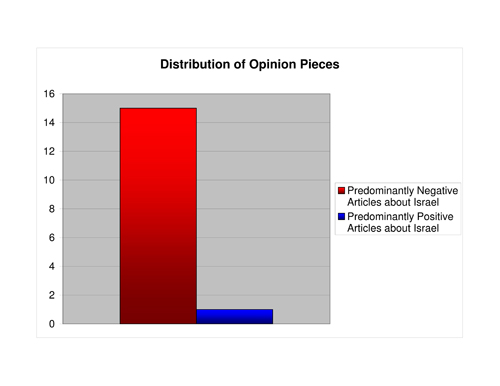
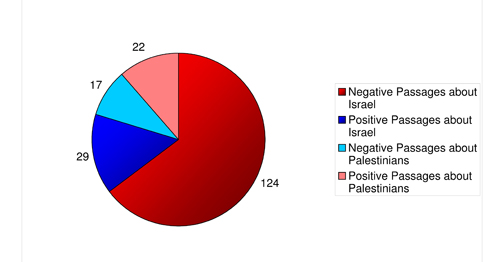
CAMERA’s nine-month study of the New York Times Opinion section found a consistent bias in the newspaper’s selection of Op-Eds. As the study explains,
The newspaper’s editors have repeatedly proclaimed their commitment to presenting a diversity of opinion on the Op-Ed pages. Former Op-Ed editor David Shipley insisted that the newspaper tends to “look for articles that cover subjects and make arguments that have not been articulated elsewhere in the editorial space. If the editorial page, for example, has a forceful, long-held view on a certain topic, we are more inclined to publish an Op-Ed that disagrees with that view.” The current editorial page editor, Andrew Rosenthal, similarly asserted that editors “are not looking for people who agree with us all the time” and are aiming for “balance over time.”
But there was no balance about the Palestinian-Israeli conflict over the study’s entire time period — not in editorials, not in columns, and not in guest Op-Eds.
• Of 7 Op-Eds discussion the Palestinian-Israeli conflict, 4 were predominantly negative toward Israel and only 1 was positive.
• There were no Op-Eds negative toward the Palestinians, and 1 Op-Ed that was positive toward the Palestinians.
The Times is certainly entitled to publish an Op-Ed by Putin. But editors should not pretend that “there is no ideological litmus test” on the opinion pages. There is.
Below are two graphs from the study.


More from SNAPSHOTS
Mahmoud Abbas’ Diatribe Threatening Israel Included Bogus Canaanite Claim
September 10, 2019
Palestinian Authority President Mahmoud Abbas’ recent anti-Israel diatribe that aired on PA TV was monitored and translated by Palestinian Media Watch (PMW). Excerpt: "I say to [Israel]: Every stone you have built on our land [...]
CNN Calls House’s Unifying Anti-BDS Vote ‘Divisive’
July 24, 2019
Yesterday, in an overwhelming vote of bipartisan support, the House of Representatives voted 398 to 17 to adopt a resolution opposing the anti-Israel BDS (boycott, divest, sanctions) campaign. Yet, CNN's headline casts the unifying vote [...]
NY Times Cites Poll, Hides Palestinian Support for Violence
July 9, 2019
The New York Times has struggled to accurately describe polls this year. In January, editor Jonathan Weisman misrepresented Pew polling data to describe a nonexistent surge in Israeli support for the United States under President [...]
CNN’s Zakaria Indulges Palestinian Propagandist Hanan Ashrawi
June 9, 2019
Fareed Zakaria’s weekly Cable News Network (CNN) program (grandiosely named “Global Public Square”) June 9 broadcast included a discussion of the current U.S. Middle East peace plan with guests Hanan Ashrawi (Palestinian Authority official) and [...]
In Robert Bernstein Obit, AFP Inappropriately References His Judaism
May 29, 2019
Robert Bernstein (Courtesy the New Press) In its obituary yesterday for American publisher Robert Bernstein, Agence France Presse inserted an inappropriate reference to the Human Rights Watch founder who later turned on the organization due [...]