
New York Times Repeats False Promises in Defense of Putin Op-Ed
In defense of his decision to publish a controversial Op-Ed by Russian president Vladimir Putin, New York Times editorial page editor Andrew Rosenthal made some high-minded claims about the newspaper’s supposedly non-judgmental and ideologically open Op-Ed pages. Those claims, however, don’t withstand scrutiny.
Although Rosenthal told the newspaper’s public editor that he doesn’t agree with many of the of the points in the Op-Ed, he goes on to insist that this is “irrelevant.”
“There is no ideological litmus test” for an Op-Ed article, he claimed.
Looking back at the newspaper’s track record, though, it’s clear that ideology does play a role in what is published and what is not.
Consider this: When Richard Goldstone, the head of a UN “fact finding mission” on the war between Hamas and Israel that began in December 2008, submitted an Op-Ed to the New York Times harshly criticizing Israel, the piece was accepted and placed in the September 17, 2009 edition of the newspaper.
A year and a half later, Goldstone approached the New York Times with a bombshell. He had repudiated the central and most slanderous finding of the anti-Israel United Nations report that bears his name, and sought to share this dramatic and important news in a new Op-Ed. But this time, the newspaper rejected his submission.
This decision to prominently highlight views that accord with the newspaper’s unsympathetic disposition toward Israel while shying away from more favorable conversation about the Jewish state fits a pattern.
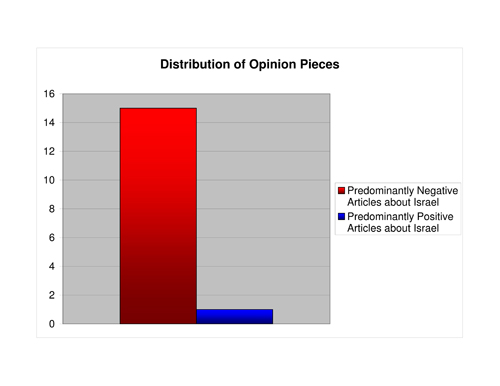
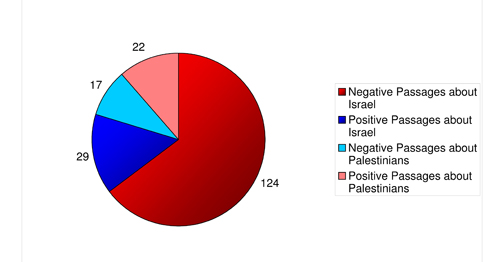
CAMERA’s nine-month study of the New York Times Opinion section found a consistent bias in the newspaper’s selection of Op-Eds. As the study explains,
The newspaper’s editors have repeatedly proclaimed their commitment to presenting a diversity of opinion on the Op-Ed pages. Former Op-Ed editor David Shipley insisted that the newspaper tends to “look for articles that cover subjects and make arguments that have not been articulated elsewhere in the editorial space. If the editorial page, for example, has a forceful, long-held view on a certain topic, we are more inclined to publish an Op-Ed that disagrees with that view.” The current editorial page editor, Andrew Rosenthal, similarly asserted that editors “are not looking for people who agree with us all the time” and are aiming for “balance over time.”
But there was no balance about the Palestinian-Israeli conflict over the study’s entire time period — not in editorials, not in columns, and not in guest Op-Eds.
• Of 7 Op-Eds discussion the Palestinian-Israeli conflict, 4 were predominantly negative toward Israel and only 1 was positive.
• There were no Op-Eds negative toward the Palestinians, and 1 Op-Ed that was positive toward the Palestinians.
The Times is certainly entitled to publish an Op-Ed by Putin. But editors should not pretend that “there is no ideological litmus test” on the opinion pages. There is.
Below are two graphs from the study.


More from SNAPSHOTS
CNN’s Amanpour Condemns “power grab” By Israel’s Prime Minister and Others
April 1, 2020
We’ve said it often, but it’s worth repeating: Anyone interested in reasonably unbiased information about Israel (at least) should avoid the broadcasts of CNN’s Chief International Correspondent and Anchor, Christiane Amanpour. In characterizing responses to [...]
Seattle Media Oblivious To Imam’s Hateful Indoctrination Condemning Jews
January 7, 2020
The Masjid Ar-Rahmah mosque teaching – that Allah transformed Jews into apes and pigs for disobeying him – delivered by Imam (prayer leader) Mohamad Joban – was posted online by mosque personnel. This December 2019 [...]
AP Distorts: Bethlehem ‘Almost Completely Surrounded’
December 10, 2019
Over two years after improving inaccurate language falsely citing Israel's security "barrier surrounding the biblical city" of Bethlehem, the Associated Press once again misrepresents. AP's Joseph Krauss and Mohammad Daraghmeh wrote yesterday ("Palestinians in Bethlehem [...]
Reuters Errs on Administrative Detention For ‘Anti-Israel Activity’
November 5, 2019
The Ofer Prison, near Ramallah (Photo by Tamar Sternthal) A Reuters article today egregiously misrepresents administrative detention, erroneously asserting that it is mainly applied to "Palestinians suspected of anti-Israeli activities," when in fact the Israeli [...]