
Ethan Bronner Reveals the Deal on Journalism in the Middle East.
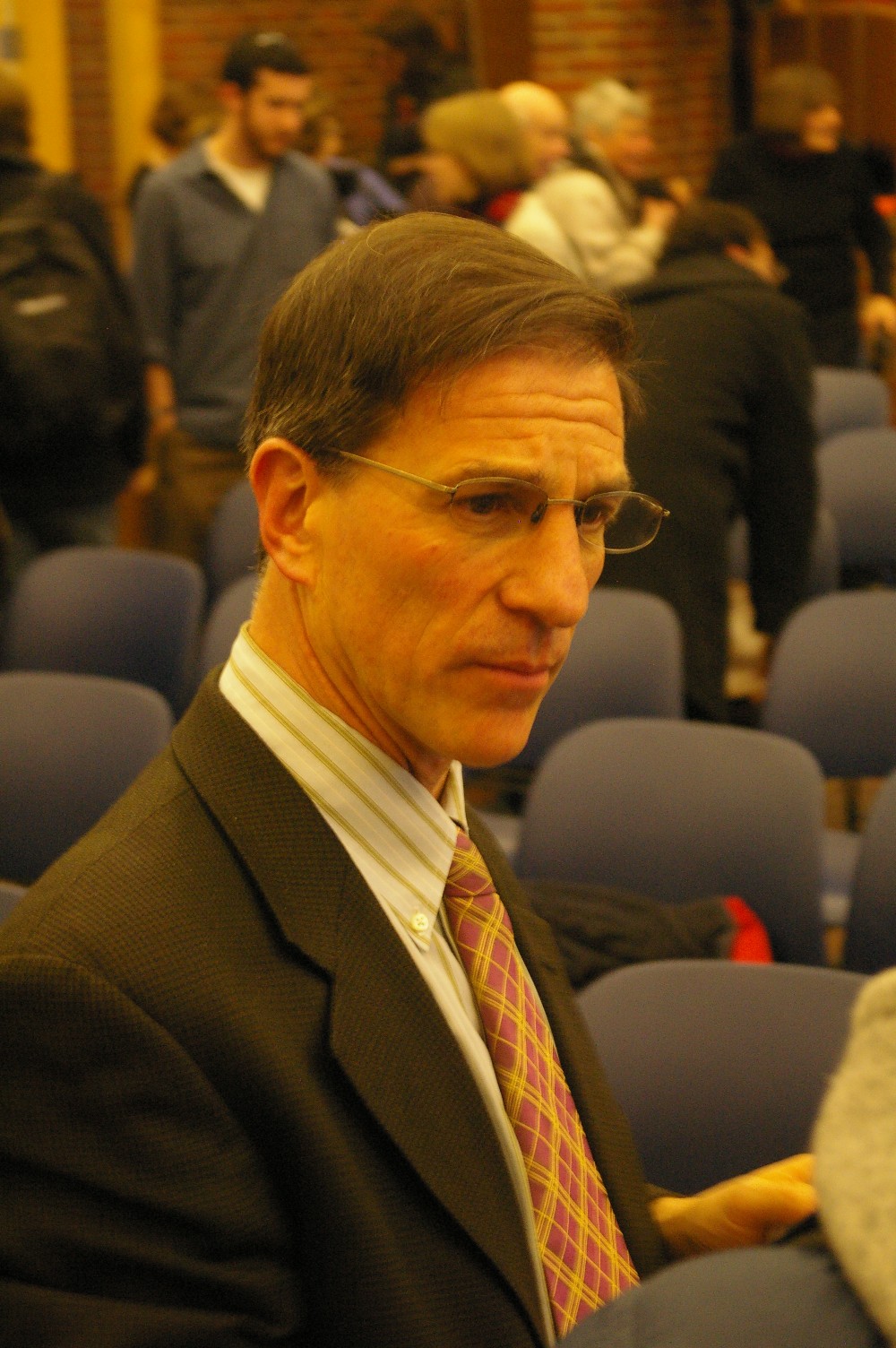
Ethan Bronner, Jerusalem Bureau Chief for the New York Times at Brandeis in February (Photo: Dexter Van Zile)
One of the biggest problems with coverage of the Arab-Israeli conflict is the failure of journalists to acknowledge and correct for the fundamental differences between Israel and its adversaries. Israel is an open society with a free press and as a result, its actions are subject to much greater scrutiny than its adversaries.
Ethan Bronner, the Jerusalem Bureau Chief for the New York Times acknowledged this problem during a recent talk at the Brandeis University. Speaking at the school in Waltham, Mass., on February 2, 2010. During his talk, Bronner stated that covering Israel is “kind of a a piece of cake, to be honest.”
He continued:
It’s pretty easy. You have enormous access to officials. You have pretty good access to the military and you have a very very open robust debate going on all the time.
And when you arrive for example in Israel as a reporter you go to the government press office they give you a list of the phone numbers of all the ministries and within about five minutes you can get the cell phone numbers of the various ministers and that is not true in Palestine or in the Arab world generally. You will get phone numbers for people, but there isn’t that same robust debate. There is very little investigative journalism, basically none, in Palestine and there are no columnists complaining about the situation the way they are in Israel.
And since we as foreign correspondents spend our time sort of creaming off the conversation that goes on inside a society, it means there’s a lot to cream on one side and very little to cream on on the other. This means that when you or others complain about unfair coverage of Israel, my advice would be “Don’t complain about our not writing positive things about Israel. Complain about our not writing enough negative things about their enemies” because I think therein lies the imbalance which is difficult and does need to be corrected. It’s hard to do because one society is more closed than the other and to remind you we rely on we live off controversy and tension. So Israel, you know, is all day long exposing itself with those questions.
The fact is that you could in the morning turn on the radio – you’d have to have two radios to do this exercise properly – for the army radio and then the Voice of Israel state radio. From six to about noon, there’s nothing but talk and each one is interviewing members of Knesset, members of the government, officials, ministers and experts and everyone’s yelling at each other all day long.
All you have to do is sit, take notes on it, go for a siesta, write your story. You don’t have to leave your bed. (Laugher)
I’ve never done that. I’m not telling you I’ve ever done that. I’m just telling you you could do it if you wanted to do it.
In the rest of the Arab world, it’s very difficult to get into a lot of countries, to Sudan, to Syria, to Saudi Arabia, to Iran.
The Times has had enormous difficulty to get into Iran since the election. And before the election there were two years that went by before we could get into Iran and so there is an imbalance there too, in terms of our coverage in the region.
And the other problem is that once you get inside once you do get your 10-day visa, it’s quite common for you to ask to see people and not get to see anybody significant and on the ninth day of your 10-day visa you’ll get a phone call telling you that the deputy agricultural minister will happy to be have tea with you on your way to the airport the next day, so it’s quite problematic in terms of getting real information from the rest of the region.
It’s not true in Jordan. It’s not true in Lebanon. It’s not true everywhere. It is true in much of the region and it’s a problem. And of course in those societies there isn’t a great deal of self-examination. It’s against the law in some places and so what you find in the press of the Arab world is a discussion of what’s going on in Israel.
It’s unbelievable.
If you go to buy The Jerusalem Post take a cab to the Allenby Bridge, go up to Amman, buy The Jordan Times – they’re mirror images of each other. Both want to know “Is there a future for Kadima?”
It’s unbelievable.
(No Ethan, it’s not unbelievable — at least not to people who know what’s going on in the Middle East. It might, however, come as a surprise to people who rely solely on the New York Times for their information about the region.)


More from SNAPSHOTS
Why Does a NY Times Journalist Want to Suppress an Anti-Hamas Article?
May 29, 2018
A New York Times journalist thinks the Wall Street Journal shouldn't have published an opinion piece criticizing Hamas's anti-Israel propaganda campaign. The reporter, Declan Walsh, is one of the Times reporters who has covered the [...]
Iran is Funding Hamas’s Violent ‘Protests’ at the Border, Media M.I.A.
May 22, 2018
Iran's Supreme Leader, Ayatollah Ali Khameini The Islamic Republic of Iran is behind the recent Hamas-orchestrated violent demonstrations—dubbed the “March of Return”—at the Israel-Gaza border, according to Israeli authorities. Yet many major U.S. news outlets [...]
Are Gaza Gunmen “Protesters”? NY Times Refuses to Say
May 21, 2018
After repeatedly insisting that "Israeli soldiers killed 60 protesters" during clashes last Monday, May 14, the New York Times is refusing to clarify whether its count of supposed protesters includes the eight armed Hamas fighters [...]
Bahrain Says Israel Has a Right to Self-Defense, and the Media Shrugs
May 15, 2018
Bahrain's Foreign Minister and then-U.S. Secretary of State John Kerry The foreign minister of the Arab nation of Bahrain, Sheikh Khalid al-Khaalifa declared on May 10, 2018 that Israel has a right to defend itself. [...]
AFP Captions Call Jerusalem Parade Participants Settlers
May 15, 2018
Numerous Agence France-Presse photo captions generalized all participants in Sunday's Jerusalem Flag Parade as "settlers," despite the fact that the crowd hailed from across Israel, within the Green Line, as well as outside. A sampling [...]
Journalist: Hezbollah Shows ‘More Maturity’ Than Israel
May 9, 2018
Hezbollah Secretary General Hassan Nasrallah A Los Angeles Times special correspondent, Nabih Bulos, declared on Twitter on May 7, 2018, that Hezbollah (“Party of God”) shows “more maturity” than Israel. Hezbollah is a Lebanese-based, Iranian-backed, [...]