
Ethan Bronner Reveals the Deal on Journalism in the Middle East.
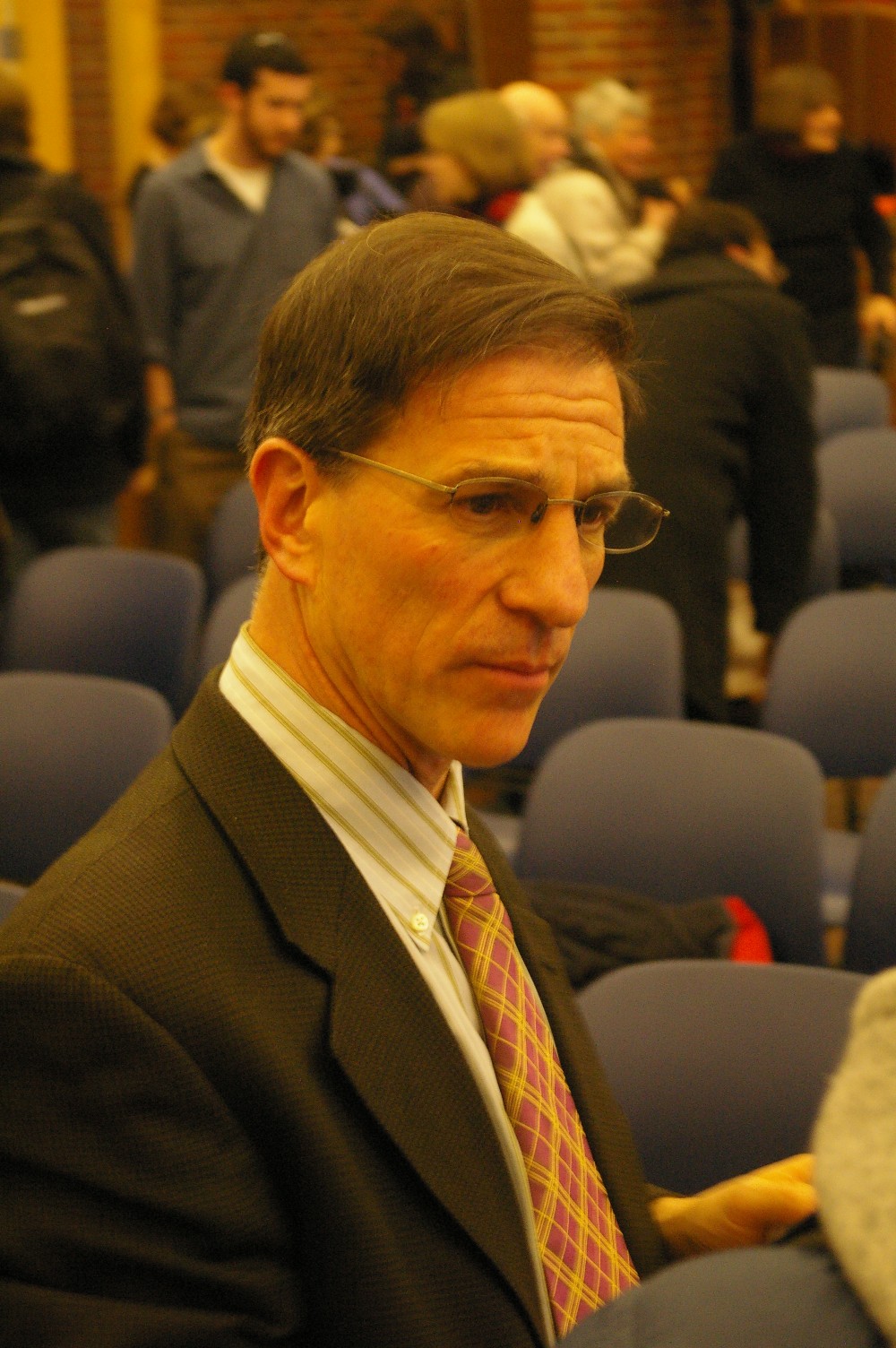
Ethan Bronner, Jerusalem Bureau Chief for the New York Times at Brandeis in February (Photo: Dexter Van Zile)
One of the biggest problems with coverage of the Arab-Israeli conflict is the failure of journalists to acknowledge and correct for the fundamental differences between Israel and its adversaries. Israel is an open society with a free press and as a result, its actions are subject to much greater scrutiny than its adversaries.
Ethan Bronner, the Jerusalem Bureau Chief for the New York Times acknowledged this problem during a recent talk at the Brandeis University. Speaking at the school in Waltham, Mass., on February 2, 2010. During his talk, Bronner stated that covering Israel is “kind of a a piece of cake, to be honest.”
He continued:
It’s pretty easy. You have enormous access to officials. You have pretty good access to the military and you have a very very open robust debate going on all the time.
And when you arrive for example in Israel as a reporter you go to the government press office they give you a list of the phone numbers of all the ministries and within about five minutes you can get the cell phone numbers of the various ministers and that is not true in Palestine or in the Arab world generally. You will get phone numbers for people, but there isn’t that same robust debate. There is very little investigative journalism, basically none, in Palestine and there are no columnists complaining about the situation the way they are in Israel.
And since we as foreign correspondents spend our time sort of creaming off the conversation that goes on inside a society, it means there’s a lot to cream on one side and very little to cream on on the other. This means that when you or others complain about unfair coverage of Israel, my advice would be “Don’t complain about our not writing positive things about Israel. Complain about our not writing enough negative things about their enemies” because I think therein lies the imbalance which is difficult and does need to be corrected. It’s hard to do because one society is more closed than the other and to remind you we rely on we live off controversy and tension. So Israel, you know, is all day long exposing itself with those questions.
The fact is that you could in the morning turn on the radio – you’d have to have two radios to do this exercise properly – for the army radio and then the Voice of Israel state radio. From six to about noon, there’s nothing but talk and each one is interviewing members of Knesset, members of the government, officials, ministers and experts and everyone’s yelling at each other all day long.
All you have to do is sit, take notes on it, go for a siesta, write your story. You don’t have to leave your bed. (Laugher)
I’ve never done that. I’m not telling you I’ve ever done that. I’m just telling you you could do it if you wanted to do it.
In the rest of the Arab world, it’s very difficult to get into a lot of countries, to Sudan, to Syria, to Saudi Arabia, to Iran.
The Times has had enormous difficulty to get into Iran since the election. And before the election there were two years that went by before we could get into Iran and so there is an imbalance there too, in terms of our coverage in the region.
And the other problem is that once you get inside once you do get your 10-day visa, it’s quite common for you to ask to see people and not get to see anybody significant and on the ninth day of your 10-day visa you’ll get a phone call telling you that the deputy agricultural minister will happy to be have tea with you on your way to the airport the next day, so it’s quite problematic in terms of getting real information from the rest of the region.
It’s not true in Jordan. It’s not true in Lebanon. It’s not true everywhere. It is true in much of the region and it’s a problem. And of course in those societies there isn’t a great deal of self-examination. It’s against the law in some places and so what you find in the press of the Arab world is a discussion of what’s going on in Israel.
It’s unbelievable.
If you go to buy The Jerusalem Post take a cab to the Allenby Bridge, go up to Amman, buy The Jordan Times – they’re mirror images of each other. Both want to know “Is there a future for Kadima?”
It’s unbelievable.
(No Ethan, it’s not unbelievable — at least not to people who know what’s going on in the Middle East. It might, however, come as a surprise to people who rely solely on the New York Times for their information about the region.)


More from SNAPSHOTS
CNN’s Ben Wedeman Falsely Reports No Soldiers Injured in Gaza Border Violence
June 17, 2018
In a June 7 broadcast and online here, Ben Wedeman incorrectly reported that in the course of the ongoing "March of Return" violence at the Gaza border, "No Israeli soldiers were killed or injured during [...]
Where’s the Coverage? Hezbollah Helps Hamas Build Terror Camps, Israel Calls for U.N. Help
June 12, 2018
Well equipped Hamas operatives Hezbollah, the Lebanese-based, Iranian-backed terrorist group is helping Hamas build rocket factories and terror training camps in southern Lebanon, according to a Jerusalem Post report. Hezbollah’s assistance violates several United Nations [...]
Where’s the Coverage? Israel Foils Assassination Plot Targeting Netanyahu and Others
June 6, 2018
Israeli authorities uncovered and thwarted a terrorist cell that planned to murder top governmental officials, including the country’s prime minister, Benjamin Netanyahu, and the mayor of Jerusalem, Nir Barkat. However, many major U.S. news outlets [...]
U.S. Official: Iran’s Support for Hezbollah Greater Than Previously Thought
June 6, 2018
Hezbollah head Hassan Nasrallah The Islamic Republic of Iran’s support for Hezbollah might be greater than previously thought. Tehran gives the Lebanese-based terrorist group $700 million a year, according to recent remarks by the U.S. [...]
Where’s the Coverage? 14 Members of Congress Call to Halt PA Aid
June 1, 2018
U.S. Secretary of State Mike Pompeo In a widely underreported move, fourteen members of the United States Congress called upon the U.S. State Department to “immediately suspend all aid payments to the Palestinian Authority.” The [...]