
Former BBC Correspondent Discusses Gaza Coverage, Media Aversion to Self-Reflection
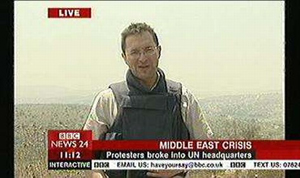
Matti Friedman’s devastating critique of news coverage of the Arab-Israeli conflict has inspired another media veteran to weigh in. “There is much that Matti Friedman writes that resonates,” writes former BBC correspondent Richard Miron, mentioning specifically “the disproportionate coverage that Israel receives, and the way that the foreign media has broadly speaking accepted a narrative of the conflict which prescribes given roles to Israel (as the guilty party) and the Palestinians (as the victims).”
While the entire piece is well worth a read — find it on Miron’s blog here (or at Haaretz here) — one of the more disheartening bits is his conclusion that any improvement in the media’s performance would require a degree of self-criticism that has generally been absent among journalists:
the (Western) media must also account for itself and for its own conduct including apparent omissions and failures in the reporting of the conflict. It must question where reporting may have ended and emoting began, if it held Israel to a standard apart from all others, and why it allowed Hamas a free pass in controlling the flow of information. Its coverage had consequences in fuelling the passions (and hatred) of many on the streets of Paris, London and elsewhere towards Israel, and by extension towards Jews.
The media is instinctively averse from turning the lens of scrutiny upon itself, and will – in all likelihood – veer away from any self-examination. It is better at calling out the wrong-doing of others, than admitting to its own faults. But whatever it chooses to do or not, the picture it painted of Gaza 2014 and its consequences are already etched in the consciousness of many around the world, and will serve as a further chapter in this never ending story.
Miron has clearly seen this “aversion” to self-examination as an insider, just as CAMERA has occasionally (though not universally) seen in our decades of holding the media accountable. But the situation is not hopeless. We’ve also seen that when the internal voice for improvement is missing, the collective voice of a public that insists on accuracy and fairness can and must take its place as a needed impetus for change.


More from SNAPSHOTS
Mahmoud Abbas’ Diatribe Threatening Israel Included Bogus Canaanite Claim
September 10, 2019
Palestinian Authority President Mahmoud Abbas’ recent anti-Israel diatribe that aired on PA TV was monitored and translated by Palestinian Media Watch (PMW). Excerpt: "I say to [Israel]: Every stone you have built on our land [...]
CNN Calls House’s Unifying Anti-BDS Vote ‘Divisive’
July 24, 2019
Yesterday, in an overwhelming vote of bipartisan support, the House of Representatives voted 398 to 17 to adopt a resolution opposing the anti-Israel BDS (boycott, divest, sanctions) campaign. Yet, CNN's headline casts the unifying vote [...]
NY Times Cites Poll, Hides Palestinian Support for Violence
July 9, 2019
The New York Times has struggled to accurately describe polls this year. In January, editor Jonathan Weisman misrepresented Pew polling data to describe a nonexistent surge in Israeli support for the United States under President [...]
CNN’s Zakaria Indulges Palestinian Propagandist Hanan Ashrawi
June 9, 2019
Fareed Zakaria’s weekly Cable News Network (CNN) program (grandiosely named “Global Public Square”) June 9 broadcast included a discussion of the current U.S. Middle East peace plan with guests Hanan Ashrawi (Palestinian Authority official) and [...]
In Robert Bernstein Obit, AFP Inappropriately References His Judaism
May 29, 2019
Robert Bernstein (Courtesy the New Press) In its obituary yesterday for American publisher Robert Bernstein, Agence France Presse inserted an inappropriate reference to the Human Rights Watch founder who later turned on the organization due [...]