
Ha’aretz Lost in Translation: Ma’aleh Adumim, It Sells
As the year comes to an end, it’s time to catch up on examples of “Ha’aretz, Lost in Translation” that we didn’t have time to post. Earlier this month, an article about funds earmarked for public housing which where not ultimately spent on that purpose appeared in Ha’aretz‘s Hebrew and English editions. In a column that covers various election issues, this time funding for public housing, reporter Or Kashti essentially recycled information that had appeared a year earlier in Calcalist. Here is how the Hebrew headline appeared in print:
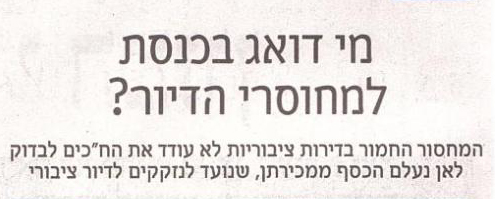
The headline reads: “Who in the Knesset is looking after the housing shortage?”
The subheadline states: “The severe shortage of public housing does not encourage MKs to check where funds from the apartment sales, meant for those in need of public housing, have disappeared.”
Like the original Calcalist article, Kashti details where the funds went, and at the end also notes:
funds were used for, among other things, paving an access road to Ma’aleh Adumim and funding the construction of public institutions.
In addition, it’s noteworthy that the amount spent on the access road to Ma’aleh Adumim was 6 million NIS, or 0.21 percent of the 2.75 billion NIS in question. Kashti, appropriately, does not focus on the relatively negligible funding to Ma’aleh Adumim road, but on the MK’s responses regarding how the funds were used.
Now let’s see what Ha’aretz‘s English print edition did with the same piece:

Under the headline “Where did funds earmarked for public housing go?” reads the subheadline: “To pave a road to Ma’aleh Adumim, among other things.”
Ha’aretz‘s English editors elevated funding for the Ma’aleh Adumim road to the subheadline, despite the fact that Kashti himself and his Hebrew editors did not at all emphasize this relatively insignificant recipient of funds, and did not mention it in a headline.
Thus, in a week in which the words “Ma’aleh Adumim, “E1,” “contiguity,” and “end of the two-state solution” were the talk of the international media, Ha’aretz‘s English editors exploit the hot button name “Ma’aleh Adumim,” even though its role in this particular story issue is nominal. And thus, a story about the misuse of public housing funds, an internal Israeli issue, morphs into something much sexier for international consumption: once again, Israel is funding settlements over the Green Line.
For the Hebrew version of this post, please visit Presspectiva.
— By Yishai Goldflam


More from SNAPSHOTS
Mahmoud Abbas’ Diatribe Threatening Israel Included Bogus Canaanite Claim
September 10, 2019
Palestinian Authority President Mahmoud Abbas’ recent anti-Israel diatribe that aired on PA TV was monitored and translated by Palestinian Media Watch (PMW). Excerpt: "I say to [Israel]: Every stone you have built on our land [...]
CNN Calls House’s Unifying Anti-BDS Vote ‘Divisive’
July 24, 2019
Yesterday, in an overwhelming vote of bipartisan support, the House of Representatives voted 398 to 17 to adopt a resolution opposing the anti-Israel BDS (boycott, divest, sanctions) campaign. Yet, CNN's headline casts the unifying vote [...]
NY Times Cites Poll, Hides Palestinian Support for Violence
July 9, 2019
The New York Times has struggled to accurately describe polls this year. In January, editor Jonathan Weisman misrepresented Pew polling data to describe a nonexistent surge in Israeli support for the United States under President [...]
CNN’s Zakaria Indulges Palestinian Propagandist Hanan Ashrawi
June 9, 2019
Fareed Zakaria’s weekly Cable News Network (CNN) program (grandiosely named “Global Public Square”) June 9 broadcast included a discussion of the current U.S. Middle East peace plan with guests Hanan Ashrawi (Palestinian Authority official) and [...]
In Robert Bernstein Obit, AFP Inappropriately References His Judaism
May 29, 2019
Robert Bernstein (Courtesy the New Press) In its obituary yesterday for American publisher Robert Bernstein, Agence France Presse inserted an inappropriate reference to the Human Rights Watch founder who later turned on the organization due [...]