
African Migrants in Egypt: Where NPR Glossed Over, CNN Dives In
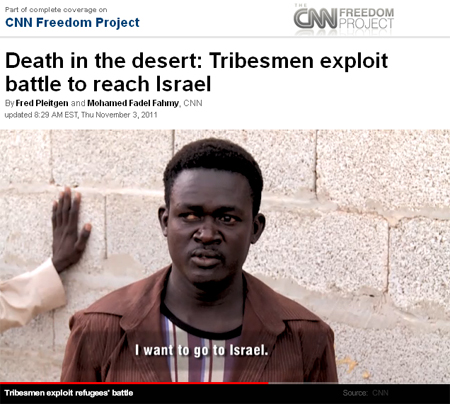
Early this year we pointed out how NPR’s obsession with criticizing Israel came at the expense of African migrants. While the network zoomed in on the nuances of Israel’s uneasy “welcome mat” for the migrants, it downplayed or ignored the rape, torture and murder of these Africans in neighboring Egypt.
CNN has now stepped in with hard-hitting investigative reporting to fill the informational void left by NPR’s kid-glove treatment.
Its two-part series about African refugees in Egypt doesn’t pull punches and, in contrast with NPR’s coverage, doesn’t strain to find a way to turn Israel into “the story” even while human rights groups struggle to direct attention toward migrants’ suffering in the Sinai.
From part one:
Many are enslaved and tortured and the women raped by the Bedouin tribes of the Sinai if they are unable to come up with large sums of money the Bedouin try to extort from them and their families, to smuggle the refugees across the border into Israel. As a result, many remain imprisoned in camps on the Sinai Peninsula.
“They are chained and kept in camps in the open with no bathrooms and little water and food and treated worse than animals,” Al-Azazy said.
And from part two, lightly substantiated but shocking allegations of organ theft:
The New Generation Foundation for Human Rights and the EveryOne Group, from Italy, have presented evidence that the bodies of African refugees have been found in the Sinai desert with organs missing. …
One Bedouin tribal chief did put CNN in touch with a Bedouin who used to be involved in people smuggling and who was close to the organ theft scheme. The source spoke on condition of anonymity but offered insights into the scheme.
“The doctors deal directly with the Sawarka family, and they buy the organs starting from $20,000,” the source said in a phone interview.
He offered further details of the logistics required to keep the organs fresh for the transplant into their new owners’ bodies: “The doctors come with some sort of mobile fridge where the organs can be stored for six to eight hours and resold in Cairo or elsewhere.”
The source claimed doctors from Cairo are involved in the organ theft, a claim that has proved impossible to verify.
“It’s like spare parts for cars,” the Bedouin, who later agreed to meet one member of the CNN crew in person, said sarcastically toward the end of the interview.
A second Bedouin, who also refused to be identified, later gave a similar account.
CNN shows that focused reporting of the mistreatment of migrants in Sinai can be done. Apparently NPR just didn’t want to do it.


More from SNAPSHOTS
Mahmoud Abbas’ Diatribe Threatening Israel Included Bogus Canaanite Claim
September 10, 2019
Palestinian Authority President Mahmoud Abbas’ recent anti-Israel diatribe that aired on PA TV was monitored and translated by Palestinian Media Watch (PMW). Excerpt: "I say to [Israel]: Every stone you have built on our land [...]
CNN Calls House’s Unifying Anti-BDS Vote ‘Divisive’
July 24, 2019
Yesterday, in an overwhelming vote of bipartisan support, the House of Representatives voted 398 to 17 to adopt a resolution opposing the anti-Israel BDS (boycott, divest, sanctions) campaign. Yet, CNN's headline casts the unifying vote [...]
NY Times Cites Poll, Hides Palestinian Support for Violence
July 9, 2019
The New York Times has struggled to accurately describe polls this year. In January, editor Jonathan Weisman misrepresented Pew polling data to describe a nonexistent surge in Israeli support for the United States under President [...]
CNN’s Zakaria Indulges Palestinian Propagandist Hanan Ashrawi
June 9, 2019
Fareed Zakaria’s weekly Cable News Network (CNN) program (grandiosely named “Global Public Square”) June 9 broadcast included a discussion of the current U.S. Middle East peace plan with guests Hanan Ashrawi (Palestinian Authority official) and [...]
In Robert Bernstein Obit, AFP Inappropriately References His Judaism
May 29, 2019
Robert Bernstein (Courtesy the New Press) In its obituary yesterday for American publisher Robert Bernstein, Agence France Presse inserted an inappropriate reference to the Human Rights Watch founder who later turned on the organization due [...]