
Hamas Reaching Out to Iran, Analysts Say
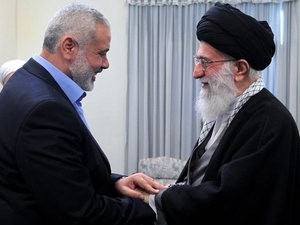
Hamas, the U.S.-designated terror group that rules the Gaza Strip, wants to “mend ties with Iran,” according to two analysts.
Grant Rumley and Amir Toumaj, researchers at the Foundation for Defense of Democracies, a Washington, D.C. think tank, note that Hamas is reaching out to Tehran.
Rumley and Tourmaj report that a “senior Hamas delegation,” including the movement’s international relations head Osama Hamdan, politburo member Mohammad Nasr and Khalid al-Qaddoumi, Hamas’ ambassador to Iran, went to Iran to attend celebrations of the 37th anniversary of the 1979 Islamic Revolution on February 11.
The Hamas delegation met with the secretary of Iran’s Supreme National Security Council, Ali Shamkhani.
Relations between Hamas and its principal benefactor, Iran, have been shaky in recent years. As Rumley and Tourmaj note, the terrorist group “has historically enjoyed Tehran’s generous financial, material and political support, but relations soured in 2012 when the Hamas leadership—then based in Damascus—publicly sided with the largely Sunni rebels against the Iranian-backed Syrian regime.”
Had Hamas chosen to side overtly with Tehran in the Syrian civil war, it likely would have faced blowback in the Sunni Arab world. Hamas, like other Iranian-supported Palestinian Arab terror groups such as Palestinian Islamic Jihad (PIJ), is comprised of Sunni Muslims, the dominant brand of Islam in the Gaza Strip, the West Bank (Judea and Samaria), and eastern Jerusalem. In this, it conflicts with the Shi’ite theocracy of the Islamic Republic. As Middle East scholar Jonathan Schanzer, among others, has pointed out, ties with Tehran have led to rivals and the Palestinian public questioning both PIJ and Hamas’ legitimacy (Hamas vs. Fatah, Palgrave Macmillan, 2010).
PIJ’s refusal to support Iranian backing of the Houthis in Yemen’s ongoing civil war also has led to a deterioration of that group’s relations with its Iranian benefactor—leading to Tehran reportedly cutting 90 percent of its funding for Islamic Jihad. In addition, the mullahs have supported a new Palestinian terror group called Al-Sabireen, which is Shi’te and as CAMERA has noted (“Journalist Profiles New Iranian-backed Palestinian Terror Group,” Oct. 29, 2015) is thought to be recruiting from disaffected members of Fatah, the majority movement in the Palestinian Authority.
In 2012, Hamas leader Ismail Haniyeh declared his support for opponents of Iranian-backed Syrian dictator Bashar al-Assad, saying he “salutes the heroic people of Syria who are striving for freedom, democracy and reform.” Of course, Haniyeh’s praise for democracy and reform do not extend to the Hamas-ruled Gaza Strip where the group has refused to hold elections and routinely imprisons—and tortures—journalists (see, for example, “Hamas Cracks Down—on Palestinian Journalists,” CAMERA, Jan. 13, 2016).
Yet, Haniyeh’s stance was not unanimously supported within the terror group. Rumley and Tourmaj note that “several members affiliated with the military wing” of Hamas, “continued to court Iranian support and technology just as before. In March 2014, Israel intercepted a cargo ship bearing Iranian arms headed for Gaza.” In August of that year, the Iran’s Islamic Revolutionary Guard Corps (IRGC) stated that it had given Hamas advanced rockets for use during Israel’s 2014 Operation Protective Edge against the movement, PIJ and similar groups.
According to Hamas’ Hamdan, the objective of the recent visit to Tehran was to reach an understanding on the Syrian civil war. Hamdan said that Hamas now supports a political resolution in the country—a reversal that is perhaps the result of recognition of growing Assad wins and strength following increased Iranian and Russian involvement to prop up the dictator.
Hamas member Khalid al-Qaddoumi said the Iranians pledged continued support against Israel. Hamdan told Iranian media that Iranian officials fully supported the ongoing terror attacks against Israelis that have occurred in Jerusalem and elsewhere.
The FDD analysts report that although Hamas has fissures and elements of the terror group have increasingly sought support from Iranian-rivals like Saudi Arabia, Qatar and Turkey, nonetheless the group “knows it will find no more committed or generous patron than the Islamic Republic of Iran.”
Grant Rumley and Amir Toumaj’s February 23 Jerusalem Post Op-ed can be found here.


More from SNAPSHOTS
CNN’s Amanpour Condemns “power grab” By Israel’s Prime Minister and Others
April 1, 2020
We’ve said it often, but it’s worth repeating: Anyone interested in reasonably unbiased information about Israel (at least) should avoid the broadcasts of CNN’s Chief International Correspondent and Anchor, Christiane Amanpour. In characterizing responses to [...]
Seattle Media Oblivious To Imam’s Hateful Indoctrination Condemning Jews
January 7, 2020
The Masjid Ar-Rahmah mosque teaching – that Allah transformed Jews into apes and pigs for disobeying him – delivered by Imam (prayer leader) Mohamad Joban – was posted online by mosque personnel. This December 2019 [...]
AP Distorts: Bethlehem ‘Almost Completely Surrounded’
December 10, 2019
Over two years after improving inaccurate language falsely citing Israel's security "barrier surrounding the biblical city" of Bethlehem, the Associated Press once again misrepresents. AP's Joseph Krauss and Mohammad Daraghmeh wrote yesterday ("Palestinians in Bethlehem [...]
Reuters Errs on Administrative Detention For ‘Anti-Israel Activity’
November 5, 2019
The Ofer Prison, near Ramallah (Photo by Tamar Sternthal) A Reuters article today egregiously misrepresents administrative detention, erroneously asserting that it is mainly applied to "Palestinians suspected of anti-Israeli activities," when in fact the Israeli [...]