
CNN Muddles Through Peace Talks

As diplomats, negotiators and media gear up for the next round of Israeli-Palestinian peace talks, CNN International demonstrates that it needs to brush up with a crash course on Mideast history. The July 21 article by Jason Hanna, Joe Sterling and Michael Martinez, “Israelis, Palestinians react to agreement on resuming peace talks,” bungles a basic historical point, stating that Israel:
annexed East Jerusalem from the Palestinian territories, uniting the historic city to make it the capital of the Jewish state.
In fact, Israel was annexed from Jordan, not the Palestinian territories. (This basic fact was correctly reported by CNN in 2010.) Nor should east Jerusalem be labeled as part of today’s Palestinian territories given that the status of that part of the city is disputed and is slated to be resolved in negotiations.
An earlier version of this article, still available through Internet archives, erroneously referred to Tel Aviv as the capital of Israel. The error has been removed, and a screenshot as it initially appeared follows:
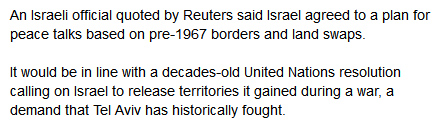
The corrected text reads:
It would be in line with a decades-old United Nations resolution calling on Israel to release territories it gained during a war, a demand that Israel has historically fought.
If CNN can’t be relied on to correctly identify Israel’s capital, and to accurately report that eastern Jerusalem was annexed from Jordan, and not “Palestinian territories,” it’s no wonder that the media outlet bungles more complex issues.
Indeed, the article repeatedly refers to the “Green Line” as “pre-1967 borders.” This is a highly distorted and misleading characterization. President Obama raised the 1967 parameter in a May 19, 2011 policy speech in which he correctly referred to the “1967 lines.”
As CAMERA has noted:
The Green Line, to which the president was referring, served as an armistice demarcation line between Israel and Jordan. The armistice line was established April 3, 1949 by Article III of the Israel-Jordan Armistice Agreement and was never the “border” between Israel and the West Bank.
On the contrary, the agreement specifically notes that the lines are not borders: “The Armistice Demarcation Lines defined in articles V and VI of this Agreement are agreed upon by the Parties without prejudice to future territorial settlements or boundary lines or to claims of either Party relating thereto.”
In short, the word “border” implies legality, political significance and permanence that does not apply in this circumstance.
Lord Caradon, the British representative to the United Nations during the 1967 Six-Day War, made this very point when discussing U.N. Security Council Resolution 242, which calls for a peace agreement based on territorial concessions and recognition of countries’ right to exist in peace and security. Explaining the meaning behind Resolution 242, which he drafted, he noted that
It would have been wrong to demand that Israel return to its positions of 4 June 1967 because those positions were undesirable and artificial. After all, they were just the places the soldiers of each side happened to be the day the fighting stopped in 1948. They were just armistice lines. That’s why we didn’t demand that the Israelis return to them and I think we were right not to …
CNN apparently confuses that very point when in a separate article, also July 21, it implies that Resolution 242 called on Israel to withdraw “completely” from territories it won in the 1967 war:
Reuters news agency quoted an Israeli official last week who said Israel agreed to a plan for peace talks based on pre-1967 borders and land swaps.
It is something the United Nations demanded in a resolution in 1967 and has been the gold standard of yearnings for Middle East peace ever since. It requires Israel to withdraw from occupied territories completely and the Palestinians to recognize the existence of an Israeli state.
But as Lord Caradon stated, and as the New York Times corrected three times in the summer of 2000, Resolution 242 does not require Israel to withdraw “completely” from occupied territories, but calls from withdrawal from an unspecified amount of territory. Nor does the current reported plan call for “complete” withdrawal from disputed territories. As CNN itself notes in the previous paragraph, Secretary of State John Kerry’s plan allows for land swaps.
Aug. 8 Update: CAMERA Prompts CNN Correction on Jerusalem


More from SNAPSHOTS
Why Does a NY Times Journalist Want to Suppress an Anti-Hamas Article?
May 29, 2018
A New York Times journalist thinks the Wall Street Journal shouldn't have published an opinion piece criticizing Hamas's anti-Israel propaganda campaign. The reporter, Declan Walsh, is one of the Times reporters who has covered the [...]
Iran is Funding Hamas’s Violent ‘Protests’ at the Border, Media M.I.A.
May 22, 2018
Iran's Supreme Leader, Ayatollah Ali Khameini The Islamic Republic of Iran is behind the recent Hamas-orchestrated violent demonstrations—dubbed the “March of Return”—at the Israel-Gaza border, according to Israeli authorities. Yet many major U.S. news outlets [...]
Are Gaza Gunmen “Protesters”? NY Times Refuses to Say
May 21, 2018
After repeatedly insisting that "Israeli soldiers killed 60 protesters" during clashes last Monday, May 14, the New York Times is refusing to clarify whether its count of supposed protesters includes the eight armed Hamas fighters [...]
Bahrain Says Israel Has a Right to Self-Defense, and the Media Shrugs
May 15, 2018
Bahrain's Foreign Minister and then-U.S. Secretary of State John Kerry The foreign minister of the Arab nation of Bahrain, Sheikh Khalid al-Khaalifa declared on May 10, 2018 that Israel has a right to defend itself. [...]
AFP Captions Call Jerusalem Parade Participants Settlers
May 15, 2018
Numerous Agence France-Presse photo captions generalized all participants in Sunday's Jerusalem Flag Parade as "settlers," despite the fact that the crowd hailed from across Israel, within the Green Line, as well as outside. A sampling [...]
Journalist: Hezbollah Shows ‘More Maturity’ Than Israel
May 9, 2018
Hezbollah Secretary General Hassan Nasrallah A Los Angeles Times special correspondent, Nabih Bulos, declared on Twitter on May 7, 2018, that Hezbollah (“Party of God”) shows “more maturity” than Israel. Hezbollah is a Lebanese-based, Iranian-backed, [...]