
BBC Justifies Self Censorship in the Face of Threats of Violence
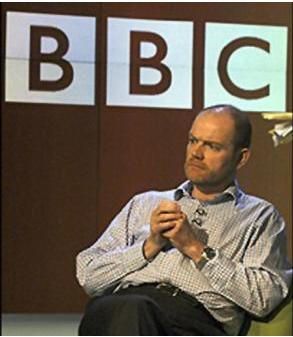
In an interview on free speech, Mark Thompson, director general of the BBC, implies that the threat of violence from religious Muslims influences the BBC’s decisions on which shows it airs. His acknowledgement and justification of self-censorship has to be disheartening to all defenders of free speech. The BBC is the world’s largest media organization and is sustained by the British government.
Questioned about the conflict between free speech and offending people’s religious beliefs, Thompson justifies censorship in criticizing some religious figures [but not others] by suggesting that such criticism can be more “heinous” than harming real people.
… they believe that their faith refers to things which have an objective reality. And so, for example, they regard blasphemy as causing objective harm. So it’s not just that a blasphemous statement or act would hurt their feelings or anger them because it went against their opinions; it would do actual objective harm. That offending of an act of sacrilege against the god head or religious figure, actually creates harm in the world as it
were and might be as heinous or more heinous than harm to a human being.
Thompson then shifts from the abstract to the specific:
I think you have to tread really quite carefully and sensitively because of the character. The point
is that for a Muslim, a depiction – particularly a comical or demeaning depiction of the Prophet Muhammad – might have the force, the emotional force, of a piece of a grotesque child pornography. One of the mistakes seculars make is I think not to understand the character of what blasphemy feels like to someone who is a realist in their religious belief.
Interviewer Timothy Garton-Ash: But it is an ace, isn’t it? And a rather nasty ace if people say, “I feel so strongly about that; if you say it or broadcast it, I will kill you.”
Thompson: Well clearly it’s a very notable move in the game, I mean without question. “I complain in the strongest possible terms” is different from “I complain in the strongest possible terms and I’m loading my AK47 as I write.” This definitely raises the stakes. But I think there’s two or three things going on, so manifestly a threat to murder, which by the way is quite rightly a crime, massively raises the stakes.
In more veiled language, Thompson also implies that such threats sway the BBC’s coverage of the Israeli-Palestinian conflict.
Ash: What, if I may just interrupt for a moment, what are the areas in your experience, your great experience as a broadcaster, have you experienced threats of violence, threats to murder?
Thompson: Well, the coverage of Israel-Palestine, and one or two other conflicts in the world, can lead to and have in my case led to threats of violence. Our editorial decision-making, where someone has come to believe you are not doing it fairly, or maybe likely not to do it fairly, have been threatened once, twice in my career about one or two major conflicts, which have some of the same features: a sense of victimhood, a sense of conspiracy – you know conspiracists who believe everyone else is conspiracist, and so forth – and a sense that the desperation or the circumstance means that the normal don’t apply.
Thompson does not spell out who is making the threats. But the penchant for sharp criticism of Israel’s government and a pronounced pro-Palestinian tilt in the BBC coverage has been widely noted. The BBC does not hesitate to criticize Israel, but seems more hesitant to expose the underside of the Palestinians. That observation, along with the contrast between Israeli society’s unfettered and openly critical press and the media control and intimidation practiced by the Palestinian Authority, suggest that the threats are coming from the Palestinian side.
I guess we should be thankful that even this interview passed the BBC censor.

More from SNAPSHOTS
Reuters Falsely Links Jerusalem Embassy, Two-State Solution
January 9, 2019
The Jerusalem office park which houses Guatemala's embassy Multiple recent Reuters articles incorrectly report that moving the Brazilian embassy from Tel Aviv to Jerusalem is a dramatic move away from the two-state solution. For instance, [...]
American Lutheran In Jerusalem Affirms that IDF Soldiers Are “Stormtroopers,” Backtracks
December 19, 2018
Rev. Carrie Ballenger Smith is a pastor at the Church of the Redeemer in Jerusalem. She ministers to the English-speaking congregation that meets at the Lutheran church, which is located in the Old City of [...]
The Washington Post Ignores Antisemitic Attack in Los Angeles
November 29, 2018
The Washington Post has warned about a “rising tide of antisemitism.” But as CAMERA has highlighted, The Post’s coverage of antisemitism has frequently been selective and is often politicized. More recently, the newspaper even ignored [...]
Think Tank: Iran Was Closer to Building a Bomb Than Previously Thought
November 23, 2018
A Nov. 20, 2018 report by a Washington D.C.-based think tank, the Institute for Science and International Security (ISIS) argues that Iran’s illegal nuclear weapons program was “more advanced than Western intelligence agencies and the [...]
AFP Headline Casts Palestinian Assailant as Victim
November 21, 2018
Agence France Presse yesterday published a throwback headline, bringing us back to the period almost two years ago in which media outlets serially produced headlines which depicted Palestinian attackers as the victims. The wire agency's [...]
More Hypocrisy and Anti-Semitism From Linda Sarsour
November 19, 2018
In an earlier CAMERA exposé, we pointed out the self-serving allegiances and disgraceful hypocrisy of Linda Sarsour (of Women's March fame). We demonstrated how she poses as a universal activist who embraces all marginalized people [...]
Small Steps: Improved NY Times Language on Target of Hamas Rockets
November 15, 2018
Earlier this week, we pointed out how a New York Times article about fighting between Israel and Hamas neglected to inform readers that Palestinian rockets were fired indiscriminately toward civilians in Israeli towns and cities. [...]