
Recent Entries:
Month: May 2016
May 13, 2016
The Money Trail Behind Jewish Voice for Peace

Jewish Voice for Peace is a fanatical anti-Israel group and a leading proponent of the Boycott, Divestment and Sanctions campaign to toxify Israel. As CAMERA has documented, the group disseminates the most vicious smears against the Jewish state, including blood libels. For example, in a guest editorial in the Detroit Free Press in 2008, Jewish Voice for Peace repeated a libelous charge that Israeli troops had committed a massacre in the village of Tantara during the 1948 war for Israeli independence. The individual who had fabricated the story, a graduate student under the tutelage of anti-Zionist professor Ilan Pappe, had admitted under oath in a libel suit brought against him that there was no evidence to support the charge of a massacre. Yet the guest editorial writers continued to promote the libelous smear.
Despite ample evidence of Jewish Voice for Peace’s mendacity, there is an ongoing effort by Israel’s detractors in both the media and academia to portray the cultish group as a legitimate participant in the discussion about Israel and the Palestinians.
On May 12, 2016, CAMERA received information about a course claiming to be affiliated with the University of Pittsburgh Global Studies Department that utilized Jewish Voice for Peace as its main information source to teach high school students about the Israeli-Palestinian conflict.
In the media, Jewish Voice for Peace is cited by journalists and commentators who share the same far left orientation. The New York Times’ columnist Nicholas Kristof cited Jewish Voice for Peace in a column on Aug. 3, 2011 in which he discussed Jewish groups “seeking balance” in the United States’ involvement in the Israeli-Palestinian peace process. Kristof depicted the group in benign terms as one that “supports divestment campaigns against companies profiting from the occupation of Palestinian territories.”
J Street, a group funded by radical billionaire currrency speculator George Soros and an obscure Asian businesswoman named Consolacion Esdicul, also has engaged with the group. While officially not endorsing Jewish Voice for Peace, J Street has welcomed its representatives to its conferences and co-sponsored various letters promoting the Iran deal and other activities with negative repercussions for Israel.
A recent report by the Israel-based NGO Monitor illuminates those who fund the anti-Israel agitation of Jewish Voice for Peace. They include familiar anti-Israel money sources as well as some surprising additions.
In the 2014-5 period, the largest visible donations were provided by:
Rockefeller Brothers Fund- ($140,000 in 2015)
Tides Foundation- ($49,477 in 2014)
Firedoll Foundation- ($25,000 in 2014)
Schwab Charitable Foundation- ($158,800 in 2014)
Jewish Communal Fund- ($25,100 in 2015)
Most other grants were below $30,000.The Rockefeller Foundation, along with several other foundation donors found on the list contribute to a variety of anti-Israel pressure groups.
The single largest source was the Schwab Charitable Foundation, but it’s important to note that this is a donor-advised fund. Using such a fund individuals make tax-deductible contributions into a special account, and only later direct money from that account to non-profit organizations. Contributions from a donor-advised fund are decided by the donor and not by the company managing the fund, in this case Schwab.
According to NGO Monitor, $448,000 went to Jewish Voice for Peace through such Schwab donor-advised funds between the years 2012-2014.
The NGO Monitor report provides documentation of a money trail that funds an emotion-driven public relations war against Israel. It also exposes the duplicity of those in the media, academia and even the Jewish community who portray Jewish Voice for Peace as a legitimate voice within the Jewish community.
Update: This post has been modified to clarify that contributions from a Schwab donor-advised fund are decided by the donor and not by Schwab.
May 12, 2016
A Shell Game: Washington Post Report on Anxious French Jews

“France is home to the largest Jewish community in Europe, and its most troubled. A wave of anti-Semitic violence in recent years has shaken Jews to the point where growing numbers no longer see a future here.”
So begins “Jews anxious about future in France,” by Washington Post correspondent James McAuley (May 10, 2016 print edition, May 9 online). Who is responsible for the “wave of anti-Semitic violence” and “sense of anxiety” pervading “a [Jewish] community that accounts for just 1 percent of the total French population”? The Post does not exactly say.
The newspaper does tell readers that community accounts for “nearly half of all victims of what French authorities call ‘Xenophobic’ violence.” Which “xenophobes”? In the 10th paragraph The Post finally says “Jews are struggling to consolidate safety and security in a France where radical Islamist violence has been rising.”
So, radical Muslims threaten French Jews with violence? The newspaper implies that, but stops short of saying so explicitly. Instead, it recalls:
“In 2006, there was the abduction and murder of a Jewish cell phone salesman by a gang of anti-Semitic youths. In 2012, a shooting at a Jewish school in Toulouse. In 2015, a shooting at a kosher supermarket the day after the Charlie Hebdo attack. And In January of this year, the machete attack on a Jewish teacher as he walked on the street in Marseille.”
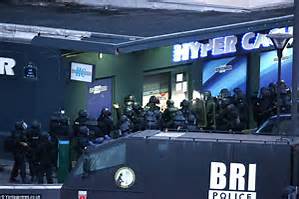
That “gang of anti-Semitic youths” who tortured Ilan Halimi to death over a period of days while taunting his family in telephone calls was Muslims. The terrorist who murdered a teacher and three children in Toulouse in 2012 was a Muslim. The shooter who killed four Jews at Paris’ Hyper-Cacher market in 2015 was a Muslim who claimed to have coordinated with the Charlie Hebdo murderers.
But The Post quickly moves on to other matters in the last 22 of the article’s 34 paragraphs. These are the argument among French Jews over whether they should abandon France for Israel or elsewhere, or stay. And, if they stay, should they work with the anti-immigrant—essentially anti-Muslim and originally antisemitic but now ostensibly pro-Jewish National Front Party—or against it?
Early in the dispatch, a man identified as an Israeli “human rights lawyer living in Paris,” is quoted as saying “in terms of security, I don’t believe Israel is a safe place for Jews. Or for anyone else.” The Post transmits that stenographically, without context.
In context, in terms of individual security, a U.N. office reports that the murder rate per 100,000 population in Israel in 2012 was 1.8; in France (2013) 1.2; Tunisia—where some French vacation—3.1 (2012); and in the United States, where more than five million Jews live and many French visit, 3.8 (2013). (Data from most recent years posted.)
Another article by McAuley (“World Views: France plans to set up ‘anti-jihadist centers’ to curb youth radicalization,” May 10 online, not yet in print) crept a little closer to cause—Islamic extremism or Islamist supremacism—in addition to effect—rising violence against French Jews and others. The short dispatch used the words “anti-jihadist” and “jihadism” in direct quotes from the French prime minister. It also referred to “militant” and “militants” and once to the Islamic State. It also noted that “many Muslims” find state secularism “alienating.”
But those whose radicalization government officials hoped to prevent turned out to be “young men,” “young people” or “French youths.” Young Catholics? Secular youths? Young French Jews?
Unlikely.When predominately Muslim suburbs of Paris and other French cities erupted in riots and arsons four years ago, reporting by the Tribune Newspapers (including The Los Angeles Times, Chicago Tribune and Baltimore Sun) suffered from descriptions of acts by “disaffected youths,” “rioting youths” and “gangs of youths.” Tribune Co. journalists, professionally expected to report who, what, when, where, why and how, erased the Muslim and/or North African-Arab identity of most of these “youths.” Washington Post coverage of violent threats to French Jews from radicalized Muslims suffers a similar erasure now.
May 12, 2016
Washington Post Editorial Notes Iranian ‘Moderates’ Mendacity on Holocaust

A Washington Post editorial “Iran’s ‘moderates’ and the Holocaust,” (May 10, 2016) noted that Iran’s foreign minister, Mohammad Javad Zarif, offered an “unconvincing disavowal of the regime’s hate speech,” including Tehran’s sponsoring of a Holocaust “cartoon festival.”
Post editorialists pointed out that “at the heart of the Obama administration’s diplomatic engagement with Iran is the notion that the regime is divided among hard-liners who foment its terrorism and regional aggression and more moderate forces who are open to cooperation with the West.”
CAMERA has noted (see, for example “The Media and the Myth of the Moderate Mullahs,” March 2, 2016) the tendency of major U.S. print news outlets, including The Washington Post, to refer to “moderates” in the theocratic, authoritarian regime that rules the Islamic Republic of Iran—often overlooking evidence that contradicts that idea.
Zarif is frequently labeled a “moderate” and is, The Post editorial said, “‘an English-speaking favorite of many Western journalists and even more so, Secretary of State John Kerry.”
Yet, this label doesn’t match Zarif’s actions or those of the regime he serves.
The Post pointed out that during the 18-month imprisonment of their Tehran bureau chief, Jason Rezain, by Iran, Zarif suggested that the journalist had been taken “advantage” of by an “overzealous low-level operative” of the U.S. government.
The foreign minister’s mendacity also was on display when he was asked to explain why Iran is sponsoring an international cartoon contest with a Holocaust denial theme. A previous Holocaust cartoon contest was held in 2006 under Iran’s then-President, Mahmoud Ahmadinejad (2005-2013) and a second in 2015. Ahmadinejad favored blunt anti-Western, anti-Israel rhetoric, unlike Zarif, was often referred to by press and policymakers as a “hard-liner.” But both men served Iran’s “Supreme Leader,” Ayatollah Ali Khamenei, who is rarely if ever characterized by the press as “moderate.”
The Post editorial noted that when Zarif was asked about the upcoming Holocaust cartoon contest by Robin Wright of The New Yorker magazine, his reaction “was a form of denialism: He claimed the Rouhani administration [Hassan Rouhani, Iran’s current President who is also frequently called a “moderate” by Western journalists] had nothing to do with the exhibition. The sponsor is a nongovernmental organization ‘that is not controlled by the Iranian government.’”
In his interview with Wright, Zarif tried to blur the lines, claiming that the event was comparable to the activity of the white supremacist Ku Klux Klan, in the United States. Zarif obfuscated, asking Wright: “Is the government of the United States responsible for the fact that there are racially hateful organizations in the United States?”
Wright, a former correspondent for The Post and Los Angeles Times, among other outlets, also works for the United States Institute of Peace and frequently argues for greater U.S. engagement with Tehran. She did not challenge Zarif’s Klan-Holocaust cartoon contest comparison although she did question his claims that the Iranian government was not involved in the event. However, as The Post editorial noted, “a spokesman for the Ministry of Culture and Islamic Guidance confirmed that the ministry supports the [Holocaust cartoon] exhibition….A festival official also reported that it was cooperating with the ministry.”
(more…)May 11, 2016
Where’s the Coverage? Antisemitism Rampant in the PA

Blogger Elder of Ziyon (EoZ) describes this week’s Palestinian Book Fair in Ramallah, translating from the Arabic-language Feneeq News the statement of Palestinian Authority (PA) Prime Minister Rami Hamdallah, “On behalf of President Mahmoud Abbas and myself, I thank all of you, the owners of publishing houses and intellectuals, visitors and guests of Palestine, who have turned this event into a cultural gathering, challenging the occupation and its repressive practices, and breaking the siege and isolation Israel wants us to be under.”
EoZ notes that, “There is not the slightest indication that Israel did anything to stop this fair.” In fact, this year’s fair is the 10th annual Palestinian Book Fair; with a decade of fairs having been held, the claim of Israeli attempts to squelch it is absurd on its face.
In addition to the insidious statements by top Palestinian officials, books on offer—many of which cannot be authenticated as no book list is made available to the public— contain antisemitic material. One confirmed example is Ramzy El-Menyawi’s “Chaos Theory—The American Scenario to Fragment the Middle East and the Zionist Theory Adapted by America,” of which EoZ writes:
In the introduction to the book Menyawi makes an analogy between the US army invading and fragmenting the Muslim world and matzah made from the bodies and blood of the people Jews murdered.
This sort of thinking such as the blood libel is not on the margins of Palestinian society – it is mainstream.
Indeed, Palestinian Authority antisemitism is rampant, as demonstrated by PMW’s report on “Palestinian Authority Antisemitism in 2015“. In its overview, Palestinian Media Watch chronicled the hate-speech promoted in Palestinian media, children’s shows, news outlets, and educational programming. The regular stream of antisemitic language by officials of the PA government is also covered, like a Fatah spokesman referring to Jews as “sons of apes and pigs.”
Yet, the international media continues to ignore this very real problem of Palestinians indoctrinated by their leaders, teachers, books and media to hate Jews because they are Jewish. Where’s the coverage?
–Rachel Frommer, CAMERA Intern
May 11, 2016
At Haaretz, Is Style Guide Just a Suggestion?

About the word “settlement,” Haaretz‘s English style guide states:
In these parts, a word with political connotations. Use it only for a Jewish locale in the West Bank (or former/evacuated settlements in Gaza).
Indeed, in the Israeli-Palestinian context, the word “settlement” refers to an Israeli community over the Green Line and that is how it is most often understood.
Nevertheless, in his Haaretz Op-Ed earlier this week, Moshe Arens uses the term to mean something else. His Op-Ed begins:
In Israel’s doorstep — within mortar range of Israeli settlements and rocket range of Ben-Gurion Aiport — live two million Palestinians in the Gaza Strip.
Arens isn’t referring here to a Jewish locale in the West Bank or an evacuated settlement in Gaza. He is talking about Jewish communities in southern Israel, close to the Gaza Strip.
CAMERA yesterday informed Haaretz English edition editors of the inconsistency with Haaretz‘s style guide. As of this writing, they have declined to amend the misleading language.
In 2014, Haaretz corrected after misleadingly identifying a Jewish community near the Gaza Strip as a “settlement.” It’s unclear why, in this case, they have declined to correct. Is the Haaretz style guide merely a suggestion? Do style guidelines, which promote consistency, accuracy and clarity, not apply to Haaretz Op-Eds?
May 10, 2016
WSJ Op-Ed: Israelis are Happy

Photo: Getty ImagesIn an Op-Ed published May 10, 2016, Avinoam Bar-Yosef details “The Improbable Happiness of Israelis”:
The World Happiness Report 2016 Update ranks Israel (Jews and Arabs) 11th of 158 countries evaluated for the United Nations. Israel also shines as No. 5 of the 36 Organization for Economic Cooperation and Development countries on the OECD’s Life Satisfaction Index—ahead of the U.S., the U.K. and France.
[…]And it isn’t just Jews. Go to any beach or shopping mall and—despite the frictions—you will see Jews and Arabs peacefully coexisting. They all can take pride in their country’s accomplishments, as when Israel faced a water crisis a decade ago and launched a desalination project that is now the envy of the world.
This despite the fact that, as Bar-Yosef notes, “Israelis live in a hostile and volatile neighborhood, engaged in an endless conflict with the Palestinians and under the threat of nuclear annihilation by Iran.” He does not even mention the constant assaults on Israel’s very right to exist, the movement to delegitimize the Jewish state in global fora, the media and at universities around the globe, or the outrageous attempts to deny the unique Jewish connection to the land of Israel and even to the Shoah.
So why are Israelis happy?
As Israel approaches its 68th Independence Day, perhaps Israelis understand that, notwithstanding these challenges—and perhaps in spite of them—they’re doing a bang-up job building a free and democratic society and contributing to the well-being of humanity. Not many countries can say that, least of all Israel’s neighbors.
May 9, 2016
Politico Downplays Palestinian Terrorism

In a May 5th article in Politico’s U.S. Edition, entitled “State Dept. assures Leahy on Israeli human rights scrutiny“, author Nahal Toosi misleads readers as she downplays Palestinian terrorism, and transfers blame for the violence onto Israel She writes:
In recent months, Palestinians have staged numerous attacks, many with knives, against Israeli security forces, who have often responded with gunfire. The violence has put both sides on edge and has led to allegations of overreaction by the Israeli military.[emphasis added]
Does Toosi consider Eitan and Naama Henkin, the young couple murdered in front of their children on October 1st to be “security forces”? How about 22-year-old yeshiva student Aharon Banita-Bennet, who was stabbed to death on his way to the Western Wall with his wife and two young children, who were stabbed as well? Or 18-year-old Ezra Schwartz from Massachusetts who was shot to death on November 19 while doing volunteer work during his gap year in Israel? Or 21-year-old Hadras Buchris who was stabbed to death as she waited for a ride on November 22? Or 45-year-old Rabbi Reuven Eduardo) Birmajer who was stabbed to death on December 23 near Jaffa gate? Or Dafna Meir, the mother of six, who was stabbed to death inside her home on January 17? Or 29-year-old Taylor Force, an American tourist who was stabbed to death on March 8?
These are just a few of the civilians who lost their lives lost their lives after being targeted by Palestinian terrorists, not to mention the dozens who were wounded and nearly lost their lives in such attacks. Anyone acquainted with the events in Israel over the past 6 months is well aware that Palestinian terrorist attacks have not just been aimed at Israeli security forces but at innocent civilians, including women, children and elderly victims. These attacks, which include 147 stabbings, 87 shootings, 43 car rammings and 1 bus bombing, have killed 34 people, 28 of them civilians, including two foreign nationals and an off-duty policeman. Of the 447 who were wounded in these attacks, nearly 200 were civilians and included several Arab and foreign national civilians .
But by falsely suggesting that these Palestinian assailants were targeting Israeli security forces who responded excessively with “gunfire” , Toosi succeeds in twisting the events completely.
CAMERA contacted both the journalist and news editor at Politico who refused to correct the erroneous reference to Palestinian violence stating that they “believe the story can stand as is.”
May 6, 2016
BBC’s Jeremy Bowen Follows PLO Dictates

BBC Middle East Editor Jeremy Bowen CAMERA has long criticized BBC’s Jeremy Bowen for his biased reporting on the Arab-Israeli conflict, and in March 2009, the BBC’s highest body upheld a complaint by CAMERA that Bowen violated the broadcasters’ guidelines requiring impartiality and accuracy. (For a full analysis of that BBC ruling and the CAMERA complaint that led up to it, see here.) As CAMERA’s BBC-Watch often documents, Bowen has not since ceased his biased reporting.
The latest example comes in a May 4 web article and a World Service radio broadcast that aired on May 6 about the violence in Jerusalem in the wake of a bus bombing carried out by a Palestinian terrorist last month. After creating a tale of equivalent mutual hatred and violence on each side, Bowen attempts to dispel the Israeli charge that Palestinian attacks are a result of relentless incitement by the Palestinian leadership. The BBC journalist imposes a blame-Israel narrative on his audience as he “explains” the “core of the conflict”:
But hundreds of conversations with Palestinians over many years here have convinced me that the biggest factor that shapes their attitudes to Israel is not the incitement to hate but the occupation of the Palestinian territories, including East Jerusalem, that started after Israel’s victory in the 1967 Middle East war.
When Palestinians who agitate against Israel find an audience, it is because of the way that the occupation, which is inherently violent, has overshadowed and controlled Palestinian lives for almost 50 years.
Not only does Bowen echo the Palestinian narrative by describing disputed territories meant to be defined in bilateral negotiations as “Palestinian territories” but he servilely obeys the PLO’s media advisory to journalists laying out what they should emphasize in their reporting, namely, that the conflict is totally and singularly about “the occupation.”
As long as the BBC continues to allow the PLO to dictate the terms of how the Arab-Israeli conflict is reported, readers and listeners cannot expect to be accurately informed about what is really going on in that part of the world.
May 5, 2016
Majority of Gazan Arabs Believe Attacking Israel is ‘Important,’ Poll Says

A recent survey shows that a majority of Palestinian Arabs in the Gaza Strip put a high premium on attacking Israel.
The poll was conducted by the Arab World for Research and Development (AWRAD), based in Ramallah, from April 18-21, 2016. Palestinian Arabs in both the West Bank (Judea and Samaria), which is administered by the Palestinian Authority (PA), and those living in the Gaza Strip, ruled by U.S.-designated terror group Hamas, were polled.
The survey had a margin of error of 3 and a sampling size of 1,200.
Seventy-one percent of Gazans polled deemed “armed attacks against Israel” as “important.” Thirty-two percent of West Bankers shared this sentiment.
Forty-five percent of Gazans surveyed believed negotiations with Israel were important, whereas only 23 percent of West Bank Arabs believed this to be the case.
A majority of both West Bank (72 percent) and Gaza residents (77 percent) polled believe that reconciliation between Hamas and Fatah, the movement that dominates the PA, is important.
The poll indicated that Hamas is not considered trustworthy: the terrorist group’s “political bureau,” shura [decision-making body] council and “military wing,” are not considered dependable by a majority of Palestinian Arabs in either the West Bank or Gaza. Fatah did only marginally better; 50 percent of West Bankers and 54 percent of Gazans surveyed said the movement was trustworthy.
Low opinions of Palestinian organizations were expressed in other ways as well.
Only 21 percent of West Bankers and 33 percent of Gazans described their rulers as transparent. Majorities of both, 60 and 52 percent respectively, didn’t find their governments as “respectful of human rights.” Seventy-seven percent of those surveyed in the West Bank did not believe the PA was “accountable to the people.” Fifty-eight percent of Gazans polled said the same about Hamas.
Only five percent of all Palestinians surveyed believed the government of PA Prime Minister Rami Hamdallah was satisfactory at providing job opportunities. Similarly, single-digit expressions (6 percent) of confidence were evidenced by all Palestinians when asked if the PA was doing a good job at “improving financial transparency.”
AWRAD noted that “more than 80 percent of respondents believe there is corruption in government institutions in both the West Bank and Gaza.”
Yet, the leader most popular with Palestinian Arabs to resolve this and other complaints expressed in the survey, is a convicted terrorist and murderer.
Marwan Barghouti is the “most electable leader,” according to AWRAD. Barghouti, the former head of Fatah’s Tanzim faction, is currently serving five life sentences plus 40 years in an Israeli prison for his role in the murders of a Greek monk in 2001 and four Israelis in 2002. As CAMERA has noted, Barghouti’s popularity was evident in a September 2015 poll by the Palestinian Center for Policy Survey (“Poll: Majority of Palestinians Support Another Intifada,” Sept. 25, 2015).
AWRAD’s poll can be found here.
May 5, 2016
U.S. Pro-Tehran Lobby Meets Putin’s Propaganda Machine

The National Iranian American Council (NIAC), a pro-Tehran non-governmental organization based in the United States, has ties to Russia Today (RT), a propaganda arm of the Russian government led by Vladimir Putin.
Michael Rubin, a scholar at the American Enterprise Institute (AEI), a Washington D.C.-based think tank, noted the connection between the NIAC and RT in a blog for Commentary magazine (“Is Iran Lobby Pro-US or Pro-Putin?,” May 4, 2016).
As CAMERA noted in its Special Report on NIAC (“The National Iranian American Council; Tehran’s Best Friend in Washington,” Nov. 24, 2015), news media often rely on the Council as a source in covering U.S.-Iranian relations and the Middle East in general. Yet, the press usually fails to disclose NIAC’s history, including ties to a corrupt former member of the U.S. Congress, connections to Iranian-state-backed businesses and the near-obstruction by the council of U.S. courts in unsuccessful lawsuits that NIAC filed to silence a critic.
CAMERA’s Special Report noted that NIAC consistently has misled outsiders about its membership numbers, possible lobbying activities and even the council’s reason for being. NIAC founder Trita Parsi has claimed the council was created “to enable Iranian Americans to condemn the Sept.11, 2001 terror attacks”—despite the origins of the group dating to 1999 with the purpose to oppose U.S. sanctions against Tehran for its presumed nuclear weapons program.
The report also highlighted Parsi and NIAC’s penchant for conspiracy theories—a tactic Rubin noted is shared by RT.
Rubin quoted an October 2015 book called Putin’s Propaganda Machine: Soft Power and Russian Foreign Policy, by Marcel H. Van Herpen, the director of the Cicero Foundation, a Paris and Maastricht think tank. In his book, Van Herpen noted that since 2009, “anchors of RT programs (such as Peter Lavelle) did not hide their explicit anti-American views. RT also started inviting representatives of marginal, often extreme right antigovernment groups, who were presented as ‘experts.’ One of these groups was the so-called 9/11 truthers, people who believe that the 9/11 attacks were not the work of al-Qaeda terrorists but a U.S. government conspiracy.”
Rubin pointed that NIAC “has come to rely on RT to publicize itself during the same period in which RT had become an offensive propaganda weapon.” The AEI scholar cited “just a few” of Parsi’s RT conspiracy-tinged contributions, as well as those by other NIAC staffers, including NIAC policy director Jamal Abdi and Reza Marashi.
Marashi, Rubin wrote, “had started at the State Department as an intern and come to attention of his bosses for his unnatural curiosity about the identities of democracy grant recipients inside Iran.” Now a NIAC staffer, he identified himself as “a former State Department officer” in an Feb. 2012 interview with RT.
Noting RT’s guests and purported “experts,” Rubin concluded:
“Many organizations seek to chime in and seek to inform or shape the policy debate, but few would think it wise to make their case alongside 9/11 Truthers, Neo-Nazis, and other hate-groups. Then again to argue that the Islamic Republic of Iran is a normal state that has shed its ideology is to be just as divorced from reality. What is shocking, however, and more than a bit worrying is that those purporting to advance a relationship which they argue would be good for the United States think nothing of associating themselves with such conspiracy theorists or lending themselves as agents of Kremlin propaganda.”
Michael Rubin’s article in Commentary can be found here.



Search:
Search this site: