
‘Pragmatic’ and ‘Self-Critical’ Palestinian Official Claims the U.S. Created ISIS (Again)
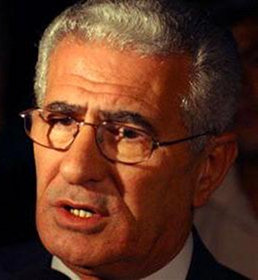
A high-ranking Palestinian Arab leader, Abbas Zaki, claimed that the United States created ISIS (Islamic State in Iraq and Syria), a U.S.-designated terrorist group. Again.
Palestinian Media Watch (PMW), a non-profit organization that monitors Arab media in the West Bank (Judea and Samaria), the Gaza Strip and eastern Jerusalem, reports that in a Jan. 10, 2016 interview with the Iraqi newspaper Al-Mashriq, Zaki charged:
“ISIS is an American product, necessary for the establishment of an Islamic state in order to justify the existence of a Jewish state, in which there is no place for Palestinians.”
Zaki is on the central committee of Fatah, the movement which the majority of Palestinian Authority (PA) officials belong to, including its current president, Mahmoud Abbas. Zaki currently is the Fatah Commissioner of Arab Relations and Relations with China. Previously he was the top PA official in Lebanon.
Zaki claimed to Al-Mashriq that ISIS was an “American plot” that “began by targeting the heart of the Arab nation, by destroying Iraq and Syria, and weakening Egypt” in order to “dismantle the Arab nation, split it, and kill its spirit of solidarity.”
This is not the first time that Zaki has peddled this particular conspiracy theory. As CAMERA has noted, Zaki declared in a June 2, 2015 interview with Syrian News TV the United States “created IS, but cannot control it” and as a result, “is destroying itself by its own hand.”
A Jan. 21, 2016 opinion editorial in Al-Hayat al-Jadida, an official PA daily newspaper, echoed Zaki’s claims.
Daniel Pipes, a Middle East scholar and president of the Middle East Forum, a Philadelphia-based think tank, has noted that conspiracy theories are “outstandingly common” in the region.
The United States did not, of course, create ISIS. The terrorist group—an offshoot of al-Qaeda—originated as the group Jama’at al-Tawhid wa-i-Jihad in 2000, according to Aaron Zelin, a researcher at the Washington Institute for Near East Policy, a D.C.-based think tank.
Zaki has also maintained that Yasser Arafat, the terrorist chieftain who ruled the PA, Fatah and the Palestine Liberation Organization (PLO) until his 2004 death, was poisoned by Israel. Zaki said Arafat’s death was “the crime of the century” and “worth taking to the International Criminal Court (ICC) (“Possible evidence that Arafat was poisoned is found,” The Boston Globe, Nov. 7, 2013).” An investigation by French authorities concluded in December 2013 that Arafat died of natural causes.
When he’s not hawking conspiracy theories, Zaki uses official PA TV to call for killing Israelis.
According to PMW, on March 12, 2014, Zaki said, “Those Israelis have no religion and no principles. They are nothing but advanced tools for evil. They talk about the Holocaust and so on. So why are they doing this to us? Therefore, in my view, Allah will gather them so that we can kill them. Every killer is bound to be killed. There is no other option.”
Yet, Zaki’s predilection for peddling conspiracy theories and exhortations to murder Jews hasn’t stopped him from being treated as a credible source by some news media.
CAMERA noted that Zaki was one of 14 new members to the Fatah Central Committee who The New York Times wrote “are considered more pragmatic than their predecessors (“New Fatah Central Committee Ties to Al Aksa Martyrs Brigades,” Aug. 13, 2009).”
A detailed 2006 profile in The Washington Post (“Divided Fatah Braces for Check on Power,” January 14) reads: “ash-gray hair, thick-framed glasses and office walls charting an itinerant political life, Zaki is the embodiment of Fatah’s old guard. The photos hanging in the waiting room of his cramped Hebron office tell the story of movement’s fading revolutionary cachet: a young Zaki with Fidel Castro in Havana, shaking hands with Vietnamese officials in Hanoi, inside the Kremlin.”
“But these days,” The Post claimed, “Zaki is more self-critical than nostalgic.”
Relatively pragmatic. More self-critical. For journalists, seeing what you want to is bad enough. Reporting it as news is worse.
This post was updated on Jan. 25, 2016 to reflect the January 21 PA daily Op-ed


More from SNAPSHOTS
Why Does a NY Times Journalist Want to Suppress an Anti-Hamas Article?
May 29, 2018
A New York Times journalist thinks the Wall Street Journal shouldn't have published an opinion piece criticizing Hamas's anti-Israel propaganda campaign. The reporter, Declan Walsh, is one of the Times reporters who has covered the [...]
Iran is Funding Hamas’s Violent ‘Protests’ at the Border, Media M.I.A.
May 22, 2018
Iran's Supreme Leader, Ayatollah Ali Khameini The Islamic Republic of Iran is behind the recent Hamas-orchestrated violent demonstrations—dubbed the “March of Return”—at the Israel-Gaza border, according to Israeli authorities. Yet many major U.S. news outlets [...]
Are Gaza Gunmen “Protesters”? NY Times Refuses to Say
May 21, 2018
After repeatedly insisting that "Israeli soldiers killed 60 protesters" during clashes last Monday, May 14, the New York Times is refusing to clarify whether its count of supposed protesters includes the eight armed Hamas fighters [...]
Bahrain Says Israel Has a Right to Self-Defense, and the Media Shrugs
May 15, 2018
Bahrain's Foreign Minister and then-U.S. Secretary of State John Kerry The foreign minister of the Arab nation of Bahrain, Sheikh Khalid al-Khaalifa declared on May 10, 2018 that Israel has a right to defend itself. [...]
AFP Captions Call Jerusalem Parade Participants Settlers
May 15, 2018
Numerous Agence France-Presse photo captions generalized all participants in Sunday's Jerusalem Flag Parade as "settlers," despite the fact that the crowd hailed from across Israel, within the Green Line, as well as outside. A sampling [...]
Journalist: Hezbollah Shows ‘More Maturity’ Than Israel
May 9, 2018
Hezbollah Secretary General Hassan Nasrallah A Los Angeles Times special correspondent, Nabih Bulos, declared on Twitter on May 7, 2018, that Hezbollah (“Party of God”) shows “more maturity” than Israel. Hezbollah is a Lebanese-based, Iranian-backed, [...]