
Recent Entries:
Month: February 2015
February 24, 2015
Moderate Rouhani or ‘Moderate’ Rouhani? News or Opinion?
Is Iranian President Hassan Rouhani a moderate, or a “moderate”? In The Washington Post, he can be either, and within 24 hours. It depends on whether one is reading the news or opinion pages.
In the Feb. 9, 2015 print edition, under the headline “Kerry rules out extending Iran nuclear talks without an outline of deal soon; ‘Fundamental decisions’ have to be made in coming weeks, he says,” Post diplomatic correspondent Carol Morello wrote:
“The nuclear talks, which began a decade ago with Iran and were revived after Hassan Rouhani, a moderate [emphasis added], was elected president in 2013, have been the subject of much concern.”
But in the next day’s editorial, “The message of Iran’s actions; The country’s foreign minister hopes a jailed Post reporter is ‘cleared,’ but his words aren’t enough” the newspaper said:
“Some analysts of Iran have speculated that the persecution of Mr. [Jacob] Rezaian [Post Tehran bureau chief] is an attempt by ‘hard-liners’ and their allies in the judiciary to undermine the ‘moderate’ [single quotation marks in original, italics added] government of President Hassan Rouhani and the nuclear negotiations being conducted by Mr. [Mohammad] Zarif [Iran’s foreign minister].”
Looking at the case of its imprisoned reporter in the framework of Western negotiations with Iran about its presumptive nuclear weapons program, the newspaper wasn’t certain “whether there is a power struggle in Tehran or not …”
However, one can be pretty sure Rouhani is no moderate in Western political terms. CAMERA pointed out soon after his election (“Hassan Rouhani—The Extremists’ ‘Moderate’,” June 21, 2013) that Rouhani has a career-long record as a loyal and sometimes deceptive, brutal servant of the Islamic Revolutionary Republic’s messianic founder, Ayatollah Ruhollah Khomeini and his successor as supreme leader—Iran’s ultimate decision-maker—Ayatollah Ali Khamenei. That record includes apparently presiding over authorization of deadly terrorist attacks on Americans and Argentine Jews.
Rouhani, like the similarly misidentified “moderate” Mahmoud Abbas, head of the Palestinian Authority, Fatah and the Palestine Liberation Organization, appears to be a pragmatist instead. That is, in each case, someone willing to use limited, “moderated” tactics in pursuit of broad, extremist strategies. (See, for example, CAMERA’s “Those Intransigent ‘Moderates’ of Fatah,” May 6, 2014, in particular the last five paragraphs.)
In spite of Rouhani’s record and The Post editorial page’s doubts, Rouhani the unsubstantiated moderate reappeared in the paper’s news coverage on February 19. A one-paragraph news brief, “Iran schedules 2016 parliamentary elections,” said, “the vote will be a key test for moderate [emphasis added] President Hassan Rouhani, who is looking for his allies to win the majority.”
The possibility that two factions of Islamic revolutionaries, one that speaks softly and the other that shouts, struggle for power under the gaze of Iran’s top revolutionary, Ayatollah Khamenei, seems too subtle for the news pages.
February 24, 2015
Palestinian Propagandists Elicit Hate With Lies
Earlier today a number of news outlets fell for an atrocity story that blamed Israel for flooding in the Gaza Strip. The most notable outlet that fell for the story is AFP.
CAMERA contacted AFP to tell the organization that the story they broadcasted was false. In response AFP and a number of other news outlets pulled the videos of the flooding falsely blamed on Israel from their websites.
But the damage was done as was evidenced by a number of comments on a Facebook page showing a video of a flood that was falsely blamed on Israel.
Below are three screenshots of the comments that people posted in response to the false propaganda story. Some of the comments are downright antisemitic.
(more…)February 24, 2015
Where’s the Coverage? Half the “Journalists” Killed in Gaza Conflict Were Actually Terrorists

A recent CAMERA article, “The Associated Press Demonstrates Its Bias Against Israel,” demonstrates how the media manipulate casualty figures from the summer’s Gaza conflict to unfairly indict Israel. On the other hand, when real information on Gaza casualties casts a negative light on Hamas, the press ignores it.
The Meir Amit Intelligence and Terrorism Information Center has done a study of the seventeen names provided by the Palestinian Journalists Syndicate purported to be journalists killed in Operation Protective Edge. The list was published by the Palestinian Authority’s Wafa News Agency, which received it from the Hamas-controlled Gaza office of the ministry of information.
The Jerusalem Post reports:
“The study, not yet complete, found that eight out of the 17 names were operatives who belonged to Hamas and Islamic Jihad, or who worked in Hamas media outlets,” the report, published Thursday, stated.
[…]Dr. Reuven Erlich, head of the Intelligence and Terrorism Information Center, compared the operatives to Islamic State cameramen who film the beheadings of hostages.
“To call them journalists is completely absurd. The fact that there are those in the world who bought into these lies is scandalous,” Erlich stated.
The fact that the casualty numbers are manipulated in every possible way to make Israel look like it is targeting civilians and journalists is indeed scandalous. And the fact that when the truth is exposed, the media neglect to report it, is journalistic malpractice. So, knowing that nearly half of the “journalists” killed were instead terrorists… Where’s the coverage?
February 24, 2015
USA Today Re-Scoops Jerusalem Mayor’s Heroics
The Washington Post reported it first, in a one-paragraph wire service news brief. The New York Times followed the next day with one sentence at the end of an online Israeli-Palestinian wrap-up that led with a fatal shooting by Israeli troops of a Palestinian man. That left the big front page color photograph and large caption, “Jerusalem Mayor Hailed As Hero; Jerusalem mayor Nir Barkat gestures as if firing a gun as he talks with Avraham Goldschmidt, 27, the victim of a stabbing attack. Barkat and his security team helped subdue the attacker” to USA Today.
Under “Jerusalem mayor wrestles Palestinian attacker in street,” set in the smallest headline type it uses, The Washington Post’s February 23, 2015 item read, in its entirety:
“The mayor of Jerusalem said he and his bodyguard apprehended a Palestinian who stabbed an Israeli near city hall. Nir Barkat said he was riding in his car when his entourage spotted a ‘terrorist’ with a knife. He said he and his bodyguard leaped from the car, the bodyguard drew a weapon, and they held the man until police arrived. He said the Israeli who was stabbed was ‘lightly injured.’”
USA Today, by contrast, used its large front-page display to tease to a February 24 article on page A-3 headlined “Jerusalem mayor praised as hero; Barkat helps stop man with knife” by correspondents Michele Chabin and Jane Onyanga-Omara. The lead paragraphs said, “Mayor Nir Barkat earned plaudits Monday—and won comparisons to a superhero—for his courage in helping apprehend a man who stabbed and wounded an Israeli in the street.
“Video footage showed Barkat, 55, and his bodyguard wrestling the attacker to the ground in Tzahal Square on Sunday, then helping the victim, an ultra-Orthodox Jewish man in his 20s. The attack was near the Old City, a major tourist destination.”
Among other things, the USA Today article said “it’s not the first time Barkat, who has been mayor since 2008, helped victims of a terror attack in Jerusalem. Eleven years ago, he helped evacuate people from a bus targeted by terrorists, giving first aid and saving a woman’s life, The Jerusalem Post reported.”
Barkat also said “ ‘terror will not frighten us. When you look at the statistics, Jerusalem is one of the safest places in the world, safer than New York, London, [or] Paris.’ ”
Kudos to USA Today and a query for The Washington Post and New York Times: If an important Palestinian official and his bodyguard helped apprehend an Israeli terrorist who had just stabbed an Arab, would you have covered it the same way?
February 20, 2015
Alarmed By Domestic Jihadis, Der Spiegel Piece Reconsiders Israel’s “Wall”

As Europe is waking up to homegrown jihadi terrorism, some are reconsidering their criticism of Israel for the measures the Jewish state took in combatting Palestinian terrorism. An opinion piece in Germany’s Der Spiegel recalls that
Israel is the first democracy to have extensive experience with Islamist terrorism. Before recent attacks on our own soil, Europeans loved nothing better than scorning the Jewish state’s efforts to address terror. In the future, we may need to turn to the Israelis for advice.
Author Jan Fleischhauer observes,
The new Greek finance minister once called the West Bank security fence, built by Israel to protect its people from terrorist attacks, a “concrete monster.” The barrier is always a key issue when critics of the Jewish state launch into their tirades.
The jump from “outrage over the wall to sympathy for terrorism is a small one,” according to Fleischhauer. He recalls,
In 2005, left-wing superstar Giannis Varoufakis said we shouldn’t be surprised when Palestinians strap on explosives belts. It’s the kind of thing people say whose only experience with terror are occasional blowups with the spouse at home.
But times have changed, and at least some in Europe are taking a second look at how Israel dealt with Palestinian terrorists infiltrating into Israel and slaughtering its civilians. Fleischhauer writes,
In the two years prior to the erection of the controversial border installations, Israeli authorities counted 89 attacks, with 305 deaths and 4,942 injuries — a significant number for a country with a population of just over 8 million. The number of casualties only began to fall after the construction of the wall. It’s a success story that has never been viewed as such outside of the embattled country itself.
It’s too soon to say whether Fleischhauer’s exposure of the lifesaving successes of Israeli measures against terrorism, rather than the usual condemnation of “the Wall” that characterizes much of the discourse among influential elements of the media in Europe, will catch on. But at least it’s a start.
February 18, 2015
On Swedish National Radio, Journalist Asks Why Jews Shouldn’t Be Blamed for Antisemitism
File this as another reminder of why Americans must hold their media accountable so that it doesn’t sink to the lows too often seen in Europe.
Here we see journalist Helena Groll asking, on a Swedish public radio station, whether Jews should be blamed for antisemitism, and demanding her Jewish guest make a case for why they should not.
The radio station has apologized.
Last month, BBC’s Tim Willcox similarly informed a Jewish citizen of France (and countless thousands of viewers) that European antisemitism and the murders at a kosher market near Paris should be understood in the context of Israeli behavior.
February 18, 2015
Is an Iranian Assault on Israel Drawing Near?
A comprehensive report by MEMRI (Middle East Media Research Institute) warns of Iran’s accelerated preparations for a massive attack on the Jewish state.
According to the report, Iran has established substantial forces within striking distance of Israel’s border. The Iranians can call upon regional Shiite forces, including Hezbollah in Lebanon and a new Hezbollah force formed out of local Syrian militias numbering 70,000 that is made up of Syrian Alawites, Shiites and collaborating Sunnis.
However, to supplement this force, Iran has “130,000 trained Iranian Basij fighters waiting to enter Syria.”
These forces only represent the first line. Iran, with a population of over 70 million and the allegiance of regional Shiites, has enormous manpower reserves that could be mobilized in time of war.
MEMRI quotes Yahya Rahim Safavi, former IRGC commander and security affairs advisor to Supreme Leader Ali Khamenei, who boasted in May 2014: “Our strategic depth reaches to the Mediterranean, and above Israel’s head.”
The MEMRI report continues,
“As part of this implementation, the Syrian Golan has become an Iranian theater of operation as well. This strategic Iranian presence in the Golan was at first clandestine… but later became public, and was accompanied by open threats to target Israel from the Syrian border.”
The report identifies the arming of Palestinians in the West Bank and even sympathetic Israeli Arabs as one of the next steps.
The report does not discuss new revelations about advances in Iran’s ballistic missile program, the introduction of new fighter jets or the recent disclosure of an Iranian built submarine capable of launching ballistic missiles. Nor does it mention Iran’s ability to utilize its newly acquired strategic base in Yemen.
The MEMRI report concludes,
“Israel faces a fateful crisis. As much as it feared the Iranian nuclear program, it never imagined that Iran would be standing on its border even before its nuclear agreement with the Americans was complete. The Iranian threat to Israel is no longer theoretical, nor does it have anything to do with Israel’s deterrent of using its nuclear weapons, which cannot be used considering the international power balance. The threat has become direct, practical and conventional.”
One conclusion that is implied, though not spelled out, is the importance to Iran of completing an agreement on its nuclear program that leaves its capability intact. With a capacity to rapidly deploy nuclear weapons, Iran could nullify any Israel threat of using un-conventional weapons with one of its own.
One only hopes that MEMRI underestimates the foresight of the Israeli defense establishment and that Israel has been actively developing the means to counter the imminent and escalating Iranian threat.
February 18, 2015
In Haaretz News, ‘Extremist’ Marzel vs. ‘Outspoken’ Zoabi
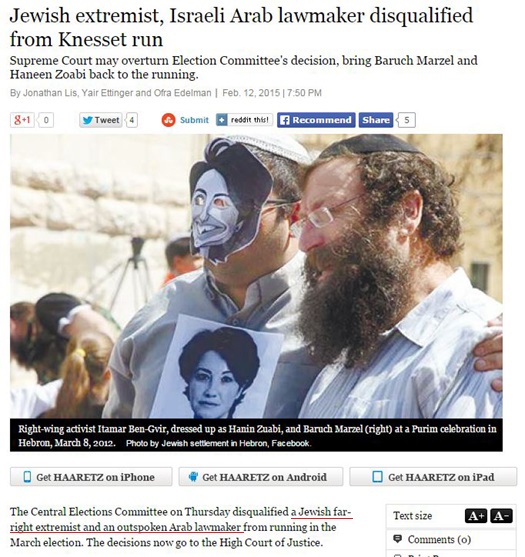
“Zoabi and Marzel should not be treated equally,” posited the Feb. 15 Haaretz editorial (“Israel’s ban of Arab lawmaker from election is unjust“), referring to last week’s decision by the Central Elections Committee to disqualify MK Haneen Zoabi (Balad) and Baruch Marzel from the upcoming Israeli elections.
Haaretz‘s English news writers apparently agreed. That alone is not a problem. Haaretz news reporters and translators, along with the editorial writers, are entitled to their personal opinions on every subject.
But it is a problem when Haaretz journalists inject their personal views into news articles. Which is just what happened in a Feb. 12 news article which began:
The Central Elections Committee on Thursday disqualified a Jewish far-right extremist and an outspoken Arab lawmaker from running in the March election. (Emphasis added.)

Israel Press Council’s “Rules of Journalistic Ethics” states: “A newspaper and a journalist shall distinguish in the publication between news items and opinion.”
By what criteria, did the translators/English writers determine that Haneen Zoabi is “outspoken” (which carries a positive connotation), as opposed to “extremist,” like Baruch Marzel?
The article’s headline — “Jewish extremist, Israeli Arab lawmaker disqualified from Knesset run” — contains the same double standard. (Marzel, a member of the outlawed Kach party, is identified as extremist, and Zoabi, who has said that the Palestinians who kidnapped and murdered three Israeli teens are not “terrorists” and whose writing has appeared on Hamas’ Web site, is not subject to any qualitative description. Just her profession is noted.)
Moreover, in what way does this language comply with the Israel Press Council’s call for objectivity? Specifically, its guidelines state that “A newspaper and a journalist shall distinguish in the publication between news items and opinion.” By applying inconsistent language, Haaretz mixes news and views.
February 17, 2015
Iranian Encirclement of Israel Procedes Apace
Iran continues to implement its encirclement of Israel. In the past week we have learned of the following developments:
Shiite militias are taking over from the Iraqi army as the main military force in Iraq opposing the Islamic State (ISIS). The growing and increasingly effective Shiite militias outnumber the disintegrating Iraqi army by two and a half to one. The Washington Post reports that senior Iranian Revolutionary Guard official Abu Mahdi al-Muhandis has assumed the role of coordinating these Shiite forces. He has been linked to terrorist attacks against the United States.
Iranian Revolutionary Guard and Hezbollah forces have assumed the main role of fighting Syrian rebels as the Assad regime’s Syrian army forces continue to diminish. Iranian general Qassem Soleimani is frequently mentioned as having taken charge of the war in Syria. Soleimani also reportedly visits Iraq and appears to have overall command of Shiite forces in both Iraq and Syria.
Meanwhile the Washington Post reports that Hezbollah chief Hassan Nasrallah has publicly acknowledged that Hezbollah forces are fighting in Iraq.
Iran and its surrogates now control the most important military forces aligned with the states of Syria and Iraq and the most powerful military force in Lebanon. With the takeover of Yemen by another Iranian proxy, the Shiite Houthis, Iran can threaten Israel from three directions.
An article in the Israeli newspaper Yedioth Ahranoth reporting on the appointment of a new chief of staff for the Israeli Defense Forces discloses that the Israelis now recognize a looming “major conflagration” against Iran and Hezbollah on Israel’s northern front.
Iran has maneuvered itself into a favorable position diplomatically as well. The United States is reportedly keen on making a deal with the Islamic Republic on its nuclear program. Israel considers the proposed agreement to be a capitulation to Iranian demands. Angered by the outspoken Israeli opposition to the proposed deal, the Obama administration has reportedly decided to cut Israel out of the loop on its discussions with the Iranians.
Meanwhile, the United States and other western powers continue to bomb ISIS, effectively serving as an airforce for the Iranian-backed forces that oppose the Sunni extremists.
February 11, 2015
Where’s the Coverage? NY Times Correction Undermines Anti-Netanyahu Narrative Promoted by… NY Times
The Tower Magazine reported:
A correction published in The New York Times on Friday shows that a key report was mistaken in earlier reporting on Israeli Prime Minister’s Benjamin Netanyahu’s acceptance of House Speaker John Boehner’s (R – Ohio) invitation to address a joint session of Congress in March. This, despite the fact that Boehner’s office released a detailed timeline two days earlier. The report played a central role in the widespread controversy that ensued about the propriety of Netanyahu’s acceptance of the invitation.
The original article reported that Netanyahu had explained why he accepted the invitation from Boehner “without first notifying the White House.”
The correction states that the White House had indeed been informed prior to Netanyahu’s acceptance.
Indeed, here is the correction in The Times:
Correction: January 30, 2015
An earlier version of this article misstated when Prime Minister Benjamin Netanyahu of Israel accepted Speaker John A. Boehner’s invitation to address Congress. He accepted after the administration had been informed of the invitation, not before.American Thinker notes that the protocol followed in arranging Netanyahu’s speech this year is no different than protocol followed in 2011:
In 2011, Boehner sent a notice to the WH stating his intention to invite Netanyahu to speak before a joint session of Congress. The White House never responded (spite? incompetence?) and Boehner proceeded to extend the invitation to Netanyahu. Netanyahu accepted the invitation and spoke. The White House did not express any outrage in 2011.
[…]Boehner clearly assumed the same series of events was occurring when the White House failed to respond this time to the notice given to the White House before he sent an invite to Netanyahu. (Hat Tip: CJL and LR).
However, the correction, and the fact that it completely undermines “speechgate,” has only been reported in some blogs, Jewish, Israeli or niche media.
Indeed, even after the correction, Times columnist Thomas Friedman continued to flog the false narrative.
Where are the journalistic ethics? Where’s the fact-based reporting? And, at the very least, when it comes to the correction of the record on the issue of Netanyahu’s upcoming speech… Where’s the coverage?

Search:
Search this site: