
Syrian Chemical Weapons Use and the Impact of Media Coverage
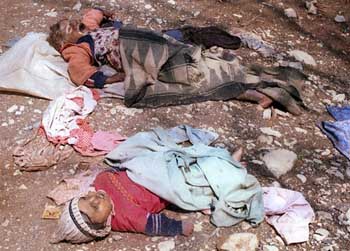
Aftermath of Iraqi Chemical Weapons Attack on Kurdish village of Halabja in 1988 that killed up to 5000 civilians
Recent statements by U.S. President Barack Obama and Secretary of State John Kerry portend a forceful American response to the Syrian government’s alleged use of chemical weapons.
It is worth noting that this is not the first, nor anywhere near the most significant alleged use of chemical weapons in the Middle East, or even by the Syrian regime. As CAMERA previously described, the use of chemical weapons by Arab regimes goes back to the 1960s with the Egyptian intervention into the civil war in Yemen. Saddam Hussein used chemical weapons against Kurdish civilians in Iraq and current Syrian President Bashir Assad’s father allegedly used them against rebellious citizens of Hama in 1982.
Back then coverage of the use of these weapons was limited. Today, with cellphone cameras and Twitter, images of the immediate after-effects of a chemical weapons attack have flooded the Internet. The ability of the media to magnify or diminish conflict is once again evident.
The Israeli-Palestinian conflict offers a classic example of disproportionate media amplification of a conflict. As CAMERA has documented, the media’s fixation over many years on the Israeli-Palestinian conflict fed the illusion that it was at the core of the region’s instability. This exaggerated media attention pressured government officials to prioritize activities addressing the Israeli-Palestinian conflict.
Media attention on the Syrian regime’s use of chemical weapons is certainly warranted, but the outcry and call for action again demonstrates the influence the media has in shaping our views on the relative importance of conflicts and in motivating action.


More from SNAPSHOTS
Head of Turkish ‘Humanitarian’ Group Financed Hamas
March 27, 2017
Shin Bet, Israel’s security agency, has arrested the Gaza-based head of a Turkish humanitarian agency, a man named Muhammad Murtaja, and charged him with providing funds to Hamas, The Jerusalem Post reported (“Israel arrests head [...]
CBS Article is Not Objective on Israel’s Security Barrier
March 21, 2017
A CBS article about the opening of subversive grafittist Banksy’s new hotel in Bethlehem demonstrates how a journalist can slant a controversial topic. Entitled "Banksy's ‘hotel with the worst view’ opens in Bethlehem,” the article [...]
Washington Post Notes Jordanian Terrorist Hailed as a ‘Hero’
March 20, 2017
King Abdullah II of Jordan A Washington Post dispatch highlighted the release of Jordanian terrorist Ahmed Daqamseh, who was imprisoned for murdering seven Israeli schoolgirls in 1997. Post reporters Ruth Eglash and Taylor Luck offered [...]
ISIS Tells Supporters to ‘Dress Up Like Jews,’ Carry Out Attacks
March 7, 2017
The Islamic State of Iraq and Syria (ISIS) is encouraging its supporters to carry out terror attacks against Western Jewish communities. According to the U.K.-based newspaper, Daily Mail, ISIS members in an online jihadi chat [...]
Travel Articles Eschew Bias, Highlight Beauty of Israel
March 6, 2017
While the mainstream national newspapers continue push the Palestinian narrative about Israel and the Middle East, two recently-published travel articles about Israel are refreshingly honest. Harper’s Bazaar has published a photo essay full of gorgeous [...]
Guardian Refuses to Correct False Claim that Journo Drove Through Mt. of Olives “Tunnel”
March 1, 2017
(Cross-posted from UK Media Watch) Earlier in the month we examined a Feb. 13th Guardian article written by Sarah Helm, “It’s too late to stop the senseless capture of Palestinian land”, a propagandistic tour de [...]