
CNN Muddles Through Peace Talks

As diplomats, negotiators and media gear up for the next round of Israeli-Palestinian peace talks, CNN International demonstrates that it needs to brush up with a crash course on Mideast history. The July 21 article by Jason Hanna, Joe Sterling and Michael Martinez, “Israelis, Palestinians react to agreement on resuming peace talks,” bungles a basic historical point, stating that Israel:
annexed East Jerusalem from the Palestinian territories, uniting the historic city to make it the capital of the Jewish state.
In fact, Israel was annexed from Jordan, not the Palestinian territories. (This basic fact was correctly reported by CNN in 2010.) Nor should east Jerusalem be labeled as part of today’s Palestinian territories given that the status of that part of the city is disputed and is slated to be resolved in negotiations.
An earlier version of this article, still available through Internet archives, erroneously referred to Tel Aviv as the capital of Israel. The error has been removed, and a screenshot as it initially appeared follows:
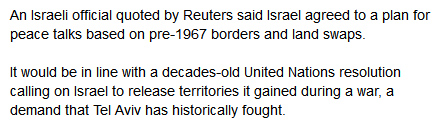
The corrected text reads:
It would be in line with a decades-old United Nations resolution calling on Israel to release territories it gained during a war, a demand that Israel has historically fought.
If CNN can’t be relied on to correctly identify Israel’s capital, and to accurately report that eastern Jerusalem was annexed from Jordan, and not “Palestinian territories,” it’s no wonder that the media outlet bungles more complex issues.
Indeed, the article repeatedly refers to the “Green Line” as “pre-1967 borders.” This is a highly distorted and misleading characterization. President Obama raised the 1967 parameter in a May 19, 2011 policy speech in which he correctly referred to the “1967 lines.”
As CAMERA has noted:
The Green Line, to which the president was referring, served as an armistice demarcation line between Israel and Jordan. The armistice line was established April 3, 1949 by Article III of the Israel-Jordan Armistice Agreement and was never the “border” between Israel and the West Bank.
On the contrary, the agreement specifically notes that the lines are not borders: “The Armistice Demarcation Lines defined in articles V and VI of this Agreement are agreed upon by the Parties without prejudice to future territorial settlements or boundary lines or to claims of either Party relating thereto.”
In short, the word “border” implies legality, political significance and permanence that does not apply in this circumstance.
Lord Caradon, the British representative to the United Nations during the 1967 Six-Day War, made this very point when discussing U.N. Security Council Resolution 242, which calls for a peace agreement based on territorial concessions and recognition of countries’ right to exist in peace and security. Explaining the meaning behind Resolution 242, which he drafted, he noted that
It would have been wrong to demand that Israel return to its positions of 4 June 1967 because those positions were undesirable and artificial. After all, they were just the places the soldiers of each side happened to be the day the fighting stopped in 1948. They were just armistice lines. That’s why we didn’t demand that the Israelis return to them and I think we were right not to …
CNN apparently confuses that very point when in a separate article, also July 21, it implies that Resolution 242 called on Israel to withdraw “completely” from territories it won in the 1967 war:
Reuters news agency quoted an Israeli official last week who said Israel agreed to a plan for peace talks based on pre-1967 borders and land swaps.
It is something the United Nations demanded in a resolution in 1967 and has been the gold standard of yearnings for Middle East peace ever since. It requires Israel to withdraw from occupied territories completely and the Palestinians to recognize the existence of an Israeli state.
But as Lord Caradon stated, and as the New York Times corrected three times in the summer of 2000, Resolution 242 does not require Israel to withdraw “completely” from occupied territories, but calls from withdrawal from an unspecified amount of territory. Nor does the current reported plan call for “complete” withdrawal from disputed territories. As CNN itself notes in the previous paragraph, Secretary of State John Kerry’s plan allows for land swaps.
Aug. 8 Update: CAMERA Prompts CNN Correction on Jerusalem


More from SNAPSHOTS
Professor John Quigley Falsely Condemns Israel and U.S. Support in His Syndicated Column
April 30, 2019
John B. Quigley In his widely distributed April syndicated opinion piece mainly about ISIS, the Islamist terrorist entity, John B. Quigley, an Ohio State University law professor, argues that claims of an imminent ISIS resurgence [...]
The New York Times’ Slow Reaction to Hamas Crackdown on Palestinian Protesters
April 4, 2019
The New York Times took a slight jab at Hamas, the terrorist organization that rules the Gaza Strip, in a recent story about Hamas's crackdown on Palestinian protesters who spoke out against its policies in [...]
CNN’s Zakaria Deals With U.S. Proclamation Recognizing Golan As Part Of Israel
April 3, 2019
Fareed Zakaria hosted an eight-minute discussion of the Golan matter at the end of his weekly (weekend) program, “Global Public Square “ (GPS) hour-long Cable News Network (CNN) broadcast. The broadcast, on both CNN and [...]
NY Times Reporter David Halbfinger Editorializes Israel as “Brutal”
March 6, 2019
New York Times Jerusalem bureau chief David Halbfinger Israel, according to the New York Times, is a brute. A March 3 news analysis piece—not an opinion piece—by the newspaper's Jerusalem bureau chief David Halbfinger uses [...]
Palestinian Malevolent Indoctrination Exposed; Mainstream Media Are Indifferent
February 26, 2019
Palestinian Media Watch (PMW), an Israel-based non-governmental organization, analyzes and presents in English to the world the ongoing inflammatory indoctrination of Palestinians in Arabic particularly via Palestinian Authority (PA) television (West Bank). PMW is a [...]
Did WCC Activists Attend A Birthday Party Promoted by Palestinian Extremist Organization?
February 4, 2019
The video is a bit fuzzy and grainy. But the footage of birthday party for Shadi Farar, a 12-year-old Palestinian boy who spent three years in an Israeli jail on charges of intent to murder, [...]