
Recent Entries:
Month: July 2011
July 28, 2011
The Washington Post Omits Novelist’s Antisemitism

The Washington Post’s “Memoir Review” of Jose Saramago (“Deep Roots in Poor Soil,” July 3) omitted the novelist’s unhinged beliefs about Israel and Jews.Reviewer Michael S. Roth painted a picture of a humble and intelligent man. But in 2003, when Palestinian terrorists of the second intifada were blowing up Israeli buses and cafes, murdering hundreds and maiming thousands, Saramago charged that Israel security checkpoints at Ramallah somehow resembled Holocaust-like repression.
“In the spirit of Auschwitz,” he orated, “this place is being turned into a concentration camp.” In fact, 2003 was the year in which Arab violence claimed the most Israeli lives since the 1973 Yom Kippur War.
As for Jews in general, Saramago proclaimed, “they didn’t learn anything from the suffering [in the Holocaust] of their parents and grandparents.”
“Political bravery and artistic originality” with which The Post credited Saramago, or the old hatred in a new bottle? Would The Post have so indulged another artist who showed such prejudice toward any other national or religious group? — by Sophie Linshitz, CAMERA Washington research intern.
July 27, 2011
One-Way Musings on One-State Solution

Eric Alterman’s July 15 column in the Forward argues that Israeli intransigence is, in effect, the sole reason a peace agreement hasn’t been reached with the Palestinians.
The CUNY professor quotes a pro-Palestinian Israeli activist pinning responsibility for the stalemate on a land-hungry version of Zionism:
[I]f all that was necessary were to work out the details of the end of the occupation and the creation of two states based on the finality of the 1947 borders — that is, of the Zionism that liberates people rather than real estate — “[Palestinian academic Sari Nusseibeh] and I could conclude a peace agreement before lunch.”
The Israeli activist suggests that Palestinians will be “liberated” only if their borders follow the 1947 lines. This is self-contradictory: If he believes the liberation of people should be valued over the liberation of land, why does he argue that a peace agreement must hinge on specific borders? If Palestinian insistence on those lines has prevented an agreement leading to their “liberation,” it is Palestinian leaders, and not Zionism, who deserve blame for valuing real estate above liberation. (Never mind that a majority of Palestinians recently rejected the concept of two states for two people under any borders.)
This passage’s focus on “the finality of the 1947 borders” is also misleading since the ’47 lines were never considered a border, let alone “final.” On the contrary, the Jordanian-Israeli General Armistice Agreement specifically notes that the lines were “agreed upon by the Parties without prejudice to future territorial settlements or boundary lines.” And UN Security Council Resolution 242 was drafted with language underscoring that, in the words of the its chief author, “the boundaries of ’67 were not drawn as permanent frontiers, they were a cease-fire line of a couple of decades earlier… . We did not say that the ’67 boundaries must be forever.”
Most notable, though, is the disconnect between Alterman’s quote and the reality of recent negotiations. Palestinians have repeatedly been offered “liberation” — not only in the distant past, as the author acknowledged, but also multiple times in recent years. At Camp David, Palestinian leader Yasir Arafat rejected peace agreements, and Palestinian statehood. And his successor Mahmoud Abbas rejected the same during his negotiations with Ehud Olmert.
Perhaps Sari Nusseibeh would be able to conclude a peace agreement “before lunch.” But his leaders clearly have other priorities above liberation.
July 26, 2011
A Modest Proposal for the World Council of Churches

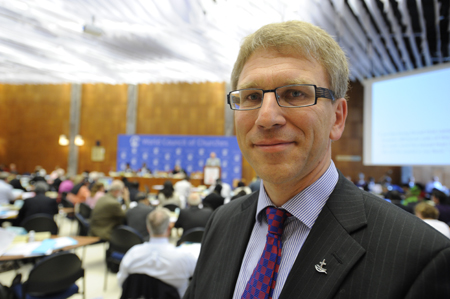
WCC General Secretary Rev. Dr Olav Fykse TveitSince its founding in 1948, the World Council of Churches has promoted interfaith dialogue, particularly between Christians and Muslims. This work has been documented in a number of books such as Meeting in Faith: Twenty Years of Christian-Muslim Conversations Sponsored by the World Council of Churches. This book, published by the WCC in 1989, is a compendium of statements issued by more than a dozen world and regional conferences between Christians and Muslims.
At these dialogues, Christians and Muslims (and sometimes people of other faiths) look for common ground and speak frankly about the differences between them. At a conference in Broumana, Lebanon in 1972, conference participants enunciated three principles for guiding interfaith dialogue: Frank witness, mutual respect, and a commitment to religious freedom.
The attendees also stated their commitment to making “a vital contribution to the extension of inter-religious harmony and international justice,” and that “Muslims and Christians are called upon to achieve a wider vision of community, inter-racial, inter-cultural and international.”
In light of these and other commitments affirmed at WCC sponsored dialogues, it is time for the World Council of Churches to promote a frank and honest discussion between Christians and Muslims about a problem common to both faiths: Antisemitism.
(more…)July 26, 2011
Israel Hayom on Missile Defense

Even — or especially — in an era of information-overload, new, solid sources on Israel are welcome. The emergence of a daily newspaper, Israel Hayom, in Hebrew has had a dramatic impact within Israel, offering a counterweight to Ha’aretz and Yediot. Now the same publication is providing some of its content in English.
A featured story on the successful testing of a component of the Arrow 3 anti-missile system by reporter Lilach Shoval was a reminder of the threats Israel faces — and has to confront:
…Arrow 3 is slated to be Israel’s next-generation missile interceptor, built to collide “metal-to-metal” with long-range ballistic missiles before they re-enter the Earth’s atmosphere. The Arrow 3 was designed as a response to longer range ballistic missile threats.
But it will take time:
Defense officials speculate that the Arrow 3 will not be operational before 2015. The missile is considered unique, and is planned to provide Israel with the needed defense from unconventional missile bombardment. Israel currently deploys the improved Arrow 2, which can shoot down long-range ballistic missiles. The Magic Wand and Iron Dome anti-missile systems were developed to shoot down shorter range projectiles.
July 26, 2011
A Jew and a Pollster Walk into a Bar
From Connecticut’s Jewish Ledger:
First there was the poll by Frank Luntz sponsored by CAMERA. Then there was Dick Morris’ poll. And now there is the poll done by Pat Caddell and John McLaughlin. They all say pretty much the same thing: Contrary to the often-expressed mantra in the mainstream media, American Jews do care about Israel and they care deeply.
More about the latest poll results at the Ledger website.
July 26, 2011
Norwegian Ambassador Compares Terror Attacks in Norway and in Israel
In an interview today with the Israeli daily, Ma’ariv, Svein Sevje, the Norwegian Ambassador to Israel, drew a distinction between the recent terror attacks in Norway and a Palestinian terror attack (the Park Hotel massacre, where terrorists murdered 30 people at a Passover Seder) in Israel.
First it is important to emphasize that terrorist attacks against innocent civilians, whether in Israel or in Norway, are completely unnacceptable. I would like to outline the similarity and the difference between the two cases.
The similarity is of course that both attacks targeted innocent civilians and in this sense they are both terrorist actions, but I’m not sure that the two cases (the Norway attacks vs. Palestinian terror attacks) are identical, despite the similarity.
The difference is that Palestinians are attacking Israel through the means of terrorist actions. Never mind how unacceptable or terrible it is, they are doing this with a defined goal that is related to the Israeli occupation. There are elements of revenge against Israel and hatred of Israel. To this you can add the religious dimension to their actions. In any case, there is a principle motive to their actions.
In answer to a question about whether the first-hand experience with terrorism might change the way Norwegians viewed Israel, the ambassador answered, “Almost definitely not.”
We Norwegians view the occupation as the reason for terror against Israel. Many Norwegians still see the occupation as the reason for attacks against Israel. Whoever thinks this way, will not change his mind as a result of the attack in Oslo.
July 26, 2011
United Nations Continues to Betray Its Mission
The United Nations, under the guise of a conference ostensibly devoted to combating racism, continues to abuse its role of promoting peace and tolerance among nations, by fostering the very intolerance it purports to be combating.
The UN has had a long history of anti-Semitic and anti-Israel activity. The Durban Conferences, the first of which was in 2001, have attempted to enshrine this bias in a sanctioned mandate of the international community.
As Anne Bayefsky, Senior Editor of Eye on the UN, writes of the first Durban Conference of 2001,
The Durban Conference provided rampant antisemitism with a global platform under UN auspices, in a conference allegedly against racism and xenophobia. It also revealed the malevolent antisemitism underlying the campaign to delegitimize the state of Israel.
Later, in describing Durban II, she writes,
Durban II, known officially as the Durban Review Conference, was held in Geneva in April 2009. It was headlined by Iranian President Mahmoud Ahmadinejad, who saw the occasion as ideal for issuing another denial of the Holocaust and an endorsement of genocide against the Jewish state.
Finally, regarding Durban III, Bayefsky goes on to write,
By virtue of a 2010 General Assembly resolution, the purpose of Durban III is to celebrate a world conference that reveled in anti-Semitism and to adopt a final declaration that reaffirms the original Durban Declaration (and Programme of Action). That’s the Declaration supposedly to combat racism, xenophobia and related intolerance but that somehow manages to charge just one of the 192 UN members with racism, namely, Israel.
The rampant singling out of Israel for vilification and delegitimization, which Hillel Neuer of UN Watch identified before the Human Rights Council of the UN, has again been made evident through the Durban Conferences.
(more…)July 26, 2011
The Banality of Anti-Semitism in Egypt
MEMRI TV has made available a video of a comedy skit aired on Egyptian Television portraying a Jewish grandfather, his granddaughter and grandson sitting around the kitchen table scheming to sell human organs. They are portrayed as bloodthirsty, greedy buffoons in order to elicit chuckles from the audience. A young woman comedian introduces the skit with some “humor,”
the Jews trade in everything, so obviously they have not neglected organ trafficking. I have recently seen someone haggle over a pancreas in order to save five shekels.
The skit exposes the banality of Egyptian bigotry against Jews. In some ways, it recalls the cartoons and children’s shows in the early years of American television that used humor to lampoon black Americans with demeaning stereotypes. In the Egyptian skit, however, the message concerning the nature of Jews is far darker.
July 26, 2011
Study: NY Times‘ Israel Obsession Half a Century Old
Omri Ceren flags an academic study which finds that the New York Times’ Israel obsession is nothing new — it dates back at least five decades. He writes:
There’s an article coming out in the next issue of Communication Research that tries to untangle how and why foreign countries get covered by U.S. news outlets in general, and by NBC and the New York Times in particular. The peer-reviewed piece is a collaboration between researchers spread across Washington state and two Dutch universities, and – like all good academic work – has a soporific title, Foreign Nation Visibility in U.S. News Coverage: A Longitudinal Analysis (1950-2006).
The long timeline means that even regional wars get pushed down the list by Cold War and global diplomacy coverage. So the USSR, China, Britain, and France are all prominent because they’re nuclear powers on the Security Council. Germany and Japan show up a lot because we had just finished fighting them and had troops on their territory.
And then there’s one other distant country with which the U.S. press seems to be preoccupied, above and beyond any country except the USSR:
The first step in our analysis was to examine which countries were most visible during each of the four geopolitical eras analyzed. Table 1 lists the top ten most mentioned foreign nations in the NYT and on NBC during the early Cold War era (1950-1973), the late Cold War era (1974-1991), the post–Cold War era (1992-2001), and the post-9/11 era (2002-2006). Notably, nine countries were among the top ten most mentioned countries in at least four of the eight series analyzed. Specifically, Russia (USSR) and Israel received the most consistent news coverage—followed closely by Britain, China, France, Japan, Germany, Iraq, and Mexico.
July 25, 2011
Ayalon Video Sparks Furious Reaction by Palestinians

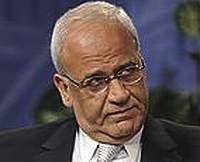
Saeb Erekat Israeli Deputy Foreign Minister Danny Ayalon’s video explaining the origin and inaccuracy of the terms “West Bank”, “occupied territories” and “67 Borders” has sparked an enraged reaction by Palestinians. In a somewhat hysterical sounding press release, Palestinian negotiator Saeb Erekat expressed the Palestinian leadership’s “shock” and outrage over the video, and stated that
With this video, the Israeli government has left no doubt on its pro-conflict agenda. Now, the international community knows the Israeli government is committed to denying the Palestinian people their inalienable right to self-determination and on continuing their illegal and colonial enterprise in the occupied Palestinian territory.
He called on the international community to
to demand an official explanation from the Government of Israel regarding this video, which openly expresses hostility towards the Palestinian people and their legitimate national rights to independence and self-determination.
For his part, politician Danny Ayalon reacted to the Palestinian press release by pointing to what he called Erekat’s false claims and asserting that
For too long the Palestinian narrative of international law and rights has gone unchallenged, and this over the top reaction to a public diplomacy video proves that they are acting like spoilt children who have had their way for too long.



Search:
Search this site: