
Committee Calls for Caterpillar to be “Denounced”
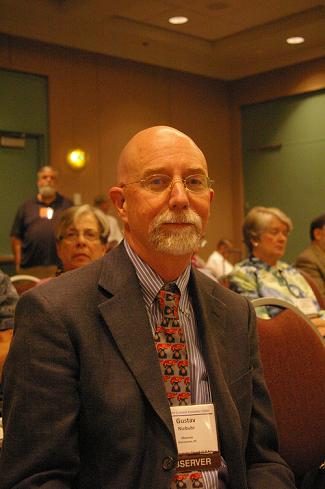
Gustav Niebuhr after testifying against the MESC report at the Presbyterian General Assembly in Minneapolis. (Dexter Van Zile)
The Middle East Peacemaking Issues Committee of the PC(USA)’s General Assembly has started to make its recommendations regarding a number of overtures that deal with the Arab-Israeli conflict.
After spending all of the morning and some of the afternoon listening to testimony about the overtures before it, the committee voted to recommend that the General Assembly approve (14-03) which calls on the denomination to “denounce” the company. (July 6, 2010 NOTE: The original version of this entry incorrectly reported that “the committee approved the overture with an amendment that opens the door for divestment in a year if the company does not change its policies.” A review of the resolution on the denomination’s website indicates that this overture was approved without amendment.)
In subsequent proceedings, the committee then voted 34-17-1 that overture 14-03 “answers” the issues raised by two other resolutions, (14-01 and 14-02), that call on the church to divest outright from Caterpillar. In other words, the committee chose to denounce Caterpillar and not divest from the company. It will be up to the General Assembly to decide whether or not to accept the committtee’s recommendations.
The vote indicates that there is a significant minority on the committee willing to take an extreme anti-Israel position and that this minority is offset by a less extreme majority that still views Israel with suspicion.
There are numerous other Israel-related overtures before the committee.
Overture 14-04 asks the General Assembly to declare Israel guilty of the crime of apartheid (as activists did at the UN “anti-racism” conference in Durban in 2001 which devolved into an anti-Semitic horror show). And overture 14-05 calls on the church to lift up the Kairos Document.
Another overture (14-09) deals with American military aid to the Middle East (with a particular emphasis on Israel), and yet another (14-10) calls on Israel and Hamas (yes, Hamas) to investigate their actions during Operation Cast Lead.
One overture (14-06) calls on the church to refrain from making expressions of unilateral support for one side or the other of the conflict, which in the context of the PC(USA), is an apparent attempt to constrain the efforts of the denomination’s peace activists who target Israel with one-sided statements such as the Middle East Study Committee’s report.
Israel’s Defenders at a Disadvantage
In theory, this overture would also constrain Israel’s defenders as well, but the reality is that Israel’s defenders within the PC(USA) understand that they are defending a nation-state which, like all other nation-states, needs to be viewed with a critical eye. Under Christian theology, nation-states are not a positive good, but a necessary evil — a response to the nature of the fallen world in which we live. Any attempts to portray Israel, or any other nation state, in overly idealistic terms is a form of idolatry. [NOTE: Please see Rev. John Wimberly’s response below in the comments section.]
Consequently, Israel’s supporters inside the PC(USA) haven’t put forth one-sided resolutions that portray Israel as completely innocent while leveling ritualistic charges at the Palestinians.
The so-called peace activists, on the other hand, regard themselves as fighting a positive evil on behalf of a wholly innocent victim — the Palestinians — and their resolutions show it.
Under these conditions, people intent on defending Israel from unreasonable and obsessive accusations are at a strategic disadvantage, because in group setting such as a General Assembly, the momentum often goes to the angrier and more energetic side.
It also helps that Israel’s defenders must protect themselves from charges of being too close to the to the Jewish community in the U.S., or worse, being agents of a foreign power.
Pro-Palestinian activists, on the other hand, find affiliating with Palestinians, some of whom are members of the PC(USA), a great source of comfort and credibility. This solidarity is almost equivalent to baptism itself in its sanctifying power. But in order for this solidarity with the Palestinians to keep its sanctifying, justifying power, Palestinians must be portrayed as holy innocents whose wrong actions can be explained by the circumstances they live under.
Of course, the right to have one’s behavior judged in the context of relevant circumstances is one denied to Israel, a reality clearly demonstrated by the text of the Middle East Study Committee’s report. In the narrative offered in this report, the human condition is split in two, with the shadow side projected onto Israel and its transcendent, pure bright side projected onto the Palestinians. The Palestinians, who symbolize the children of light are embraced while Israel is cast off as a representation of the children of darkness.
Caterpillar Testimony
This splitting process, and the accusations used to further it, was also evident at this morning’s testimony, particularly when spoke about divestment from Caterpillar. Proponents of divestment spoke about how the equipment is used demolish homes, uproot olive trees and build the security barrier. They argued the church should have nothing to do with a company that allows its equipment to do these things. Caterpillar became the link between the PC(USA) and an exterior evil that can be removed as simply as washing one’s hands.
“Caterpillar symbolizes the immoral occupation of Palestine,” one delegate said. “It’s a powerful symbol. We are given an opportunity to say as a church that we do not want to endorse the occupation of Palestine. We do not want to endorse in any way the destruction of a people.”
This is an oblique accusation of genocide leveled at Israel, which given any honest interpretation of the facts, is insupportable and as such is not an attempt to educate, inform, or persuade, but an attempt to inflame apocalyptic passions.
Presbyterians from Illinois argued against divestment because it would, in effect, put Presbyterians who work for Caterpillar outside the beloved community of the Presbyterian church. They didn’t say it in those words, but it was clear enough. They wanted the perimeter of the beloved community to include them. It remains to be seen how Presbyterians who work for Caterpillar will respond to a resolution denouncing, as opposed to divesting from, the company they work for.
It’s not likely to be pretty.
One Presbyterian staff member from Peoria, Illinois made it perfectly clear that if the resolution were passed, some congregations would in effect divest from the denomination. “When they decide how to use the money they earned from Caterpillar, they will be quite upset if you tell them that the money is tainted and should not be given to the congregation.”
Overall, the testimony underscored an important aspect of the divestment campaign in mainline churches and in other institutions where it has taken root.
As a strategy, divestment is perfectly suited to efforts to focus attention on Israel’s misdeeds, real or imagined, and giving people reason not to pay any heed to the actions of its adversaries. There is no real way to divest from companies that do business with Hamas or Hezbollah and as a result, the proponents of divestment can avoid speaking about the misdeeds of Israel’s adversaries. Divestment structures the argument in such a manner that the conversation is exclusively focused on Israel.
Halper Supports Apartheid Charge
Of course, no mainline discussion of Israel’s sins would be complete without the testimony of Jeff Halper from the Israeli Committee Against Home Demolitions (a group for which the PC(USA) collects donations). Halper, a native of Minnesota and a regular critic of Israel, spoke in favor of the overture convicting Israel of the crime of apartheid.

The whole world got on board with the fight to end apartheid in South Africa in the 1970s and 80s, he said. “Why was apartheid such a big deal that we all mobilized? How did that affect us?” he asked. “If you have a state based on racism that’s in our international community, it sullies all of us … it’s the same in the case of Israel.”
The problems with this comparison are manifold, the most obvious being that the black South Africans were not led by leaders who called for the destruction of the whites in the country.
MESC Report
Fortunately, there are signs that mainline intellectuals are starting to realize that extremist anti-Israel rhetoric does more harm than good. This became apparent when Gustav Niebuhr testified against the Middle East Study Committee’s report. Niebuhr, the grandson of H. Richard Niebuhr and an influential writer in his own right, said the MESC report, if passed “will obscure in a major way” the role the Presbyterian Church (USA) and its historical antecedents have played in American society.
“Reputations are hard to win and they are easy to lose,” he said.
“The short narrative” on the MESC report is that it is anti-Israel, and there is “no bright line between anti-Israel and anti-Semitism in the minds of most Americans,” Niebuhr stated.
Niebuhr called on the committee to reject the report which he described as “terribly imbalanced,” stating “it will do a terrible disservice to the church at large.”
Another prominent figure in mainline Protestantism has also called for the report to be rejected: Rev. Dr. John Buchanan, pastor of the Fourth Presbyterian Church in Chicago. Buchanan, who is known to most people as editor and publisher of Christian Century has signed a letter (along with many other pastors) stating the report is historically inaccurate, intellectually flawed and imbalanced.
The letter laments, among other things, that there “is no call to neighboring nations to recognize the legitimate right of Israel to exist as a state and no affirmation of the right of Israeli citizens to defend themselves against aggression and to live in peace without the threat of terrorism.”
The letter also criticizes the Kairos Document because it “represents a troubling and weighted perspective which should not be commended because of its particularly one-sided views.”
Coming from Rev. Dr. Buchanan, who runs the magazine James M. Wall used to use to atack Israel on a regular basis, this is a pretty big deal. At one point during this morning’s proceedings, Buchanan’s name was called to give him an opportunity to testify against the MESC report. (He was not in the room at the time, reportedly because he was testifying on another resolution).
The willingness of Buchanan and Nieburh and other “heavy hitters” (such as Rev. Dr. Katharine Henderson) to come forward in opposition to the report indicates that the MESC crossed a line and that the actions of the PC(USA)’s General Assembly regarding Israel will be subject to increasing debate and scrutiny after the proceedings are over.
In other words, it won’t be over even after it’s over.


More from SNAPSHOTS
Why Does a NY Times Journalist Want to Suppress an Anti-Hamas Article?
May 29, 2018
A New York Times journalist thinks the Wall Street Journal shouldn't have published an opinion piece criticizing Hamas's anti-Israel propaganda campaign. The reporter, Declan Walsh, is one of the Times reporters who has covered the [...]
Iran is Funding Hamas’s Violent ‘Protests’ at the Border, Media M.I.A.
May 22, 2018
Iran's Supreme Leader, Ayatollah Ali Khameini The Islamic Republic of Iran is behind the recent Hamas-orchestrated violent demonstrations—dubbed the “March of Return”—at the Israel-Gaza border, according to Israeli authorities. Yet many major U.S. news outlets [...]
Are Gaza Gunmen “Protesters”? NY Times Refuses to Say
May 21, 2018
After repeatedly insisting that "Israeli soldiers killed 60 protesters" during clashes last Monday, May 14, the New York Times is refusing to clarify whether its count of supposed protesters includes the eight armed Hamas fighters [...]
Bahrain Says Israel Has a Right to Self-Defense, and the Media Shrugs
May 15, 2018
Bahrain's Foreign Minister and then-U.S. Secretary of State John Kerry The foreign minister of the Arab nation of Bahrain, Sheikh Khalid al-Khaalifa declared on May 10, 2018 that Israel has a right to defend itself. [...]
AFP Captions Call Jerusalem Parade Participants Settlers
May 15, 2018
Numerous Agence France-Presse photo captions generalized all participants in Sunday's Jerusalem Flag Parade as "settlers," despite the fact that the crowd hailed from across Israel, within the Green Line, as well as outside. A sampling [...]
Journalist: Hezbollah Shows ‘More Maturity’ Than Israel
May 9, 2018
Hezbollah Secretary General Hassan Nasrallah A Los Angeles Times special correspondent, Nabih Bulos, declared on Twitter on May 7, 2018, that Hezbollah (“Party of God”) shows “more maturity” than Israel. Hezbollah is a Lebanese-based, Iranian-backed, [...]