
Recent Entries:
Month: February 2010
February 10, 2010
More Evidence of Goldstone Commissioner’s Bias

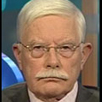
Desmond Travers, one of the four commissioners responsible for the Human Rights Council’s “Fact Finding Mission on the Gaza Conflict,” or the Goldstone Report, had previously revealed his bad faith by arguing during his “investigation” that Israeli soldiers are uniquely conditioned to murder children.Now, further evidence of his pronounced anti-Israel bias emerges. A report by JCPA notes that Travers is peddling the “fact” that, in the month before Israel’s Operation Cast Lead, “something like two” rockets were fired into Israel. In fact, in December 2008, up through the 27th of that month when the Operation began, roughly 145 rockets and another 145 mortars were fired at Israel from the Gaza Strip.
A Ha’aretz story on the JCPA report adds:
Travers also rejects Israel Defense Forces photographs as proof that Hamas hid weapons in mosques during the conflict.
“I do not believe the photographs,” Travers said, describing the IDF evidence as “spurious.”
Travers also criticized Israel’s past presence in Southern Lebanon, asserting that Israeli soldiers had “taken out and deliberately shot” Irish peacekeeping forces in the area.
He accused “Jewish lobbyists” of influencing British foreign policy in the Middle East and said that efforts to block the Goldstone reports findings have failed.
February 5, 2010
Iranian Turtlenauts, Syrian Threats

Israeli Foreign Minister Avigdor Lieberman’s comments warning of a possible war with Syria have received wide coverage in the news media. Comments from Syria and Iran have received much less attention.
On Feb. 4, 2010, Syrian foreign minister Walid al-Moallem implicitly threatened to commit war crimes against Israeli civilians by threatening to bring any war to Israeli cities should fighting break out. The Syrian government’s news agency (SANA) carried his comments in a meeting with the Spanish ambassador Spanish Foreign Minister Miguel Angel Moratinos. Moallem is quoted as stating:
“Israel should not test Syria’s determination… Israel knows that war will move to the Israeli cities….Israel has to commit to the just and comprehensive peace requirements.”
This follows a statement by Syrian President Bashar al-Assad also reported by the Syrian News Agency that “Israel is not serious about achieving peace since all facts point out that Israel is pushing the region towards war, not peace..”
For his part Spanish ambassador Moratinos “expressed appreciation of Syria’s positive role for the establishment of security and stability in the Middle East.”
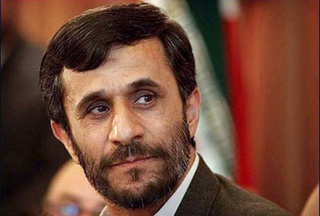
These words came within days of the threatening words reported on the Iranian government’s Internet News site PressTV (Feb. 1, 2010) from Iranian President Mahmoud Ahmadinejad that Iran “will deliver a harsh blow to the ‘global arrogance’ on this year’s anniversary of the Islamic Revolution.” Iran recently launched a rocket into orbit carrying turtles, mice and worms. There is concern that this rocket could be utilized for delivering warheads as well. Ahmadinejad’s explicit threat received little coverage from the American news media.
February 3, 2010
Financial Times of London’s Bias Against Israel Attracts Attention

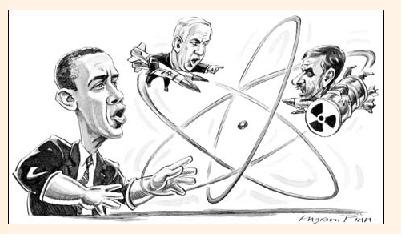
Cartoon appearing on the Financial Times’ Rachman blogThe Financial Times of London (FT) is a prominent business-oriented newspaper with an international reach. Over the years its slanted coverage of the Arab-Israeli conflict has attracted notice. Two recent pieces expose the depths of this bias.
Just Journalism, an independent media research group based in the UK, published an investigative report that assesses 121 Financial Times editorials relating to the Middle East over the past year. According to Just Journalism board member Robin Shepherd, “This report demonstrates that the FT has repeatedly disregarded salient facts when it comes to the Middle East and disproportionately blames Israel for the region’s woes.”
The report finds that
1. The FT views Israel as primarily responsible for the perpetuation of the Israeli-Palestinian conflict, while downplaying other factors. Other aggravating factors such as terrorism, disunity within Palestinian ranks and a failure to accept Israel as a Jewish state are downplayed.
2. The prospect of an Israeli attack on Iranian nuclear facilities is referred to in five editorials; yet no Financial Times editorial in 2009 makes reference to the threatening rhetoric from Iran’s President Ahmadinejad against Israel.
3. Israeli political leaders are depicted as ‘irredentist’, ‘hawkish’, and ‘ultra-nationalist’. In contrast, Palestinian
leaders are portrayed as ‘moderate’ and ‘conciliatory’, if corrupt.4. The Saudi Peace Initiative of 2002 is touted in seven editorials and the newspaper expresses sympathy with the recent Arab refusal to meet Israeli concessions with Arab concessions. The newspaper attacks the West – the
US in particular – for backing ‘an ossified order of … Arab strongmen’ typified by the Mubarak regime in Egypt;
however, Saudi Arabia is spared harsh criticism, particularly regarding its human rights record.5. The publication backed the Goldstone Report, which described the Israeli military operation as ‘a deliberately
disproportionate attack designed to punish, humiliate and terrorize a civilian population’. The Financial Times
described Israel’s actions in Gaza as ‘disproportionate’ in four editorials.6. Israel’s total military and civilian withdrawal from Gaza in August 2005 is not viewed as a meaningful Israeli
concession, rather it is seen as inadequate at best, and a cynical ploy at worstThe report notes a tone of deference towards the Saudi regime, which raises the question of what influence the wealthy Saudi regime has on the newspaper.
The Just Journalism report prompted Marty Peretz, publisher of the New Republic, to pen an editorial on Feb. 1, 2010 where he notes that the CEO of the group that owns the Financial Times was associated with the Jimmy and Rosalyn Carter Foundation. The Foundation has been the beneficiary of substantial donations from wealthy Arab individuals and states.
February 2, 2010
Gearing Up for Another Season of Anti-Zionism in the PC(USA)
By now it’s axiomatic that most of the people in the Presbyterian Church (USA) object to the obsession the denomination’s peace activists have for the alleged sins of Israel, the Jewish state.
Most Presbyterians sense there is something unseemly about the manner in which church staffers and activists regularly condemn Israel without acknowledging the manifest sins of its adversaries or the ideology that animates hostility toward Israel in the Middle East.
Nevertheless, a small and persistent group of church staffers and activists continue in their ongoing effort to portray Israel as uniquely worthy of the PC(USA)’s condemnation. Their activities quicken in the months before the denomination’s General Assembly which takes place every two years.
When it comes to evangelization, these anti-Israel activists are indefatigable.
This year will be no different. Late last year, the denomination’s Committee on Mission Responsibility Through Investment (MRTI) set the stage for the upcoming debate over Israel in November when it issued a report on its “Israel-Palestine” activities from 2004 to 2009.
In the report, the committee described the efforts of shareholder activists from a number of church-related organizations to draw attention to the alleged misdeeds of Citigroup, Motorola, Caterpillar and other companies.
Predictably, the report states that Caterpillar “does not measure up to the General Assembly’s stated position that the church’s investments in companies doing business in Israel, Gaza, East Jerusalem and the West Bank be in companies involved in only peaceful pursuits.”
(more…)February 2, 2010
Bias Trifecta at Washington Post
Leo Rennert, writing in American Thinker, outlines the Washington Post‘s inconsistent use of the “T” word and the paper’s double standard on covering foreign aid to Haiti.
February 2, 2010
Enderlin’s Latest Cover-Ups Attempts

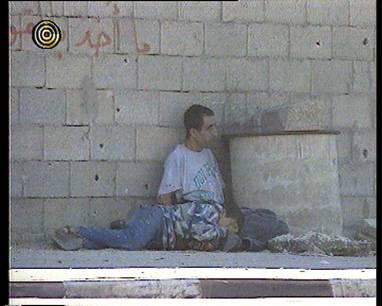
Responding to Reuven Pehatzur’s Jan. 24, 2010 Op-Ed recapping evidence pointing to the staged killing of Mohammed Al Dura, France 2’s Charles Enderlin writes in a letter in Ha’aretz today:
Regarding “Mohammed is not dead,” January 24, by Reuven Pedatzur
The claim that there was not a drop of blood at the scene [where Mohammed al-Dura allegedly was killed in 2000] is erroneous. Blood is clearly visible in the videos, and is mentioned in the reports prepared by the hospital that treated Jamal al-Dura, Mohammed’s father.
Jamal filed a libel suit in France against Dr. Yehua David and a French Jewish newspaper that published his argumetn that the father’s scars are from an operation conducted six years earlier. Dr. David was referring only to injuries to the limbs, and not to a serious injury to Jamal’s hip. An investigative judge in France accepted the suit, and the case will be heard in court.
I would like to point out that no doctor in Shifa Hospital has claimed that the child brought to the emergency room arrived at 10 A.M. The emergency room director said: “Mohammed al-Dura arrived around 1 P.M.” That was 2 P.M. Israel time, because the Palestinians switched to winter time.
Pedatzur implies there was a conspiracy involving hundreds of Palestinian protesters, Shifa Hospital doctors and doctors from the military hospital in Jordan, where Jamal al-Dura was treated, and that Israeli security services did not find anything about it. Is this possible?
Talal Abu Rahma filmed the real time events as they occurred on September 20, 2000, at the Netzarim junction for the French station, France 2. This not a staged event [sic], but rather problematic events that led to Mohammed al-Dura being killed and his father being seriously injured. In order to review the incident, France 2 and Jamasl have announced more than once that they are willing to have the boy’s remains exhumed. France 2 stated that it is willing to establish an investigative committee based on international standards.
Despite this, an official request from any Israeli entity to participate in a serious and official investigation has never been received.
I would like to clarify that the legal battle against Philippe Karsenty is not yet over and is still pending before the High Court of Appeals in Paris. In addition, France 2’s management voiced sharp protest over Esther Shapira’s film.
Is Enderlin to be believed now? In the past, Enderlin has said “I cut the images of the child’s agony (death throes), they were unbearable,” and yet journalists who saw the complete, unedited footage said they saw no agonized death throes.
In addition, Enderlin’s claim today that the boy’s body was brought into the hospital at 2 p.m. is also problematic, given that his original report put the time of the shooting incident at 3 pm:
3 pm… everything has turned over near the Netzarim settlement in the Gaza Strip…here Jamal and his son Mohammed are the targets of gunshots that have come from the Israeli position…. A new burst of gunfire, Mohammed is dead and his father seriously wounded.” [September 30, 2000, France 2 evening newscast]
February 1, 2010
All Aspects of the Aftonbladet Affair
JCPA publishes “The Aftonbladet Organ-Trafficking Accusations against Israel: A Case Study” by Swedish scholar Mikael Tossavainen, detailing all of the players (including CAMERA), and concluding:
Yet the big losers from the affair appear to be Aftonbladet itself, the Swedish government in the international sphere, and Europe as a whole, since Sweden stood at its helm for six months. From a European perspective, the crisis ended with the Spanish assumption of the presidency on 1 January 2010. The question of how long it will take for Swedish-Israeli relations to heal is another matter.
Search:
Search this site: